III ) Fe+3(aq) + SCN-(aq) ß→ Fe(SCN)+2(aq) (3) Prepare a stock solution by mixing 2mL each...
III ) Fe+3(aq) + SCN-(aq) ß→ Fe(SCN)+2(aq)
(3) Prepare a stock solution by mixing 2mL each of 0.1M FeCl3 and 0.1M KSCN in 100mL graduated cylinder. Add enough water to make 100mL solution. Note the color. If you are the first one to use this station, make this solution and save it for the rest of the class. If you are using someone else's stock solution, make sure to make observations of each reactant.
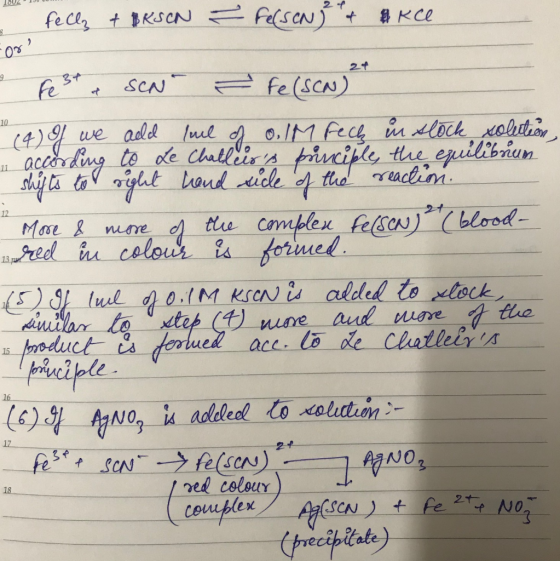
(4) *Add about 1mL of 0.1M FeCl3 to about 5mL of stock solution.
(5) *Add about 1mL of 0.1M KSCN to about 5mL of stock solution.
^^^What is the stress and which direction should the equilibrium shift
(6) *Add 0.1M AgNO3 DROPWISE (less than 1mL) to about 5mL of stock solution until almost all the color is discharges. (The white ppt is a mixture of AgCl and AgSCN.) Split the solution into two test tubes including the precipitate.
(6a) Add 0.1M KSCN dropwise (about 2mL) to one tube
(6b) Add 0.1M FeCl3 dropwise (about 2mL) to the other tube.
(Q4) Write a balanced net ionic equation showing what happened in step (6).
Homework Answers
The solution to the above problem is in the attached image.
Don't forget to give a thumbs up if you think ur problem is
resolved!!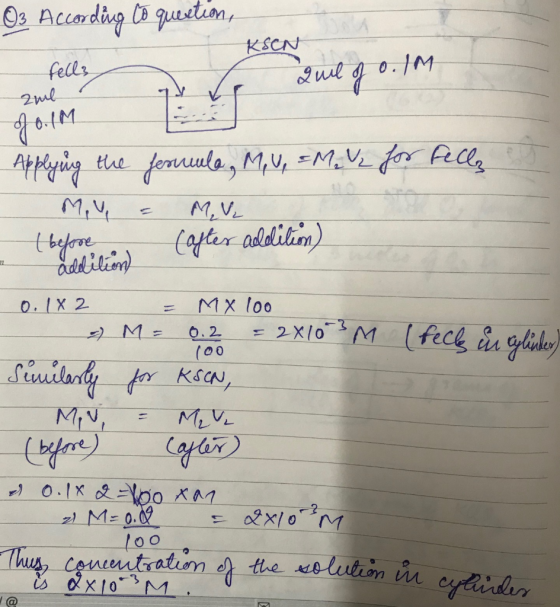
Add Answer to:
III ) Fe+3(aq) + SCN-(aq) ß→
Fe(SCN)+2(aq)
(3) Prepare a stock solution by mixing 2mL each...
2. The stock solution at equilibrium used in test tube # 4 contains Fe3 (aq), SCN-(aq)...
 2. The stock solution at equilibrium used in test tube # 4 contains Fe3 (aq), SCN-(aq) and [FESCNP2 (aq). When NaOH was added to test tube #4 a shift in the equilibrium was observed. What chemical species in the stock solution reacted with NAOH? Write the balanced chemical reaction associated with the change observed from the addition of NaOH to test tube #4? Explain in terms of LeChatelier's Principle the observed results from the addition of 0.1 M KSCN to...
number 2 please 2. The stock solution at equilibrium used in teat tuba #4 contains Fe"(aq),...
 number 2 please
2. The stock solution at equilibrium used in teat tuba #4 contains Fe"(aq), SCN-(aq) and FeSCNPtaq). When NaOH was added to test iube #4 a slaft in the equilibrium was observed. What chemical species in the stock solution reacted with NEOH Vilite the balanced chemical reaction associated with the change observed from the addition NaOH to iest tube #4? Explain in terms of LeChatelier's Principle the observed results from the addition of 0.1 M KSCN to test...
number 2 please
2. The stock solution at equilibrium used in teat tuba #4 contains Fe"(aq), SCN-(aq) and FeSCNPtaq). When NaOH was added to test iube #4 a slaft in the equilibrium was observed. What chemical species in the stock solution reacted with NEOH Vilite the balanced chemical reaction associated with the change observed from the addition NaOH to iest tube #4? Explain in terms of LeChatelier's Principle the observed results from the addition of 0.1 M KSCN to test...
are theses correct? please correct me if they are not. Results Fe Test Tube 2: FeSCN...
 are
theses correct?
please correct me if they are not.
Results Fe Test Tube 2: FeSCN (aa) SCN () Fe Chemical equation: Explanation: The equilibrium shifted toward the increased the due to the addition of Fe(NO,)) because it of the Test Tube 3: FESCN 0) SCN () (as Chemical equation: Fe(ag) Explanation: Test Tube 4: Chemical equation: Fe(agk FeSCN( (aq)h Explanation: Test Tube 5: Chemical equation: Fe"( SCN () FESCN 3+ + (sq) Explanation: Test Tube 6 Chemical equation: Fe(a...
are
theses correct?
please correct me if they are not.
Results Fe Test Tube 2: FeSCN (aa) SCN () Fe Chemical equation: Explanation: The equilibrium shifted toward the increased the due to the addition of Fe(NO,)) because it of the Test Tube 3: FESCN 0) SCN () (as Chemical equation: Fe(ag) Explanation: Test Tube 4: Chemical equation: Fe(agk FeSCN( (aq)h Explanation: Test Tube 5: Chemical equation: Fe"( SCN () FESCN 3+ + (sq) Explanation: Test Tube 6 Chemical equation: Fe(a...
My question is #2 for the reaction Fe3+ (aq) + SCN- (aq) FeSCN2+ (aq). The goal...
 My question is #2 for the reaction Fe3+ (aq) + SCN- (aq)
FeSCN2+ (aq). The goal is to predict the color change (darker or
lighter) for test tubes 2-8. I have attached the supplemental
sheets given to help with the problem. The test tubes 2-8 are being
manipulated either by temperature or things being added which can
be seen by one of the pictures.
2. For reaction "UCTIONS are increased by the same amount. Fe3+ (aq) + SCN (aq) $...
My question is #2 for the reaction Fe3+ (aq) + SCN- (aq)
FeSCN2+ (aq). The goal is to predict the color change (darker or
lighter) for test tubes 2-8. I have attached the supplemental
sheets given to help with the problem. The test tubes 2-8 are being
manipulated either by temperature or things being added which can
be seen by one of the pictures.
2. For reaction "UCTIONS are increased by the same amount. Fe3+ (aq) + SCN (aq) $...
f. Place about 2 mL of iron (III) chloride solution, FeCl3(aq), in a test tube. Add...
 f. Place about 2 mL of iron (III) chloride solution, FeCl3(aq), in a test tube. Add about 10 drops of potassium thiocyanate solution, KSCN(aq). Observe any changes. Place a small amount of solid sodium bicarbonate, NaHCO3. also known as baking soda) in the bottom of a dry test tube. Cover the bottom to a depth of about 1 em. Quickly pour in about 2 mL of acetic acid, HC2H309. Observe any changes. There are really two reactions occurring here, one...
I need help with finding the total added SCN concentration and Total added Fe3+. If I can see two examples of each, then I will be able to find the rest on my own. Data Tab Molarity of stock KSCN sol...
 I need help with finding the total added SCN concentration and
Total added Fe3+. If I can see two examples of each, then I will be
able to find the rest on my own.
Data Tab Molarity of stock KSCN solution Molarity of stock Fe(NOs)s solutiona Total added Total added Absorbance SCN cone Few cone at 447 nm Test mL Stock l Stoek Tube mL. H,o KSCN Fe(NO,)s M) 4.0 2 S dlo .2.S (o3 2. 1I. Data Collection- Quantitative:...
I need help with finding the total added SCN concentration and
Total added Fe3+. If I can see two examples of each, then I will be
able to find the rest on my own.
Data Tab Molarity of stock KSCN solution Molarity of stock Fe(NOs)s solutiona Total added Total added Absorbance SCN cone Few cone at 447 nm Test mL Stock l Stoek Tube mL. H,o KSCN Fe(NO,)s M) 4.0 2 S dlo .2.S (o3 2. 1I. Data Collection- Quantitative:...
Not washing the precipitate in part III-2 that is used in part III-3 will have no...
Not washing the precipitate in part III-2 that is used in part III-3 will have no effect on the identification of iron and manganese. True False When adding NaOH to the supernatent in part III-2, if a pH of only 7 was reached instead of 8, it would potentially give a false negative for iron and manganese. True False Procedure III-2 Separation of Fe3+ and Mn2+ from Al3+ and Zn2: Treatment of Precipitate from III-1: Add 15 drops of 3M...
Question: Procedure Separation and Identification of Pb2 (aq), Fe (aq), Al(a), and Cu Note: Tests should...
 Question:
Procedure Separation and Identification of Pb2 (aq), Fe (aq), Al(a), and Cu Note: Tests should be performed concurrently on the known and the unknown solutions. Volumes are approximate. All work excepting the centrifugation should be done in the fume hood 1. To about 2. mL of your sample in a test tube, add 5 drops (-0.2 mL) of 6 M HCl(a). Mix well and centrifuge. Decant the clear liquid into a clean test tube and save it for Step...
Question:
Procedure Separation and Identification of Pb2 (aq), Fe (aq), Al(a), and Cu Note: Tests should be performed concurrently on the known and the unknown solutions. Volumes are approximate. All work excepting the centrifugation should be done in the fume hood 1. To about 2. mL of your sample in a test tube, add 5 drops (-0.2 mL) of 6 M HCl(a). Mix well and centrifuge. Decant the clear liquid into a clean test tube and save it for Step...
Name Part B. Iron un Chloride (FeCl) plus Potassium Thiocyanate (KSCN Prepare a stock solution to...
 Name Part B. Iron un Chloride (FeCl) plus Potassium Thiocyanate (KSCN Prepare a stock solution to be tested by adding 12 drops each of 0.1 M FeCl, and 0.1 MKSON well. Fill each of four medium sized test tubes (all the same size) half full of the stock solution FeSCN'(a) pale yellow colorless 1. The first tube is a control. Always compare to this color. 2. Add 20 drops of 0.1 Miron () chloride solution to the second tube. Observe...
 2. The stock solution at equilibrium used in test tube # 4 contains Fe3 (aq), SCN-(aq) and [FESCNP2 (aq). When NaOH was added to test tube #4 a shift in the equilibrium was observed. What chemical species in the stock solution reacted with NAOH? Write the balanced chemical reaction associated with the change observed from the addition of NaOH to test tube #4? Explain in terms of LeChatelier's Principle the observed results from the addition of 0.1 M KSCN to...
 number 2 please
2. The stock solution at equilibrium used in teat tuba #4 contains Fe"(aq), SCN-(aq) and FeSCNPtaq). When NaOH was added to test iube #4 a slaft in the equilibrium was observed. What chemical species in the stock solution reacted with NEOH Vilite the balanced chemical reaction associated with the change observed from the addition NaOH to iest tube #4? Explain in terms of LeChatelier's Principle the observed results from the addition of 0.1 M KSCN to test...
number 2 please
2. The stock solution at equilibrium used in teat tuba #4 contains Fe"(aq), SCN-(aq) and FeSCNPtaq). When NaOH was added to test iube #4 a slaft in the equilibrium was observed. What chemical species in the stock solution reacted with NEOH Vilite the balanced chemical reaction associated with the change observed from the addition NaOH to iest tube #4? Explain in terms of LeChatelier's Principle the observed results from the addition of 0.1 M KSCN to test...
 are
theses correct?
please correct me if they are not.
Results Fe Test Tube 2: FeSCN (aa) SCN () Fe Chemical equation: Explanation: The equilibrium shifted toward the increased the due to the addition of Fe(NO,)) because it of the Test Tube 3: FESCN 0) SCN () (as Chemical equation: Fe(ag) Explanation: Test Tube 4: Chemical equation: Fe(agk FeSCN( (aq)h Explanation: Test Tube 5: Chemical equation: Fe"( SCN () FESCN 3+ + (sq) Explanation: Test Tube 6 Chemical equation: Fe(a...
are
theses correct?
please correct me if they are not.
Results Fe Test Tube 2: FeSCN (aa) SCN () Fe Chemical equation: Explanation: The equilibrium shifted toward the increased the due to the addition of Fe(NO,)) because it of the Test Tube 3: FESCN 0) SCN () (as Chemical equation: Fe(ag) Explanation: Test Tube 4: Chemical equation: Fe(agk FeSCN( (aq)h Explanation: Test Tube 5: Chemical equation: Fe"( SCN () FESCN 3+ + (sq) Explanation: Test Tube 6 Chemical equation: Fe(a...
 My question is #2 for the reaction Fe3+ (aq) + SCN- (aq)
FeSCN2+ (aq). The goal is to predict the color change (darker or
lighter) for test tubes 2-8. I have attached the supplemental
sheets given to help with the problem. The test tubes 2-8 are being
manipulated either by temperature or things being added which can
be seen by one of the pictures.
2. For reaction "UCTIONS are increased by the same amount. Fe3+ (aq) + SCN (aq) $...
My question is #2 for the reaction Fe3+ (aq) + SCN- (aq)
FeSCN2+ (aq). The goal is to predict the color change (darker or
lighter) for test tubes 2-8. I have attached the supplemental
sheets given to help with the problem. The test tubes 2-8 are being
manipulated either by temperature or things being added which can
be seen by one of the pictures.
2. For reaction "UCTIONS are increased by the same amount. Fe3+ (aq) + SCN (aq) $...
 f. Place about 2 mL of iron (III) chloride solution, FeCl3(aq), in a test tube. Add about 10 drops of potassium thiocyanate solution, KSCN(aq). Observe any changes. Place a small amount of solid sodium bicarbonate, NaHCO3. also known as baking soda) in the bottom of a dry test tube. Cover the bottom to a depth of about 1 em. Quickly pour in about 2 mL of acetic acid, HC2H309. Observe any changes. There are really two reactions occurring here, one...
 I need help with finding the total added SCN concentration and
Total added Fe3+. If I can see two examples of each, then I will be
able to find the rest on my own.
Data Tab Molarity of stock KSCN solution Molarity of stock Fe(NOs)s solutiona Total added Total added Absorbance SCN cone Few cone at 447 nm Test mL Stock l Stoek Tube mL. H,o KSCN Fe(NO,)s M) 4.0 2 S dlo .2.S (o3 2. 1I. Data Collection- Quantitative:...
I need help with finding the total added SCN concentration and
Total added Fe3+. If I can see two examples of each, then I will be
able to find the rest on my own.
Data Tab Molarity of stock KSCN solution Molarity of stock Fe(NOs)s solutiona Total added Total added Absorbance SCN cone Few cone at 447 nm Test mL Stock l Stoek Tube mL. H,o KSCN Fe(NO,)s M) 4.0 2 S dlo .2.S (o3 2. 1I. Data Collection- Quantitative:...
 Question:
Procedure Separation and Identification of Pb2 (aq), Fe (aq), Al(a), and Cu Note: Tests should be performed concurrently on the known and the unknown solutions. Volumes are approximate. All work excepting the centrifugation should be done in the fume hood 1. To about 2. mL of your sample in a test tube, add 5 drops (-0.2 mL) of 6 M HCl(a). Mix well and centrifuge. Decant the clear liquid into a clean test tube and save it for Step...
Question:
Procedure Separation and Identification of Pb2 (aq), Fe (aq), Al(a), and Cu Note: Tests should be performed concurrently on the known and the unknown solutions. Volumes are approximate. All work excepting the centrifugation should be done in the fume hood 1. To about 2. mL of your sample in a test tube, add 5 drops (-0.2 mL) of 6 M HCl(a). Mix well and centrifuge. Decant the clear liquid into a clean test tube and save it for Step...
 Name Part B. Iron un Chloride (FeCl) plus Potassium Thiocyanate (KSCN Prepare a stock solution to be tested by adding 12 drops each of 0.1 M FeCl, and 0.1 MKSON well. Fill each of four medium sized test tubes (all the same size) half full of the stock solution FeSCN'(a) pale yellow colorless 1. The first tube is a control. Always compare to this color. 2. Add 20 drops of 0.1 Miron () chloride solution to the second tube. Observe...
Most questions answered within 3 hours.
-
Where is the error in this code sequence?
String s1 = "Hello";
String s2 = "ello";...
asked 11 months ago -
Financial data for Joel de Paris, Inc., for last year
follow:
Joel de Paris, Inc.
Balance...
asked 11 months ago -
Consider this reaction:
Al2(SO4)3 (aq)+ BaCl3
(aq) Al2Cl6 (aq)- +
3BaSO4(s) . What is the...
asked 11 months ago -
Suppose that Savneet is considering increasing her
recent random sample from 20 car rentals to 40...
asked 11 months ago -
Trucks arrive at an unloading terminal at an average rate of 120
per hour.
Trucks arrive...
asked 11 months ago -
Why are methanol and ethanol completely soluble in water while
octanol is not very little soluble....
asked 11 months ago -
A facilities manager at a university reads in a research report
that the mean amount of...
asked 11 months ago -
When the CuSO4 is rehydrated by adding water to the anhydrous
compound, is this an endothermic...
asked 11 months ago -
A ray of sunlight is passing from diamond into crown glass; the
angle of incidence is...
asked 11 months ago -
A block of mass 0.249 kg is placed on top of a light, vertical
spring of...
asked 11 months ago -
how do the kidneys compensate in the presences of acidosis
a) trigger hyperventilate
b) reserve acid...
asked 11 months ago -
Question 501 pts
The rental rate of capital to the firm increases. Which of the
following...
asked 11 months ago