What is the constant-volume molar heat cApacity of NH3 (ammonia) using the equipartition theorem?
Homework Answers

Add Answer to:
What is the constant-volume molar heat cApacity of NH3 (ammonia)
using the equipartition theorem?
Use the equipartition theorem to estimate the constant-volume molar heat capacity of CHs in the gas...
 Use the equipartition theorem to estimate the constant-volume molar heat capacity of CHs in the gas phase at 25 °C 4) 5) Use statistical thermodynamic arguments to show that for a perfect gas, ),-0.
Assuming perfect gas behavior, what are the CV,m (the constant volume molar heat capacity) for (a)...
Assuming perfect gas behavior, what are the CV,m (the constant volume molar heat capacity) for (a) NH3 and (b) BeF2? Make sure you have the correct units.
7. For CO2 near room temperature: Cy - molar heat capacity at constant volume = 28.5...
 7. For CO2 near room temperature: Cy - molar heat capacity at constant volume = 28.5 J/(mole K) Other useful information gas constant R 8.314 J/(mole K) Boltzmann's constant k - 1.38 x 10⁻²³ J/K a) The internal energy of a sample of N molecules of CO2 near room temperature can be written U = a + bNKT where a and b are constants. What is the value of b? (15 points) b) The Equipartition Theorem allots energy VkT to...
Use the equipartition theorem to estimate the heat capacity Cv per molecule of a dilute gas...
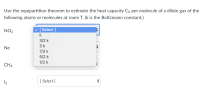 Use the equipartition theorem to estimate the heat capacity Cv per molecule of a dilute gas of the following atoms or molecules at room T. (k is the Boltzmann constant.) NO2 ✓ [Select ] Ne 3/2 k Зk 7/2 k 5/2 k 1/2 k [ Select ]
3,1 moles of an ideal gas with a molar heat capacity at constant volume of 5,1...
3,1 moles of an ideal gas with a molar heat capacity at constant volume of 5,1 cal/(mol∙K) and a molar heat capacity at constant pressure of 7,7 cal/(mol∙K) starts at 317,6 K and is heated at constant pressure to 335,9 K, then cooled at constant volume to its original temperature. How much heat (cal) flows into the gas during this two-step process? Answer in two decimal places.
An ideal monatomic gas has a molar heat capacity Cmp at constant pressure. What is the...
An ideal monatomic gas has a molar heat capacity Cmp at constant pressure. What is the molar heat capacity at constant volume of an ideal diatomic gas?
What is the heat capacity at constant volume, Cv, of an ideal gas, in ??? ??...
What is the heat capacity at constant volume, Cv, of an ideal gas, in ??? ?? °? if the constant pressure heat capacity, Cp = 0.124 ?? ??? ? and the molar mass of the material is 28 ton/ton-mole?
How much heat energy is required to boil 14.8 g of ammonia, NH3? The molar heat...
How much heat energy is required to boil 14.8 g of ammonia, NH3? The molar heat of vaporization of ammonia is 23.4 kJ/mol.
The molar constant volume heat capacity of acetylene (H-C≡C-H) approaches xR at high temperatures. What is...
The molar constant volume heat capacity of acetylene (H-C≡C-H) approaches xR at high temperatures. What is x? Assume ideality.
The molar heat capacity of an unknown gas at constant volume depends on its temperature as:...
 The molar heat capacity of an unknown gas at constant volume depends on its temperature as: Cv,m = 12.8 kJ moll.K1 +0.0091 kJ molK2xT What is the change in internal energy of 1 mol of this gas as its temperature increases from 278 K to 357 K? (The sign matters!)
 Use the equipartition theorem to estimate the constant-volume molar heat capacity of CHs in the gas phase at 25 °C 4) 5) Use statistical thermodynamic arguments to show that for a perfect gas, ),-0.
 7. For CO2 near room temperature: Cy - molar heat capacity at constant volume = 28.5 J/(mole K) Other useful information gas constant R 8.314 J/(mole K) Boltzmann's constant k - 1.38 x 10⁻²³ J/K a) The internal energy of a sample of N molecules of CO2 near room temperature can be written U = a + bNKT where a and b are constants. What is the value of b? (15 points) b) The Equipartition Theorem allots energy VkT to...
 Use the equipartition theorem to estimate the heat capacity Cv per molecule of a dilute gas of the following atoms or molecules at room T. (k is the Boltzmann constant.) NO2 ✓ [Select ] Ne 3/2 k Зk 7/2 k 5/2 k 1/2 k [ Select ]
 The molar heat capacity of an unknown gas at constant volume depends on its temperature as: Cv,m = 12.8 kJ moll.K1 +0.0091 kJ molK2xT What is the change in internal energy of 1 mol of this gas as its temperature increases from 278 K to 357 K? (The sign matters!)
Most questions answered within 3 hours.
-
Where is the error in this code sequence?
String s1 = "Hello";
String s2 = "ello";...
asked 10 months ago -
Financial data for Joel de Paris, Inc., for last year
follow:
Joel de Paris, Inc.
Balance...
asked 10 months ago -
Consider this reaction:
Al2(SO4)3 (aq)+ BaCl3
(aq) Al2Cl6 (aq)- +
3BaSO4(s) . What is the...
asked 10 months ago -
Suppose that Savneet is considering increasing her
recent random sample from 20 car rentals to 40...
asked 10 months ago -
Trucks arrive at an unloading terminal at an average rate of 120
per hour.
Trucks arrive...
asked 10 months ago -
Why are methanol and ethanol completely soluble in water while
octanol is not very little soluble....
asked 10 months ago -
A facilities manager at a university reads in a research report
that the mean amount of...
asked 10 months ago -
When the CuSO4 is rehydrated by adding water to the anhydrous
compound, is this an endothermic...
asked 10 months ago -
A ray of sunlight is passing from diamond into crown glass; the
angle of incidence is...
asked 10 months ago -
A block of mass 0.249 kg is placed on top of a light, vertical
spring of...
asked 10 months ago -
how do the kidneys compensate in the presences of acidosis
a) trigger hyperventilate
b) reserve acid...
asked 10 months ago -
Question 501 pts
The rental rate of capital to the firm increases. Which of the
following...
asked 10 months ago