Using retro synthesis what alkyl halide and ketone were used to produce 3-ethyl-3-hexanol. The two starting...
Using retro synthesis what alkyl halide and ketone were used to produce 3-ethyl-3-hexanol. The two starting materials cannot be 1-bromopropane and 3-pentanone.
Calculate the percent yield of the final product which weighed 0.16g. The starting weight of Magnesium was 0.612g and starting weight of Ammonium Chloride was 0.6012g.
Homework Answers
2)
Mg + 2 NH4Cl ------------ MgCl2 + 2 NH3 + H2
1 mole 2 mole 1 mole
mass of Mg= 0.612 g
molar mass of Mg = 24.0gram/mole
number of moles of Mg = mass/molar mass = 0.612/24.0= 0.0255 mole
mass of NH4Cl = 0.6012 grams
molar mass of NH4Cl = 53.49 gram/mole
number of moles of NH4Cl = 0.6012/53.49 = 0.0112 moles
according to equation
1 mole of Mg = 2 mole of NH4Cl
0.0255 moles of Mg = ?
= 0.0255x2/1= 0.051 mole of Nh4Cl
we need 0.051 moles of NH4Cl. but we have 0.0112 mole of NH4Cl. so , NH4Cl is completed first in the reaction .
Hence NH4Cl is limiting reagent.
according to euation
2 mole of NH4Cl = 1 mole ofMgCl2
0.0112 mole of NH4Cl = ?
= 0.0112x1/2= 0.0056 mole
number of moles of MgCl2 formed = 0.0056 moles
molar mass of MgCl2 = 95.2 gram/mole
mass of 0.0056 moles ofMgCl2 = 0.0056 x 95.2 = 0.53312 grans
Theoritical yield of MgCl2 = 0.533 grams
Actual yield = 0.16 gram
Percent yield = actual yield/theoritical yield x100 = 0.16/0.533 x100=30.018 %
Percent yield = 30.02%.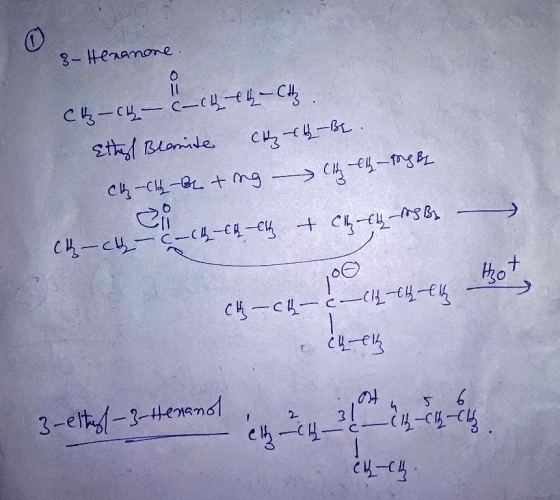
Add Answer to:
Using retro synthesis what alkyl halide and ketone were used to
produce 3-ethyl-3-hexanol. The two starting...
What alkyl halide was used in the synthesis? The ketone whose 1H NMR spectrum is shown...
 What alkyl halide was used in the synthesis?
The ketone whose 1H NMR spectrum is shown here was obtained as the product of an acetoacetic ester synthesis.
What alkyl halide was used in the synthesis?
The ketone whose 1H NMR spectrum is shown here was obtained as the product of an acetoacetic ester synthesis.
Here is a molecule. Do a retro synthesis (reaction scheme) on the molecule and go all the way back to produce the molecu...
 Here is a molecule. Do a retro synthesis (reaction
scheme) on the molecule and go all the way back to produce the
molecule until you can't go back anymore (think benzene or carbon).
You can use any source and synthesis/reaction to produce the
molecule above. Some notes about the molecule:
I would say start by writing down all the one step
reactions you know that would make the molecule without considering
from where the starting material comes. With some luck...
Here is a molecule. Do a retro synthesis (reaction
scheme) on the molecule and go all the way back to produce the
molecule until you can't go back anymore (think benzene or carbon).
You can use any source and synthesis/reaction to produce the
molecule above. Some notes about the molecule:
I would say start by writing down all the one step
reactions you know that would make the molecule without considering
from where the starting material comes. With some luck...
Here is a molecule. Do a retro synthesis (reaction scheme) on the molecule and go all the way back to produce the molecu...
 Here is a molecule. Do a retro synthesis (reaction
scheme) on the molecule and go all the way back to produce the
molecule until you can't go back anymore (think benzene or carbon).
You can use any source and synthesis/reaction to produce the
molecule above. Some notes about the molecule:
I would say start by writing down all the one step
reactions you know that would make the molecule without considering
from where the starting material comes. With some luck...
Here is a molecule. Do a retro synthesis (reaction
scheme) on the molecule and go all the way back to produce the
molecule until you can't go back anymore (think benzene or carbon).
You can use any source and synthesis/reaction to produce the
molecule above. Some notes about the molecule:
I would say start by writing down all the one step
reactions you know that would make the molecule without considering
from where the starting material comes. With some luck...
Organic chemistry post-lab question: "Why is important to add the alkyl halide dropwise in your reaction?...
 Organic chemistry post-lab question: "Why is important
to add the alkyl halide dropwise in your reaction? (Hint: your
reaction is not heated, but you still need a water-cooled
condenser!)" Please answer in detail!
Here is a copy of the experiment, thank you!
The Grignard reaction is an important synthetic process by which a carbon-carbon bond is formed. Magnesium metal is first reacted with an organic halide. The resultant organo-magnesium halide (Grignard reagent) is then combined with a carbonyl compound, ultimately...
Organic chemistry post-lab question: "Why is important
to add the alkyl halide dropwise in your reaction? (Hint: your
reaction is not heated, but you still need a water-cooled
condenser!)" Please answer in detail!
Here is a copy of the experiment, thank you!
The Grignard reaction is an important synthetic process by which a carbon-carbon bond is formed. Magnesium metal is first reacted with an organic halide. The resultant organo-magnesium halide (Grignard reagent) is then combined with a carbonyl compound, ultimately...
Can you help me identify reagent (i), Compound 8 and Compound 12 in the reaction scheme?...
 Can you help me identify reagent (i), Compound 8 and
Compound 12 in the reaction scheme?
You have laboratory data on all the compounds in the
synthesis, however the amount of data available to you varies. Some
have the entirety of the spectral data, others have as little as
the elemental analysis. Use the laboratory data to help you
discover which reaction has been performed.
The lab data for Compound 8 and 12 is as
follows:
You can use any...
Can you help me identify reagent (i), Compound 8 and
Compound 12 in the reaction scheme?
You have laboratory data on all the compounds in the
synthesis, however the amount of data available to you varies. Some
have the entirety of the spectral data, others have as little as
the elemental analysis. Use the laboratory data to help you
discover which reaction has been performed.
The lab data for Compound 8 and 12 is as
follows:
You can use any...
What is the theoretical yield (in grams) and percent yield of your triphenylmethanol product in this...
 What is the theoretical yield (in grams) and percent yield of your
triphenylmethanol product in this experiment? (Weight of
triphenylmethanol: 0.060g)
BACKGROUND AND THEORY The Grignard reaction was one of the first organometallic reactions discovered and is still one of the most useful synthetically. By reacting an organohalide (usually a bromide) with magnesium in ethereal solvent, carbon becomes a nucleophile. Grignard reagents are the starting points for the syntheses of many alkanes, primary, secondary, and tertiary alcohols, alkenes, and carboxylic...
What is the theoretical yield (in grams) and percent yield of your
triphenylmethanol product in this experiment? (Weight of
triphenylmethanol: 0.060g)
BACKGROUND AND THEORY The Grignard reaction was one of the first organometallic reactions discovered and is still one of the most useful synthetically. By reacting an organohalide (usually a bromide) with magnesium in ethereal solvent, carbon becomes a nucleophile. Grignard reagents are the starting points for the syntheses of many alkanes, primary, secondary, and tertiary alcohols, alkenes, and carboxylic...
If you were to run this reaction on a 0.5 g acetaminophen, how much powdered potassium...
 If you were to run this reaction on a 0.5 g acetaminophen, how
much powdered potassium carbonate would you use ? Show your
work
Alcohols and Ethers 185 14.3 THE WILLIAMSON ETHER SYNTHESIS: PREPARATION OF PHENACETIN FROM ACETAMINOPHEN One of the most common methods used to prepare ether Williamson ether synthesis. In this reaction, an alkoxide anion (RO) acts as a nucleophile in an S, 2 process, displacing a leaving group (X) from an electrophile (R-X). R-20 . RY ROR...
If you were to run this reaction on a 0.5 g acetaminophen, how
much powdered potassium carbonate would you use ? Show your
work
Alcohols and Ethers 185 14.3 THE WILLIAMSON ETHER SYNTHESIS: PREPARATION OF PHENACETIN FROM ACETAMINOPHEN One of the most common methods used to prepare ether Williamson ether synthesis. In this reaction, an alkoxide anion (RO) acts as a nucleophile in an S, 2 process, displacing a leaving group (X) from an electrophile (R-X). R-20 . RY ROR...
Calculate the theoretical yield and percent yield for experiments 7, 8, and 9. For experiment 9,...
 Calculate the theoretical yield and percent yield for
experiments 7, 8, and 9. For experiment 9, determine the
theoretical yield based on starting with 0.50g of 3-nitrobenzoic
acid. Show work
Acid I (experiment 7): Weight of methyl 3-nitrobenzoate = 1.9
g
Acid II (experiment 8): Weight of 3-nitrobenzoic acid = 1.75
g
Acid III (experiment 9): Weight of 3-nitrobenzamide = 0.30 g
Experiment 7:
-2.5 mL concentrated H2SO4
-1.75 mL concentrated HNO3 (16M)
-2.1 mL concentrated Methyl Benzoate
Experiment 8:...
Calculate the theoretical yield and percent yield for
experiments 7, 8, and 9. For experiment 9, determine the
theoretical yield based on starting with 0.50g of 3-nitrobenzoic
acid. Show work
Acid I (experiment 7): Weight of methyl 3-nitrobenzoate = 1.9
g
Acid II (experiment 8): Weight of 3-nitrobenzoic acid = 1.75
g
Acid III (experiment 9): Weight of 3-nitrobenzamide = 0.30 g
Experiment 7:
-2.5 mL concentrated H2SO4
-1.75 mL concentrated HNO3 (16M)
-2.1 mL concentrated Methyl Benzoate
Experiment 8:...
Need help, numbers 3-6 please show work. and fill out table of chemicals for all chemical...
 Need help, numbers 3-6 please show work. and fill out table of
chemicals for all chemical used.
calculate mmol in the table as well show work please
and each of these must be listed in its own row. There are 10 column headings: IUPAC name OR common name, structure, CAS number (Chemical Abstract Service number) molecular mass, melting point (if applicable), boiling point (if applicable), solubility (in water, if applicable), density, amounts to be used in the experiment, and the...
Need help, numbers 3-6 please show work. and fill out table of
chemicals for all chemical used.
calculate mmol in the table as well show work please
and each of these must be listed in its own row. There are 10 column headings: IUPAC name OR common name, structure, CAS number (Chemical Abstract Service number) molecular mass, melting point (if applicable), boiling point (if applicable), solubility (in water, if applicable), density, amounts to be used in the experiment, and the...
CHROMIC ACID OXIDATION Pre Lab Questions the amounts of materials that will be used from the...
 CHROMIC ACID OXIDATION Pre Lab Questions the amounts of materials that will be used from the experimental section above) H2SO4 + Na2Cr207 2H20- H2O, A Molecular Weight Theoretical yield amount moles on (if applicable) Equivalents 2. Look up the melting point for p-nitrobenzoic acid and record the reference. 3. What color change is expected to be observed in the reaction? Explain why. CHROMIC ACID OXIDATION Experimental Procedure: Part I: Synthesis of p-nitrobenzoic Acid 1. Under the hood, add 0.400 g...
 What alkyl halide was used in the synthesis?
The ketone whose 1H NMR spectrum is shown here was obtained as the product of an acetoacetic ester synthesis.
What alkyl halide was used in the synthesis?
The ketone whose 1H NMR spectrum is shown here was obtained as the product of an acetoacetic ester synthesis.
 Here is a molecule. Do a retro synthesis (reaction
scheme) on the molecule and go all the way back to produce the
molecule until you can't go back anymore (think benzene or carbon).
You can use any source and synthesis/reaction to produce the
molecule above. Some notes about the molecule:
I would say start by writing down all the one step
reactions you know that would make the molecule without considering
from where the starting material comes. With some luck...
Here is a molecule. Do a retro synthesis (reaction
scheme) on the molecule and go all the way back to produce the
molecule until you can't go back anymore (think benzene or carbon).
You can use any source and synthesis/reaction to produce the
molecule above. Some notes about the molecule:
I would say start by writing down all the one step
reactions you know that would make the molecule without considering
from where the starting material comes. With some luck...
 Here is a molecule. Do a retro synthesis (reaction
scheme) on the molecule and go all the way back to produce the
molecule until you can't go back anymore (think benzene or carbon).
You can use any source and synthesis/reaction to produce the
molecule above. Some notes about the molecule:
I would say start by writing down all the one step
reactions you know that would make the molecule without considering
from where the starting material comes. With some luck...
Here is a molecule. Do a retro synthesis (reaction
scheme) on the molecule and go all the way back to produce the
molecule until you can't go back anymore (think benzene or carbon).
You can use any source and synthesis/reaction to produce the
molecule above. Some notes about the molecule:
I would say start by writing down all the one step
reactions you know that would make the molecule without considering
from where the starting material comes. With some luck...
 Organic chemistry post-lab question: "Why is important
to add the alkyl halide dropwise in your reaction? (Hint: your
reaction is not heated, but you still need a water-cooled
condenser!)" Please answer in detail!
Here is a copy of the experiment, thank you!
The Grignard reaction is an important synthetic process by which a carbon-carbon bond is formed. Magnesium metal is first reacted with an organic halide. The resultant organo-magnesium halide (Grignard reagent) is then combined with a carbonyl compound, ultimately...
Organic chemistry post-lab question: "Why is important
to add the alkyl halide dropwise in your reaction? (Hint: your
reaction is not heated, but you still need a water-cooled
condenser!)" Please answer in detail!
Here is a copy of the experiment, thank you!
The Grignard reaction is an important synthetic process by which a carbon-carbon bond is formed. Magnesium metal is first reacted with an organic halide. The resultant organo-magnesium halide (Grignard reagent) is then combined with a carbonyl compound, ultimately...
 Can you help me identify reagent (i), Compound 8 and
Compound 12 in the reaction scheme?
You have laboratory data on all the compounds in the
synthesis, however the amount of data available to you varies. Some
have the entirety of the spectral data, others have as little as
the elemental analysis. Use the laboratory data to help you
discover which reaction has been performed.
The lab data for Compound 8 and 12 is as
follows:
You can use any...
Can you help me identify reagent (i), Compound 8 and
Compound 12 in the reaction scheme?
You have laboratory data on all the compounds in the
synthesis, however the amount of data available to you varies. Some
have the entirety of the spectral data, others have as little as
the elemental analysis. Use the laboratory data to help you
discover which reaction has been performed.
The lab data for Compound 8 and 12 is as
follows:
You can use any...
 What is the theoretical yield (in grams) and percent yield of your
triphenylmethanol product in this experiment? (Weight of
triphenylmethanol: 0.060g)
BACKGROUND AND THEORY The Grignard reaction was one of the first organometallic reactions discovered and is still one of the most useful synthetically. By reacting an organohalide (usually a bromide) with magnesium in ethereal solvent, carbon becomes a nucleophile. Grignard reagents are the starting points for the syntheses of many alkanes, primary, secondary, and tertiary alcohols, alkenes, and carboxylic...
What is the theoretical yield (in grams) and percent yield of your
triphenylmethanol product in this experiment? (Weight of
triphenylmethanol: 0.060g)
BACKGROUND AND THEORY The Grignard reaction was one of the first organometallic reactions discovered and is still one of the most useful synthetically. By reacting an organohalide (usually a bromide) with magnesium in ethereal solvent, carbon becomes a nucleophile. Grignard reagents are the starting points for the syntheses of many alkanes, primary, secondary, and tertiary alcohols, alkenes, and carboxylic...
 If you were to run this reaction on a 0.5 g acetaminophen, how
much powdered potassium carbonate would you use ? Show your
work
Alcohols and Ethers 185 14.3 THE WILLIAMSON ETHER SYNTHESIS: PREPARATION OF PHENACETIN FROM ACETAMINOPHEN One of the most common methods used to prepare ether Williamson ether synthesis. In this reaction, an alkoxide anion (RO) acts as a nucleophile in an S, 2 process, displacing a leaving group (X) from an electrophile (R-X). R-20 . RY ROR...
If you were to run this reaction on a 0.5 g acetaminophen, how
much powdered potassium carbonate would you use ? Show your
work
Alcohols and Ethers 185 14.3 THE WILLIAMSON ETHER SYNTHESIS: PREPARATION OF PHENACETIN FROM ACETAMINOPHEN One of the most common methods used to prepare ether Williamson ether synthesis. In this reaction, an alkoxide anion (RO) acts as a nucleophile in an S, 2 process, displacing a leaving group (X) from an electrophile (R-X). R-20 . RY ROR...
 Calculate the theoretical yield and percent yield for
experiments 7, 8, and 9. For experiment 9, determine the
theoretical yield based on starting with 0.50g of 3-nitrobenzoic
acid. Show work
Acid I (experiment 7): Weight of methyl 3-nitrobenzoate = 1.9
g
Acid II (experiment 8): Weight of 3-nitrobenzoic acid = 1.75
g
Acid III (experiment 9): Weight of 3-nitrobenzamide = 0.30 g
Experiment 7:
-2.5 mL concentrated H2SO4
-1.75 mL concentrated HNO3 (16M)
-2.1 mL concentrated Methyl Benzoate
Experiment 8:...
Calculate the theoretical yield and percent yield for
experiments 7, 8, and 9. For experiment 9, determine the
theoretical yield based on starting with 0.50g of 3-nitrobenzoic
acid. Show work
Acid I (experiment 7): Weight of methyl 3-nitrobenzoate = 1.9
g
Acid II (experiment 8): Weight of 3-nitrobenzoic acid = 1.75
g
Acid III (experiment 9): Weight of 3-nitrobenzamide = 0.30 g
Experiment 7:
-2.5 mL concentrated H2SO4
-1.75 mL concentrated HNO3 (16M)
-2.1 mL concentrated Methyl Benzoate
Experiment 8:...
 Need help, numbers 3-6 please show work. and fill out table of
chemicals for all chemical used.
calculate mmol in the table as well show work please
and each of these must be listed in its own row. There are 10 column headings: IUPAC name OR common name, structure, CAS number (Chemical Abstract Service number) molecular mass, melting point (if applicable), boiling point (if applicable), solubility (in water, if applicable), density, amounts to be used in the experiment, and the...
Need help, numbers 3-6 please show work. and fill out table of
chemicals for all chemical used.
calculate mmol in the table as well show work please
and each of these must be listed in its own row. There are 10 column headings: IUPAC name OR common name, structure, CAS number (Chemical Abstract Service number) molecular mass, melting point (if applicable), boiling point (if applicable), solubility (in water, if applicable), density, amounts to be used in the experiment, and the...
 CHROMIC ACID OXIDATION Pre Lab Questions the amounts of materials that will be used from the experimental section above) H2SO4 + Na2Cr207 2H20- H2O, A Molecular Weight Theoretical yield amount moles on (if applicable) Equivalents 2. Look up the melting point for p-nitrobenzoic acid and record the reference. 3. What color change is expected to be observed in the reaction? Explain why. CHROMIC ACID OXIDATION Experimental Procedure: Part I: Synthesis of p-nitrobenzoic Acid 1. Under the hood, add 0.400 g...
Most questions answered within 3 hours.
-
Where is the error in this code sequence?
String s1 = "Hello";
String s2 = "ello";...
asked 10 months ago -
Financial data for Joel de Paris, Inc., for last year
follow:
Joel de Paris, Inc.
Balance...
asked 10 months ago -
Consider this reaction:
Al2(SO4)3 (aq)+ BaCl3
(aq) Al2Cl6 (aq)- +
3BaSO4(s) . What is the...
asked 10 months ago -
Suppose that Savneet is considering increasing her
recent random sample from 20 car rentals to 40...
asked 10 months ago -
Trucks arrive at an unloading terminal at an average rate of 120
per hour.
Trucks arrive...
asked 10 months ago -
Why are methanol and ethanol completely soluble in water while
octanol is not very little soluble....
asked 10 months ago -
A facilities manager at a university reads in a research report
that the mean amount of...
asked 10 months ago -
When the CuSO4 is rehydrated by adding water to the anhydrous
compound, is this an endothermic...
asked 10 months ago -
A ray of sunlight is passing from diamond into crown glass; the
angle of incidence is...
asked 10 months ago -
A block of mass 0.249 kg is placed on top of a light, vertical
spring of...
asked 10 months ago -
how do the kidneys compensate in the presences of acidosis
a) trigger hyperventilate
b) reserve acid...
asked 10 months ago -
Question 501 pts
The rental rate of capital to the firm increases. Which of the
following...
asked 10 months ago