Describe the two general types of dielectrics, including how each behaves in an external electric field.
Describe the two general types of dielectrics, including how each behaves in an external electric field.
Homework Answers


Add Answer to:
Describe the two general types of dielectrics, including how
each behaves in an external electric field.
Displacement field ED IV. Superposition of sources for the displacement field In systems containing dielectrics, we oft...
 Displacement field ED IV. Superposition of sources for the displacement field In systems containing dielectrics, we often consider any field caused by the dielectric as an induced field, and any other field as an external field. A. Consider the electrostatic field. 1. Is the electrostatic field sourced by free charges, bound charges, or both? 2. Suppose you wanted to determine the net electric field by superposition. What would be the most convenient way to subdivide net electric field? Write out...
The top left diagram below shows a 1-C positive charge placed in a uniform external electric field. The electric field...
 The top left diagram below shows a 1-C positive charge placed in
a uniform external electric field. The electric field in which the
charge is placed is represented by field lines (drawn in red), and
the resulting electric force on the charge is represented by the
blue vector. Suppose the 1-C charge is removed, and is replaced, in
turn, by each of the charges shown in the other three diagrams
below. Assuming that the external electric field remains the same,...
The top left diagram below shows a 1-C positive charge placed in
a uniform external electric field. The electric field in which the
charge is placed is represented by field lines (drawn in red), and
the resulting electric force on the charge is represented by the
blue vector. Suppose the 1-C charge is removed, and is replaced, in
turn, by each of the charges shown in the other three diagrams
below. Assuming that the external electric field remains the same,...
Question 3 a) Two perfect dielectrics sit side by side in free space. Describe the boundary...
 Question 3 a) Two perfect dielectrics sit side by side in free space. Describe the boundary conditions for E and the dielectric boundary. fields across 4 marks b) The boundary is parallel to the j direction. Material 1 has parameters &r-5 and 1. Material 2 has parameters Er-12 and 0.95. In material 1, there is a uniform E-field and H-field, with strengths: 10 20 Assuming no loss, what are the E and H field strengths in material 2? 6 marks...
An electron and a proton are each placed at rest in an external uniform electric field...
An electron and a proton are each placed at rest in an external uniform electric field of magnitude 392 N/C. Calculate the speed of each particle after 51 ns. a.) proton speed = m/s b.) electron speed = m/s
Imagine parallel plates are placed in an external electric field as shown below. What will be...
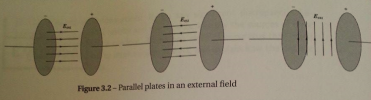 Imagine parallel plates are placed in an external electric field
as shown below. What will be different in each pictured case? How
does the value of C change?
Imagine parallel plates are placed in an external electric field
as shown below. What will be different in each pictured case? How
does the value of C change?
The electrostatic force acting on an electron due to an external electric field is measured at...
 The electrostatic force acting on an electron due to an external electric field is measured at various regions of space, as shown to the right. The direction and magnitude of the electrostatic force at each point is indicated with a vector. Which of the following electric field diagrams best represents the electric field (Assume the charge is sufficiently small that it has no significant effect on the charge creating the electric field.)
18 Net electric field Two hidden arrangements of charged particles each produce an electric field, i.e....
 18 Net electric field Two hidden arrangements of charged particles each produce an electric field, i.e. one electric field vector at each point. These are illustrated at two points. The net electric field at any point is the sum of the two field vectors at each point. Use vector components to determine the net electric field at point A and the net 300 N/C electric field at point B. 20N/C A 500N/C
350-400 words Describe and discuss Maslow's hierarchy of needs including the types of needs and how...
350-400 words Describe and discuss Maslow's hierarchy of needs including the types of needs and how they become dominant. organizational behavior
A point charge of 1.26x10^-10 C is mobed by an external agent through an electric field...
A point charge of 1.26x10^-10 C is mobed by an external agent through an electric field from point A at an electric potential of 6.32Volts to 12.4Volts. This particle begins and ends at rest. How much work was done by the agent?
(1 point) Two different ideal dielectrics fill all of space. The relative permittivity in the region...
 (1 point) Two different ideal dielectrics fill all of space. The relative permittivity in the region where 6x – 2y + 3z > 6 is eri = 3.5, while the relative permittivity everywhere else is Er2 = 1.5. In each dielectric region, the electric field intensity is constant. (Of course the constant for Region 1 need not be identical to the constant for Region 2.) Given the electric field intensity E(2,1,1) = (–70, 0, 42) V/m, find the electric flux...
 Displacement field ED IV. Superposition of sources for the displacement field In systems containing dielectrics, we often consider any field caused by the dielectric as an induced field, and any other field as an external field. A. Consider the electrostatic field. 1. Is the electrostatic field sourced by free charges, bound charges, or both? 2. Suppose you wanted to determine the net electric field by superposition. What would be the most convenient way to subdivide net electric field? Write out...
 The top left diagram below shows a 1-C positive charge placed in
a uniform external electric field. The electric field in which the
charge is placed is represented by field lines (drawn in red), and
the resulting electric force on the charge is represented by the
blue vector. Suppose the 1-C charge is removed, and is replaced, in
turn, by each of the charges shown in the other three diagrams
below. Assuming that the external electric field remains the same,...
The top left diagram below shows a 1-C positive charge placed in
a uniform external electric field. The electric field in which the
charge is placed is represented by field lines (drawn in red), and
the resulting electric force on the charge is represented by the
blue vector. Suppose the 1-C charge is removed, and is replaced, in
turn, by each of the charges shown in the other three diagrams
below. Assuming that the external electric field remains the same,...
 Question 3 a) Two perfect dielectrics sit side by side in free space. Describe the boundary conditions for E and the dielectric boundary. fields across 4 marks b) The boundary is parallel to the j direction. Material 1 has parameters &r-5 and 1. Material 2 has parameters Er-12 and 0.95. In material 1, there is a uniform E-field and H-field, with strengths: 10 20 Assuming no loss, what are the E and H field strengths in material 2? 6 marks...
 Imagine parallel plates are placed in an external electric field
as shown below. What will be different in each pictured case? How
does the value of C change?
Imagine parallel plates are placed in an external electric field
as shown below. What will be different in each pictured case? How
does the value of C change?
 The electrostatic force acting on an electron due to an external electric field is measured at various regions of space, as shown to the right. The direction and magnitude of the electrostatic force at each point is indicated with a vector. Which of the following electric field diagrams best represents the electric field (Assume the charge is sufficiently small that it has no significant effect on the charge creating the electric field.)
 18 Net electric field Two hidden arrangements of charged particles each produce an electric field, i.e. one electric field vector at each point. These are illustrated at two points. The net electric field at any point is the sum of the two field vectors at each point. Use vector components to determine the net electric field at point A and the net 300 N/C electric field at point B. 20N/C A 500N/C
 (1 point) Two different ideal dielectrics fill all of space. The relative permittivity in the region where 6x – 2y + 3z > 6 is eri = 3.5, while the relative permittivity everywhere else is Er2 = 1.5. In each dielectric region, the electric field intensity is constant. (Of course the constant for Region 1 need not be identical to the constant for Region 2.) Given the electric field intensity E(2,1,1) = (–70, 0, 42) V/m, find the electric flux...
Most questions answered within 3 hours.
-
Where is the error in this code sequence?
String s1 = "Hello";
String s2 = "ello";...
asked 10 months ago -
Financial data for Joel de Paris, Inc., for last year
follow:
Joel de Paris, Inc.
Balance...
asked 10 months ago -
Consider this reaction:
Al2(SO4)3 (aq)+ BaCl3
(aq) Al2Cl6 (aq)- +
3BaSO4(s) . What is the...
asked 10 months ago -
Suppose that Savneet is considering increasing her
recent random sample from 20 car rentals to 40...
asked 10 months ago -
Trucks arrive at an unloading terminal at an average rate of 120
per hour.
Trucks arrive...
asked 10 months ago -
Why are methanol and ethanol completely soluble in water while
octanol is not very little soluble....
asked 10 months ago -
A facilities manager at a university reads in a research report
that the mean amount of...
asked 10 months ago -
When the CuSO4 is rehydrated by adding water to the anhydrous
compound, is this an endothermic...
asked 10 months ago -
A ray of sunlight is passing from diamond into crown glass; the
angle of incidence is...
asked 10 months ago -
A block of mass 0.249 kg is placed on top of a light, vertical
spring of...
asked 10 months ago -
how do the kidneys compensate in the presences of acidosis
a) trigger hyperventilate
b) reserve acid...
asked 10 months ago -
Question 501 pts
The rental rate of capital to the firm increases. Which of the
following...
asked 10 months ago