14. A thermistors resistance varies with temperature as: R=R0eBT where R is in ohms Ω, T...
14. A thermistors resistance varies with temperature as:
R=R0eBT where R is in ohms Ω, T is in kelvins, and R0 and B are
constants. If R=8991.9 Ω at the ice point and R=358 Ω at the steam
point, Ts=373.15K.
Determine B.
Homework Answers

Add Answer to:
14. A thermistors resistance varies with temperature as:
R=R0eBT where R is in ohms Ω, T...
(i) Let the resistance R of a piece of wire be a thermometric property for measuring...
 (i) Let the resistance R of a piece of wire be a thermometric property for measuring the temperature T. Assume that where a and b are constants. The resistance of the wire is found to be 512 when it is at the temperature of melting ice and 70 when it is at the temperature at which water boils at atmospheric pressure. If the ice point is taken as 100° and the boiling point as 5000 on a particular scale, what...
21. A resistance thermometer is such that resistance varies with temperature as Rt = Ro(1+at+bTS) Where...
 21. A resistance thermometer is such that resistance varies with temperature as Rt = Ro(1+at+bTS) Where T represent temperature on Celsius scale an a, b, Ro are constants. Ro unit is ohm. Base on above data, find out the unit of b. a. (°C)2 b. (°C) 5 C. (°C)-2 d. (°C) 5
The resistance of a RTD, RT, at a given temperature T is given by the following equation
 (a) The resistance of a RTD, RT, at a given temperature T is given by the following equation: RT = R0 (1 + αT) where R0 is the resistance of the RTD at the reference temperature 0°C, α is the temperature coefficient at 0 °C. It is found that the resistance of the RTD are 130 Ω and 150 Ω at 10°C and at 50°C respectively. Calculate: (i) the temperature coefficient a, and (ii) the resistance of the RTD at 0°C, R0.(b) The RTD in part...
Q2. Consider a thermistor device, where the following relationship between temperature T (°C) and resistance R...
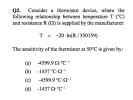 Q2. Consider a thermistor device, where the following relationship between temperature T (°C) and resistance R (S2) is supplied by the manufacturer: T -20 . ln(R / 350159) = The sensitivity of the thermistor at 50°C is given by: (a) -4599.9 Ω"C-1 (b) -1437°C2-1 (c) -4599.9 oC.Ω! (d) -1 437 Ω"C-1
Problem 19.40 7 of 16 Constants Part A Assume that R1-41 Ω , R: 78 Ω...
 Problem 19.40 7 of 16 Constants Part A Assume that R1-41 Ω , R: 78 Ω . R: 11 Ω , R1-14 Ω R5 10 Ω , and R6-24 Ω Find the equivalent resistance of the combination shown in (Figure 1). Express your answer in ohms to two significant figures. Figure Submit Request Answer 1 o14> 25 Ω 12Ω 5.0 Ω Part B Find the equivalent resistance of the combination shown in (Figure 2). Express your answer in ohms to...
QUESTION A thermistor is a device whose resistance varies with temperature. At 200 Cathermistor's resistance is...
 QUESTION A thermistor is a device whose resistance varies with temperature. At 200 Cathermistor's resistance is 100 When connected to a 1.2 V battery, the current through the thermistor increases by 30 y as the temperature is increased to 30°C. What is the thermistor's resistance at the higher temperature? QUESTION 7 What is the magnitude of the current in the wire above the junction in amperes indicate the direction of current flow by making your answer positive to indicate the...
2) Let the cross-correlation function of two processes X(t) and Y(t) be where A, B, and ω are con...
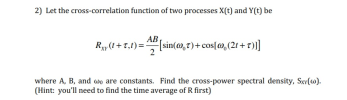 2) Let the cross-correlation function of two processes X(t) and Y(t) be where A, B, and ω are constants. Find the cross-power spectral density, SXY(ω). (Hint: you'll need to find the time average of R first)
2) Let the cross-correlation function of two processes X(t) and Y(t) be where A, B, and ω are constants. Find the cross-power spectral density, SXY(ω). (Hint: you'll need to find the time average of R first)
2) Let the cross-correlation function of two processes X(t) and Y(t) be where A, B, and ω are constants. Find the cross-power spectral density, SXY(ω). (Hint: you'll need to find the time average of R first)
(a) Briefly describe how the resistance R of a metal resistor changes with the temperature T....
(a) Briefly describe how the resistance R of a metal resistor changes with the temperature T. Sketch a functional form of R(T) and explain why. (b) Briefly describe how the resistance R of a semiconductor resistor changes with the temperature T. Sketch a functional form of R(T) and explain why.
Determine ZT and I for the given circuit, where R = 14 Ω. Please report your...
 Determine ZT and I for the given circuit, where R = 14 Ω. Please
report your answer so the magnitude is positive and all angles are
in the range of negative 180 degrees to positive 180 degrees.
The values of ZT = ∠ ∠ ° Ω and I = ∠ ∠ ° A.
Determine Zy and I for the given circuit, where R = 14 Q. Please report your answer so the 482 -j622 w th R w 392 1422...
Determine ZT and I for the given circuit, where R = 14 Ω. Please
report your answer so the magnitude is positive and all angles are
in the range of negative 180 degrees to positive 180 degrees.
The values of ZT = ∠ ∠ ° Ω and I = ∠ ∠ ° A.
Determine Zy and I for the given circuit, where R = 14 Q. Please report your answer so the 482 -j622 w th R w 392 1422...
2.3 Analytic form of transfer function. In certain cases the transfer function is available as an...
 2.3 Analytic form of transfer function. In certain cases the transfer function is available as an analytic expression. One common transfer function used for resistance temperature sensors (to be discussed in Chapter 3) is the Callendar- Van Duzen equation. It gives the resistance of the sensor at a temperature T as R(T)= Ro(1+AT+ BT2 - 100CT3 +CT*) [2), where the constants A, B, and C are determined by direct measurement of resis tance for the specific material used in the...
 (i) Let the resistance R of a piece of wire be a thermometric property for measuring the temperature T. Assume that where a and b are constants. The resistance of the wire is found to be 512 when it is at the temperature of melting ice and 70 when it is at the temperature at which water boils at atmospheric pressure. If the ice point is taken as 100° and the boiling point as 5000 on a particular scale, what...
 21. A resistance thermometer is such that resistance varies with temperature as Rt = Ro(1+at+bTS) Where T represent temperature on Celsius scale an a, b, Ro are constants. Ro unit is ohm. Base on above data, find out the unit of b. a. (°C)2 b. (°C) 5 C. (°C)-2 d. (°C) 5
 Q2. Consider a thermistor device, where the following relationship between temperature T (°C) and resistance R (S2) is supplied by the manufacturer: T -20 . ln(R / 350159) = The sensitivity of the thermistor at 50°C is given by: (a) -4599.9 Ω"C-1 (b) -1437°C2-1 (c) -4599.9 oC.Ω! (d) -1 437 Ω"C-1
 Problem 19.40 7 of 16 Constants Part A Assume that R1-41 Ω , R: 78 Ω . R: 11 Ω , R1-14 Ω R5 10 Ω , and R6-24 Ω Find the equivalent resistance of the combination shown in (Figure 1). Express your answer in ohms to two significant figures. Figure Submit Request Answer 1 o14> 25 Ω 12Ω 5.0 Ω Part B Find the equivalent resistance of the combination shown in (Figure 2). Express your answer in ohms to...
 QUESTION A thermistor is a device whose resistance varies with temperature. At 200 Cathermistor's resistance is 100 When connected to a 1.2 V battery, the current through the thermistor increases by 30 y as the temperature is increased to 30°C. What is the thermistor's resistance at the higher temperature? QUESTION 7 What is the magnitude of the current in the wire above the junction in amperes indicate the direction of current flow by making your answer positive to indicate the...
 2) Let the cross-correlation function of two processes X(t) and Y(t) be where A, B, and ω are constants. Find the cross-power spectral density, SXY(ω). (Hint: you'll need to find the time average of R first)
2) Let the cross-correlation function of two processes X(t) and Y(t) be where A, B, and ω are constants. Find the cross-power spectral density, SXY(ω). (Hint: you'll need to find the time average of R first)
2) Let the cross-correlation function of two processes X(t) and Y(t) be where A, B, and ω are constants. Find the cross-power spectral density, SXY(ω). (Hint: you'll need to find the time average of R first)
 Determine ZT and I for the given circuit, where R = 14 Ω. Please
report your answer so the magnitude is positive and all angles are
in the range of negative 180 degrees to positive 180 degrees.
The values of ZT = ∠ ∠ ° Ω and I = ∠ ∠ ° A.
Determine Zy and I for the given circuit, where R = 14 Q. Please report your answer so the 482 -j622 w th R w 392 1422...
Determine ZT and I for the given circuit, where R = 14 Ω. Please
report your answer so the magnitude is positive and all angles are
in the range of negative 180 degrees to positive 180 degrees.
The values of ZT = ∠ ∠ ° Ω and I = ∠ ∠ ° A.
Determine Zy and I for the given circuit, where R = 14 Q. Please report your answer so the 482 -j622 w th R w 392 1422...
 2.3 Analytic form of transfer function. In certain cases the transfer function is available as an analytic expression. One common transfer function used for resistance temperature sensors (to be discussed in Chapter 3) is the Callendar- Van Duzen equation. It gives the resistance of the sensor at a temperature T as R(T)= Ro(1+AT+ BT2 - 100CT3 +CT*) [2), where the constants A, B, and C are determined by direct measurement of resis tance for the specific material used in the...
Most questions answered within 3 hours.
-
Where is the error in this code sequence?
String s1 = "Hello";
String s2 = "ello";...
asked 10 months ago -
Financial data for Joel de Paris, Inc., for last year
follow:
Joel de Paris, Inc.
Balance...
asked 10 months ago -
Consider this reaction:
Al2(SO4)3 (aq)+ BaCl3
(aq) Al2Cl6 (aq)- +
3BaSO4(s) . What is the...
asked 10 months ago -
Suppose that Savneet is considering increasing her
recent random sample from 20 car rentals to 40...
asked 10 months ago -
Trucks arrive at an unloading terminal at an average rate of 120
per hour.
Trucks arrive...
asked 10 months ago -
Why are methanol and ethanol completely soluble in water while
octanol is not very little soluble....
asked 10 months ago -
A facilities manager at a university reads in a research report
that the mean amount of...
asked 10 months ago -
When the CuSO4 is rehydrated by adding water to the anhydrous
compound, is this an endothermic...
asked 10 months ago -
A ray of sunlight is passing from diamond into crown glass; the
angle of incidence is...
asked 10 months ago -
A block of mass 0.249 kg is placed on top of a light, vertical
spring of...
asked 10 months ago -
how do the kidneys compensate in the presences of acidosis
a) trigger hyperventilate
b) reserve acid...
asked 10 months ago -
Question 501 pts
The rental rate of capital to the firm increases. Which of the
following...
asked 10 months ago