Write a function show_value() that takes two arguments: a potential key and a dictionary name. If...
Write a function show_value() that takes two arguments:
- a potential key and
- a dictionary name.
If the potential key is in the dictionary, the function should return the value for that key. If the potential key, say invalid_key, is not in the dictionary, it should return the string:
invalid_key is not a valid key.
Homework Answers
# do comment if any problem arises
# Code
# this function returns value of a given key in dictionary if it is valid
def show_value(given_key, dictionary):
# iterate over all keys and values
for key, value in dictionary.items():
# if current key is the given key to search then return its value
if key == given_key:
return value
# if key not found in dictionary return key is not valid
return f"{given_key} is not a valid key."
# testing above function
dictionary = {'1': 'Mango', '2': 'Apple', 'r': 'Blue Berry'}
print(f'Value of key r in dictionary is: {show_value("r", dictionary)}')
print(f'Value of key m in dictionary is: {show_value("m", dictionary)}')
Screenshot for indentation:

Output:

Add Answer to:
Write a function show_value() that takes two arguments:
a potential key and
a dictionary name.
If...
Python 3 Write a function named inverse that takes a single parameter, a dictionary. In this...
Python 3 Write a function named inverse that takes a single parameter, a dictionary. In this dictionary each key is a student, represented by a string. The value of each key is a list of courses, each represented by a string, in which the student is enrolled. The function inverse should compute and return a dictionary in which each key is a course and the associated value is a list of students enrolled in that course. For example, the following...
Python 3 Write a function named starCounter that takes three parameters: 1. a dictionary named starDictionary....
Python 3 Write a function named starCounter that takes three parameters: 1. a dictionary named starDictionary. Each key in starDictionary is the name of a star (a string). Its value is a dictionary with two keys: the string 'distance' and the string 'type'. The value associated with key 'distance' is the distance from our solar system in light years. The value associated with key 'type' is a classification such as 'supergiant' or 'dwarf'. 2. a number, maxDistance 3. a string,...
With using Python . Write a function that: 1. Takes two arguments and returns the product...
With using Python . Write a function that: 1. Takes two arguments and returns the product of the arguments. The return value should be of type integer. 2. Takes two arguments and returns the quotient of the arguments. The return value should be of type float. 3. Takes one argument and squares the argument. It then uses the two values and returns the product of the two arguments.(Reuse function in 1.) 4. Takes one argument and prints the argument. Use...
Python 3 Define a function below, get_subset, which takes two arguments: a dictionary of strings (keys)...
 Python 3
Define a function below, get_subset, which takes two arguments: a dictionary of strings (keys) to integers (values) and a list of strings. All of the strings in the list are keys to the dictionary. Complete the function such that it returns the subset of the dictionary defined by the keys in the list of strings. For example, with the dictionary ("puffin": 5, "corgi": 2, "three": 3) and the list ("three", "corgi"), your function should return {"corgi": 2, "three"...
Python 3
Define a function below, get_subset, which takes two arguments: a dictionary of strings (keys) to integers (values) and a list of strings. All of the strings in the list are keys to the dictionary. Complete the function such that it returns the subset of the dictionary defined by the keys in the list of strings. For example, with the dictionary ("puffin": 5, "corgi": 2, "three": 3) and the list ("three", "corgi"), your function should return {"corgi": 2, "three"...
HW13.13. Update a dictionary, following some rules, with another dictionary Define a function below, update_dict_with_rules, which...
 HW13.13. Update a dictionary, following some rules, with another dictionary Define a function below, update_dict_with_rules, which takes two arguments: both are a dictionary of strings (keys) to integers (values). Complete the function such that it updates the first dictionary as follows: • For key-value pairs in both dictionaries, sum them • For key-value pairs in the second dictionary only, insert them into the first • Make no changes to key-value pairs unique to the first dictionary These updates should be...
HW13.13. Update a dictionary, following some rules, with another dictionary Define a function below, update_dict_with_rules, which...
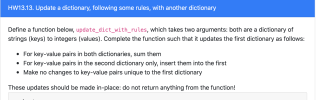 HW13.13. Update a dictionary, following some rules, with another dictionary Define a function below, update_dict_with_rules, which takes two arguments: both are a dictionary of strings (keys) to integers (values). Complete the function such that it updates the first dictionary as follows: • For key-value pairs in both dictionaries, sum them • For key-value pairs in the second dictionary only, insert them into the first • Make no changes to key-value pairs unique to the first dictionary These updates should be...
Write the function, toppings, that takes a dictionary and modifies it as follows: If the key...
Write the function, toppings, that takes a dictionary and modifies it as follows: If the key "potato" has a value, set that as the value for the key "fries". If the key "salad" has a value, set that as the value for the key "spinach". the starter code is listed bellow do not change the code complete in Python def toppings(dictionary): #Your code here pass #placeholder statement - delete when you have actual code here #testing code dict1 = {'potato':...
3. Write a function that takes, as arguments, three numbers, and returns their average. Round the...
3. Write a function that takes, as arguments, three numbers, and returns their average. Round the values to the nearest tenth. Name this function calculate Average (p1, p2, p3). For example, >>>calculate Average (2.5, 3.5, 9) average of those 3 values, using decimal division. Round the values to the nearest tenth. Name your function get Average String (p1, p2, p3). For example, >>>get Average String (1.5, 3.5, 4) should return the string “The average value is 3.0.” Your sentence must...
Python 3.0 Please Write a function that takes, as arguments, a binary string, a list of...
Python 3.0 Please Write a function that takes, as arguments, a binary string, a list of characters and the corresponding Huffman code for those characters. It decodes the binary string using the Huffman code, and returns the resulting decoded string. Name this function decodeStringHuffman(binaryString, myCharacters, myCode). For example, >>>decodeStringHuffman("1001100010111010101010111", ["A", "B", "C"], ["1", "00", "01"]) should return the string 'ABAABCCAACCCCCAA'
PYTHON 3: Write a function removeRand() that takes a dictionary d and an integer n as...
PYTHON 3: Write a function removeRand() that takes a dictionary d and an integer n as parameters. The function randomly chooses n key-value pairs and removes them from the dictionary d. If n is greater than the number of elements in the dictionary, the function prints a message but does not make any changes to d. If n is equal to the number of elements in d, the function clears the dictionary. Otherwise the function goes through n rounds in...
 Python 3
Define a function below, get_subset, which takes two arguments: a dictionary of strings (keys) to integers (values) and a list of strings. All of the strings in the list are keys to the dictionary. Complete the function such that it returns the subset of the dictionary defined by the keys in the list of strings. For example, with the dictionary ("puffin": 5, "corgi": 2, "three": 3) and the list ("three", "corgi"), your function should return {"corgi": 2, "three"...
Python 3
Define a function below, get_subset, which takes two arguments: a dictionary of strings (keys) to integers (values) and a list of strings. All of the strings in the list are keys to the dictionary. Complete the function such that it returns the subset of the dictionary defined by the keys in the list of strings. For example, with the dictionary ("puffin": 5, "corgi": 2, "three": 3) and the list ("three", "corgi"), your function should return {"corgi": 2, "three"...
 HW13.13. Update a dictionary, following some rules, with another dictionary Define a function below, update_dict_with_rules, which takes two arguments: both are a dictionary of strings (keys) to integers (values). Complete the function such that it updates the first dictionary as follows: • For key-value pairs in both dictionaries, sum them • For key-value pairs in the second dictionary only, insert them into the first • Make no changes to key-value pairs unique to the first dictionary These updates should be...
 HW13.13. Update a dictionary, following some rules, with another dictionary Define a function below, update_dict_with_rules, which takes two arguments: both are a dictionary of strings (keys) to integers (values). Complete the function such that it updates the first dictionary as follows: • For key-value pairs in both dictionaries, sum them • For key-value pairs in the second dictionary only, insert them into the first • Make no changes to key-value pairs unique to the first dictionary These updates should be...
Most questions answered within 3 hours.
-
Where is the error in this code sequence?
String s1 = "Hello";
String s2 = "ello";...
asked 10 months ago -
Financial data for Joel de Paris, Inc., for last year
follow:
Joel de Paris, Inc.
Balance...
asked 10 months ago -
Consider this reaction:
Al2(SO4)3 (aq)+ BaCl3
(aq) Al2Cl6 (aq)- +
3BaSO4(s) . What is the...
asked 10 months ago -
Suppose that Savneet is considering increasing her
recent random sample from 20 car rentals to 40...
asked 10 months ago -
Trucks arrive at an unloading terminal at an average rate of 120
per hour.
Trucks arrive...
asked 10 months ago -
Why are methanol and ethanol completely soluble in water while
octanol is not very little soluble....
asked 10 months ago -
A facilities manager at a university reads in a research report
that the mean amount of...
asked 10 months ago -
When the CuSO4 is rehydrated by adding water to the anhydrous
compound, is this an endothermic...
asked 10 months ago -
A ray of sunlight is passing from diamond into crown glass; the
angle of incidence is...
asked 10 months ago -
A block of mass 0.249 kg is placed on top of a light, vertical
spring of...
asked 10 months ago -
how do the kidneys compensate in the presences of acidosis
a) trigger hyperventilate
b) reserve acid...
asked 10 months ago -
Question 501 pts
The rental rate of capital to the firm increases. Which of the
following...
asked 10 months ago