Using Python code. Fill in the gaps in the nametag function so that it uses the...
Using Python code.
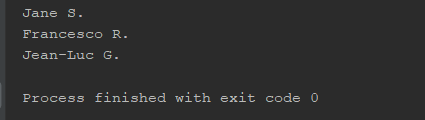
Fill in the gaps in the nametag function so that it uses the format method to return first_name and the first initial of last_name followed by a period. For example, nametag("Jane", "Smith") should return "Jane S."
def nametag(first_name, last_name):
return("___.".format(___))
print(nametag("Jane", "Smith"))
# Should display "Jane S."
print(nametag("Francesco", "Rinaldi"))
# Should display "Francesco R."
print(nametag("Jean-Luc", "Grand-Pierre"))
# Should display "Jean-Luc G."
Homework Answers
def nametag(first_name, last_name):
    return ("{} {}.".format(first_name, last_name[0]))


print(nametag("Jane", "Smith"))
# Should display "Jane S."
print(nametag("Francesco", "Rinaldi"))
# Should display "Francesco R."
print(nametag("Jean-Luc", "Grand-Pierre"))
# Should display "Jean-Luc G."
Add Answer to:
Using Python code.
Fill in the gaps in the nametag function so that it uses
the...
In python class Customer: def __init__(self, customer_id, last_name, first_name, phone_number, address): self._customer_id = int(customer_id) self._last_name =...
In python class Customer: def __init__(self, customer_id, last_name, first_name, phone_number, address): self._customer_id = int(customer_id) self._last_name = str(last_name) self._first_name = str(first_name) self._phone_number = str(phone_number) self._address = str(address) def display (self): return str(self._customer_id) + ", " + self._first_name + self._last_name + "\n" + self._phone_number + "\n" + self._address customer_one = Customer("694", "Abby", "Boat", "515-555-4289", "123 Bobby Rd", ) print(customer_one.display()) customer_two = Customer ("456AB", "Scott", "James", "515-875-3099", "23 Sesame Street Brooklyn, NY 11213") print(customer_two.display()) Use Customer class remove the address attribute.Place the code...
Write a program that does the following in Python Code: Stores the following three lists: last_name...
Write a program that does the following in Python Code: Stores the following three lists: last_name = ["Smith", "Jones", "Williams", "Bailey", "Rogers", "Pyle", "Rossington"] first_name =["Lisa", "Bill", "Jay", "Sally", "Walter","Jake","Gary"] phone_number =["240-233-1921", "301-394-2745", "571-321-8934", "703-238-3432", "703-947-9987", "301-945-3593", "240-671-3221"] Has a function named combine_lists() that takes in last_names, first_names and phone_numbers as lists and returns a dictionary called phone_book that uses last_name as the key and a list consisting of first_name and phone_number. Has a main function that iterates through the...
Python help! Any help is appreciated, thank you! Fill in the missing function, monthString(), in the...
Python help! Any help is appreciated, thank you! Fill in the missing function, monthString(), in the program. The function should take number between 1 and 12 as a parameter and returns the corresponding month as a string. For example, if the parameter is 1, your function should return "January". If the parameter is 2, your function should return out "February", etc. def monthString(monthNum): """ Takes as input a number, monthNum, and returns the corresponding month name as a string. Example:...
Write a program that does the following in Python Code: Stores the following three lists: last_...
Write a program that does the following in Python Code: Stores the following three lists: last_name = ["Smith", "Jones", "Williams", "Bailey", "Rogers", "Pyle", "Rossington"] first_name =["Lisa", "Bill", "Jay", "Sally", "Walter","Jake","Gary"] phone_number =["240-233-1921", "301-394-2745", "571-321-8934", "703-238-3432", "703-947-9987", "301-945-3593", "240-671-3221"] Has a function named combine_lists() that takes in last_names, first_names and phone_numbers as lists and returns a dictionary called phone_book that uses last_name as the key and a list consisting offirst_name and phone_number. Has a main function that iterates through the phone_book...
***IN PYTHON 2.7****Augment the following code with a new class named 'Coin'. Coin should inherit from...
***IN PYTHON 2.7****Augment the following code with a new class named 'Coin'. Coin should inherit from Die, with the following modifications; The constructor should not take any arguments; a coin always has two sides add a flip() method that uses the roll() method from the parent class. If roll returns 1; flip should return "HEADS". If roll returns a 2, flip should return "TAILS" Do not override the roll or rollMultiple methods from the parent class #!/usr/bin/python # your class...
the code has to be in PYTHON Question 1: Fill in the {} such that pi...
the code has to be in PYTHON Question 1: Fill in the {} such that pi is printed using 15 spaces and printed out to 5 decimal places, in left, right, center aligned STARTER CODE: def print_pi(): left = "Pi is fun to 5 places:{}<-".format(math.pi) print(left) right= "Pi is fun to 5 places:{}<-".format(math.pi) print(right) center= "Pi is fun to 5 places:{}<-".format(math.pi) print(center) Question2: Define the function table_of_fun(end). Using format, print out the multiplication table shown below. You will be passed...
[Using Python] I need my code given below to loop the user input, so that you...
[Using Python] I need my code given below to loop the user input, so that you are asked to input without it stopping after 4 inputs. Code: #A program that converts a hexadecimal number to its decimal value #Define function for hexadecimal to decimal def hexToDec(hexi): result = 0 #For loop to test input for correct values for char in hexi: if 'A' <= char <= 'F' or 'a' <= char <= 'f': if 'a' <= char <= 'f': result...
Python 3+ Adjust the following code so the two errors below are non-present: 1. __init__() :...
Python 3+ Adjust the following code so the two errors below are non-present: 1. __init__() : Since Pizza object don't have it's own set() datastructure, the toppings in the pizza object are manimupated from out of the object. (-1.0) 2. __eq__() : How about "self.toppings == other.toppings" rather than "self.toppings - other.toppin == set())". Code: ## Program 1 ## --------------------------------- class Pizza: def __init__(self, s='M', top=set()): self.setSize(s) self.toppings = top def setSize(self, s): self.size = s def getSize(self): return self.size...
PYTHON FILL IN THE BLANK CODE REMEMBER TO UTILIZE DICTIONARIES # Implement this function: def store_checkout(inventory_tuple_list,...
PYTHON FILL IN THE BLANK CODE REMEMBER TO UTILIZE DICTIONARIES # Implement this function: def store_checkout(inventory_tuple_list, item_purchase_list): """ inventory_tuple_list: A list of tuples. Each tuple has a string representing an item name, an int representing a price, and a string representing a description. Example: [("A", 5, "shiny new A"), ("B", 10, "big heavy B")] item_purchase_list: A list of strings. Each string represents an item name. Example: ["A", "A", "B", "C"] Return the total price of the items in item_purchase_list by...
The group_list function accepts a group name and a list of members, and returns a string...
The group_list function accepts a group name and a list of members, and returns a string with the format: group_name: member1, member2, … For example, group_list("g", ["a","b","c"]) returns "g: a, b, c". Fill in the gaps in this function to do that. def group_list(group, users): members=[] members += "," .join(users) return ("{}:{}".format(group,users)) print(group_list("Marketing", ["Mike", "Karen", "Jake", "Tasha"])) # Should be "Marketing: Mike, Karen, Jake, Tasha" print(group_list("Engineering", ["Kim", "Jay", "Tom"])) # Should be "Engineering: Kim, Jay, Tom" print(group_list("Users", "")) #...
Most questions answered within 3 hours.
-
Where is the error in this code sequence?
String s1 = "Hello";
String s2 = "ello";...
asked 10 months ago -
Financial data for Joel de Paris, Inc., for last year
follow:
Joel de Paris, Inc.
Balance...
asked 10 months ago -
Consider this reaction:
Al2(SO4)3 (aq)+ BaCl3
(aq) Al2Cl6 (aq)- +
3BaSO4(s) . What is the...
asked 10 months ago -
Suppose that Savneet is considering increasing her
recent random sample from 20 car rentals to 40...
asked 10 months ago -
Trucks arrive at an unloading terminal at an average rate of 120
per hour.
Trucks arrive...
asked 10 months ago -
Why are methanol and ethanol completely soluble in water while
octanol is not very little soluble....
asked 10 months ago -
A facilities manager at a university reads in a research report
that the mean amount of...
asked 10 months ago -
When the CuSO4 is rehydrated by adding water to the anhydrous
compound, is this an endothermic...
asked 10 months ago -
A ray of sunlight is passing from diamond into crown glass; the
angle of incidence is...
asked 10 months ago -
A block of mass 0.249 kg is placed on top of a light, vertical
spring of...
asked 10 months ago -
how do the kidneys compensate in the presences of acidosis
a) trigger hyperventilate
b) reserve acid...
asked 10 months ago -
Question 501 pts
The rental rate of capital to the firm increases. Which of the
following...
asked 10 months ago