Relation between polarity of a compound and the order of elution on a column.
Homework Answers

Add Answer to:
Relation between polarity of a compound and the order of elution on
a column.
Problem 6: Based solely on molecular polarity, predict the most likely order of elution for each...
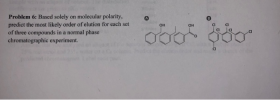 Problem 6: Based solely on molecular polarity, predict the most likely order of elution for each set of three compounds in a normal phase chromatographic experiment. он он
Please help with 2 and 3 1. What factors affect the rate of elution in organic...
 Please help with 2 and 3
1. What factors affect the rate of elution in organic compounds? 2. Explain what is the relationship between polarities of compounds (polar/non- polar compound) and rate of elution (Rf). 3. Explain what is the relationship between solvent polarity (polar/non-polar solvent) and rate of elution (Rf)
Please help with 2 and 3
1. What factors affect the rate of elution in organic compounds? 2. Explain what is the relationship between polarities of compounds (polar/non- polar compound) and rate of elution (Rf). 3. Explain what is the relationship between solvent polarity (polar/non-polar solvent) and rate of elution (Rf)
Discuss how the difference in molecular weight, density, and polarity could be used to predict the...
Discuss how the difference in molecular weight, density, and polarity could be used to predict the elution order when doing column chromatography. Please be as specific and detailed as possible! Sending good vibes to whomever answers!
The column chromatography procedure for the separation of a polar and a non- polar compound calls...
The column chromatography procedure for the separation of a polar and a non- polar compound calls for sequential elution with the following solvents: hexane, 70:30 hexane : acetone, acetone and 80:20 acetone : methanol. Why it is important to follow this solvent order?
Gradient elution in ion-exchange chromatography may involve:_________. A) changing the polarity of the eluent. B) increasing...
Gradient elution in ion-exchange chromatography may involve:_________. A) changing the polarity of the eluent. B) increasing the temperature of the system. C) increasing the ionic strength of the eluent. D) modifying the rate flow of the eluent. E) continuously increasing the pressure.
Hi can someone help me with my pre lab theory questions (1,2,3) on rate of elution...
 Hi can someone help me with my pre lab theory questions (1,2,3)
on rate of elution or Rf? Here is some background below. Please
help explain as many as possible (1-3)! I dont really get the
relation ships in this lab, thank you!
1. What factors affect the rate of elution in organic compounds? 2. Explain what is the relationship between polarities of compounds (polar/non- polar compound) and rate of elution (Rf). 3. Explain what is the relationship between solvent...
Hi can someone help me with my pre lab theory questions (1,2,3)
on rate of elution or Rf? Here is some background below. Please
help explain as many as possible (1-3)! I dont really get the
relation ships in this lab, thank you!
1. What factors affect the rate of elution in organic compounds? 2. Explain what is the relationship between polarities of compounds (polar/non- polar compound) and rate of elution (Rf). 3. Explain what is the relationship between solvent...
20 > Species A and B were separated using column chromatography. The elution time for species...
 20 > Species A and B were separated using column chromatography. The elution time for species A (A) was 200 s with a peak width (WA) of 35 s, and the elution time for species B (') was 382 s with a peak width (WR) of 42 s. What is the length of the column (in centimeters) if the theoretical plate height for species B is 1.0 mm? L =
Species A and B were separated using column chromatography. The elution time for species A (tA)...
Species A and B were separated using column chromatography. The elution time for species A (tA) was 200 s with a peak width (wA) of 35 s, and the elution time for species B (tB) was 353 s with a peak width (wB) of 51 s. What is the length of the column (in centimeters) if the theoretical plate height for species B is 3.0 mm? L=
Polarity index is a value indicative of the polarity of a compound (higher polarity index means...
Polarity index is a value indicative of the polarity of a compound (higher polarity index means more polar). Compare the polarity index of acetone, ethyl acetate, and hexane (available via the solvent miscibility table on Blackboard). Use your uncanny knowledge of chemical structures to evaluate the relative polarity of caffeine, aspirin, and acetaminophen. Use this information to predict which compound is likely to elute with each of the solvents employed in your chromatographic separation.
4) What is the order of elution of the following compounds from a reverse-phase packed HPLC...
4) What is the order of elution of the following compounds from a reverse-phase packed HPLC column? Briefly justify your reasoning. Benzyl alcohol (C6H5CH2OH), benzaldehyde (C6H5CHO), benzoic acid (C6H5COOH), Acetophenone (C6H5C(O)CH3)
 Problem 6: Based solely on molecular polarity, predict the most likely order of elution for each set of three compounds in a normal phase chromatographic experiment. он он
 Please help with 2 and 3
1. What factors affect the rate of elution in organic compounds? 2. Explain what is the relationship between polarities of compounds (polar/non- polar compound) and rate of elution (Rf). 3. Explain what is the relationship between solvent polarity (polar/non-polar solvent) and rate of elution (Rf)
Please help with 2 and 3
1. What factors affect the rate of elution in organic compounds? 2. Explain what is the relationship between polarities of compounds (polar/non- polar compound) and rate of elution (Rf). 3. Explain what is the relationship between solvent polarity (polar/non-polar solvent) and rate of elution (Rf)
 Hi can someone help me with my pre lab theory questions (1,2,3)
on rate of elution or Rf? Here is some background below. Please
help explain as many as possible (1-3)! I dont really get the
relation ships in this lab, thank you!
1. What factors affect the rate of elution in organic compounds? 2. Explain what is the relationship between polarities of compounds (polar/non- polar compound) and rate of elution (Rf). 3. Explain what is the relationship between solvent...
Hi can someone help me with my pre lab theory questions (1,2,3)
on rate of elution or Rf? Here is some background below. Please
help explain as many as possible (1-3)! I dont really get the
relation ships in this lab, thank you!
1. What factors affect the rate of elution in organic compounds? 2. Explain what is the relationship between polarities of compounds (polar/non- polar compound) and rate of elution (Rf). 3. Explain what is the relationship between solvent...
 20 > Species A and B were separated using column chromatography. The elution time for species A (A) was 200 s with a peak width (WA) of 35 s, and the elution time for species B (') was 382 s with a peak width (WR) of 42 s. What is the length of the column (in centimeters) if the theoretical plate height for species B is 1.0 mm? L =
Most questions answered within 3 hours.
-
Where is the error in this code sequence?
String s1 = "Hello";
String s2 = "ello";...
asked 10 months ago -
Financial data for Joel de Paris, Inc., for last year
follow:
Joel de Paris, Inc.
Balance...
asked 10 months ago -
Consider this reaction:
Al2(SO4)3 (aq)+ BaCl3
(aq) Al2Cl6 (aq)- +
3BaSO4(s) . What is the...
asked 10 months ago -
Suppose that Savneet is considering increasing her
recent random sample from 20 car rentals to 40...
asked 10 months ago -
Trucks arrive at an unloading terminal at an average rate of 120
per hour.
Trucks arrive...
asked 10 months ago -
Why are methanol and ethanol completely soluble in water while
octanol is not very little soluble....
asked 10 months ago -
A facilities manager at a university reads in a research report
that the mean amount of...
asked 10 months ago -
When the CuSO4 is rehydrated by adding water to the anhydrous
compound, is this an endothermic...
asked 10 months ago -
A ray of sunlight is passing from diamond into crown glass; the
angle of incidence is...
asked 10 months ago -
A block of mass 0.249 kg is placed on top of a light, vertical
spring of...
asked 10 months ago -
how do the kidneys compensate in the presences of acidosis
a) trigger hyperventilate
b) reserve acid...
asked 10 months ago -
Question 501 pts
The rental rate of capital to the firm increases. Which of the
following...
asked 10 months ago