my sudject :Artificial Inttelegence Question 2: a. Show that breadth-first search given constant cost for all...
my sudject :Artificial Inttelegence
Question 2:
a. Show that breadth-first search given constant cost for all actions is guaranteedto find the shortest solution.
b. Show that this is not the case for varying costs.
Homework Answers
a) BFS guarantees finding shortest path from a source to all other nodes when all edges are of the same cost. This is because BFS traverses the graph level by level. That is all nodes at distance 0 are visited first and then distance 1 and then those at distance 2...and so on.
For a more detailed proof see here : http://www.cs.toronto.edu/~krueger/csc263h/lectures/BFS.pdf
b) Example to prove that bfs doesn't work for varying cost edges.
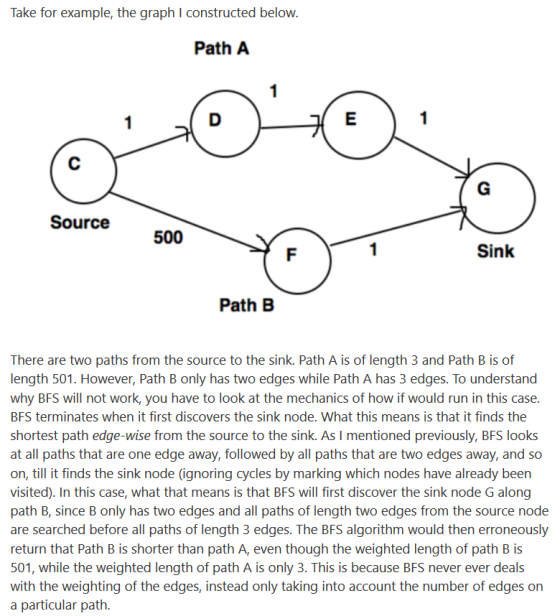
Please upvote if you found the answer useful.
Add Answer to:
my sudject :Artificial Inttelegence
Question 2:
a. Show that breadth-first search given constant cost
for all...
Question 3 1 pts Select all of the following that are true: Breadth-First Search only adds...
 Question 3 1 pts Select all of the following that are true: Breadth-First Search only adds each vertex to the queue once. Breadth-First Search generally uses more space compared to Depth-First search. Breadth-First Search may not find the shortest path for an unweighted graph if the graph contains a cycle. At any time during Breadth-First Search, the queue holds at most two distinct dist values from all vertices in
This is an Artificial Intelligence assignment. Implement 8 Queen Problem in C/C++ using Breadth First Search....
This is an Artificial Intelligence assignment. Implement 8 Queen Problem in C/C++ using Breadth First Search. The number of steps should be minumum to find the position on the 8x8 board where all queens are at non attacking positions. Also mention the State space,transition operators and the initial state as per the definiton of state space with the code.
From the given graph discover the structure of the graph using 1. breadth first search(BFS) a. depth first search(DFS) b. Show the steps and techniques used for each method (20 points) From the...
 From the given graph discover the structure of the graph using 1. breadth first search(BFS) a. depth first search(DFS) b. Show the steps and techniques used for each method (20 points)
From the given graph discover the structure of the graph using 1. breadth first search(BFS) a. depth first search(DFS) b. Show the steps and techniques used for each method (20 points)
From the given graph discover the structure of the graph using 1. breadth first search(BFS) a. depth first search(DFS) b. Show the steps and techniques used for each method (20 points)
discrete 2 question 31 For Esercises 25.28, write the nodes in a breadth first search of the graph for Exercises 21 the node specified 25、 26, g 20. In the computer network in the accompanying fi...
 discrete 2
question 31
For Esercises 25.28, write the nodes in a breadth first search of the graph for Exercises 21 the node specified 25、 26, g 20. In the computer network in the accompanying figure, the same message is to be broade Dribe ( 21-24 28. e 27. to nodes 4.Е. F and G. One way to do this is to find the shortest path from C to send out multiple copies of the same message. A more etficient...
discrete 2
question 31
For Esercises 25.28, write the nodes in a breadth first search of the graph for Exercises 21 the node specified 25、 26, g 20. In the computer network in the accompanying figure, the same message is to be broade Dribe ( 21-24 28. e 27. to nodes 4.Е. F and G. One way to do this is to find the shortest path from C to send out multiple copies of the same message. A more etficient...
1) Use the Breadth-First-Search with Branch-and-Bound Pruning algorithm for the 0–1 Knapsack problem to maximize the...
 1) Use the Breadth-First-Search with Branch-and-Bound Pruning
algorithm for the 0–1 Knapsack problem to maximize the profit for
the following problem instance. Show the actions step by step.
2) Use the Best-First Search with Branch-and-Bound Pruning
algorithm for the 0–1 Knapsack problem to maximize the profit for
the following problem instance. Show the actions step by step.
i PiPi 1 $20 210 2 $30 5 6 3 $35 75 4 $12 3 4 5 $3 13 wi Wー13
1) Use the Breadth-First-Search with Branch-and-Bound Pruning
algorithm for the 0–1 Knapsack problem to maximize the profit for
the following problem instance. Show the actions step by step.
2) Use the Best-First Search with Branch-and-Bound Pruning
algorithm for the 0–1 Knapsack problem to maximize the profit for
the following problem instance. Show the actions step by step.
i PiPi 1 $20 210 2 $30 5 6 3 $35 75 4 $12 3 4 5 $3 13 wi Wー13
Consider the following directed graph for each of the problems: 1. Perform a breadth-first search on...
 Consider the following directed graph for each of the
problems:
1. Perform a breadth-first search on the graph assuming that the
vertices and adjacency lists
are listed in alphabetical order. Show the breadth-first search
tree that is generated.
2. Perform a depth-first search on the graph assuming that the
vertices and adjacency lists
are listed in alphabetical order. Classify each edge as tree, back
or cross edge. Label each
vertex with its start and finish time.
3. Remove all the...
Consider the following directed graph for each of the
problems:
1. Perform a breadth-first search on the graph assuming that the
vertices and adjacency lists
are listed in alphabetical order. Show the breadth-first search
tree that is generated.
2. Perform a depth-first search on the graph assuming that the
vertices and adjacency lists
are listed in alphabetical order. Classify each edge as tree, back
or cross edge. Label each
vertex with its start and finish time.
3. Remove all the...
Section 6.1 1. Use Algorithm 6.1 (The Breadth-First Search with Branch-and-Bound Pruning algorithm for the 0-1...
 Section 6.1 1. Use Algorithm 6.1 (The Breadth-First Search with Branch-and-Bound Pruning algorithm for the 0-1 Knapsack problem) to maximize the profit for the following problem instance. Show the actions step by step i P t0 1 $20 2 10 2 830 56 3 835 75 4 812 3 4 5 83 1 3 W= 13
(5 marks) a. The pseudo-code for breadth-first search, modified slightly from Drozdek,1 is as follows: void...
 (5 marks) a. The pseudo-code for breadth-first search, modified slightly from Drozdek,1 is as follows: void breadthFirstSearch (vertex w) for all vertices u num (u) 0 null edges i=1; num (w) i++ enqueue (w) while queue is not empty dequeue ( V= for all vertices u adjacent to v if num(u) is 0 num (u) = i++; enqueue (u) attach edge (vu) to edges; output edges; Now consider the following graph. Give the breadth-first traversal of the graph, starting from...
BFS Given an undirected graph below (a) Show the shortest distance to each vertex from source ver...
 Solve (a) and (b) using BFS and DFS diagram
BFS Given an undirected graph below (a) Show the shortest distance to each vertex from source vertex H and predecessor tree on the graph that result from running breadth-finst search (BFS).Choose adjacen vertices in al phabetical order b) Show the start and finsh time for each vertex, starting from source vertex H, that result from running depth-first search (DFS)Choose aljacent vertices in alphabet- ical order DFS
BFS Given an undirected graph...
Solve (a) and (b) using BFS and DFS diagram
BFS Given an undirected graph below (a) Show the shortest distance to each vertex from source vertex H and predecessor tree on the graph that result from running breadth-finst search (BFS).Choose adjacen vertices in al phabetical order b) Show the start and finsh time for each vertex, starting from source vertex H, that result from running depth-first search (DFS)Choose aljacent vertices in alphabet- ical order DFS
BFS Given an undirected graph...
 Question 3 1 pts Select all of the following that are true: Breadth-First Search only adds each vertex to the queue once. Breadth-First Search generally uses more space compared to Depth-First search. Breadth-First Search may not find the shortest path for an unweighted graph if the graph contains a cycle. At any time during Breadth-First Search, the queue holds at most two distinct dist values from all vertices in
 From the given graph discover the structure of the graph using 1. breadth first search(BFS) a. depth first search(DFS) b. Show the steps and techniques used for each method (20 points)
From the given graph discover the structure of the graph using 1. breadth first search(BFS) a. depth first search(DFS) b. Show the steps and techniques used for each method (20 points)
From the given graph discover the structure of the graph using 1. breadth first search(BFS) a. depth first search(DFS) b. Show the steps and techniques used for each method (20 points)
 discrete 2
question 31
For Esercises 25.28, write the nodes in a breadth first search of the graph for Exercises 21 the node specified 25、 26, g 20. In the computer network in the accompanying figure, the same message is to be broade Dribe ( 21-24 28. e 27. to nodes 4.Е. F and G. One way to do this is to find the shortest path from C to send out multiple copies of the same message. A more etficient...
discrete 2
question 31
For Esercises 25.28, write the nodes in a breadth first search of the graph for Exercises 21 the node specified 25、 26, g 20. In the computer network in the accompanying figure, the same message is to be broade Dribe ( 21-24 28. e 27. to nodes 4.Е. F and G. One way to do this is to find the shortest path from C to send out multiple copies of the same message. A more etficient...
 1) Use the Breadth-First-Search with Branch-and-Bound Pruning
algorithm for the 0–1 Knapsack problem to maximize the profit for
the following problem instance. Show the actions step by step.
2) Use the Best-First Search with Branch-and-Bound Pruning
algorithm for the 0–1 Knapsack problem to maximize the profit for
the following problem instance. Show the actions step by step.
i PiPi 1 $20 210 2 $30 5 6 3 $35 75 4 $12 3 4 5 $3 13 wi Wー13
1) Use the Breadth-First-Search with Branch-and-Bound Pruning
algorithm for the 0–1 Knapsack problem to maximize the profit for
the following problem instance. Show the actions step by step.
2) Use the Best-First Search with Branch-and-Bound Pruning
algorithm for the 0–1 Knapsack problem to maximize the profit for
the following problem instance. Show the actions step by step.
i PiPi 1 $20 210 2 $30 5 6 3 $35 75 4 $12 3 4 5 $3 13 wi Wー13
 Consider the following directed graph for each of the
problems:
1. Perform a breadth-first search on the graph assuming that the
vertices and adjacency lists
are listed in alphabetical order. Show the breadth-first search
tree that is generated.
2. Perform a depth-first search on the graph assuming that the
vertices and adjacency lists
are listed in alphabetical order. Classify each edge as tree, back
or cross edge. Label each
vertex with its start and finish time.
3. Remove all the...
Consider the following directed graph for each of the
problems:
1. Perform a breadth-first search on the graph assuming that the
vertices and adjacency lists
are listed in alphabetical order. Show the breadth-first search
tree that is generated.
2. Perform a depth-first search on the graph assuming that the
vertices and adjacency lists
are listed in alphabetical order. Classify each edge as tree, back
or cross edge. Label each
vertex with its start and finish time.
3. Remove all the...
 Section 6.1 1. Use Algorithm 6.1 (The Breadth-First Search with Branch-and-Bound Pruning algorithm for the 0-1 Knapsack problem) to maximize the profit for the following problem instance. Show the actions step by step i P t0 1 $20 2 10 2 830 56 3 835 75 4 812 3 4 5 83 1 3 W= 13
 (5 marks) a. The pseudo-code for breadth-first search, modified slightly from Drozdek,1 is as follows: void breadthFirstSearch (vertex w) for all vertices u num (u) 0 null edges i=1; num (w) i++ enqueue (w) while queue is not empty dequeue ( V= for all vertices u adjacent to v if num(u) is 0 num (u) = i++; enqueue (u) attach edge (vu) to edges; output edges; Now consider the following graph. Give the breadth-first traversal of the graph, starting from...
 Solve (a) and (b) using BFS and DFS diagram
BFS Given an undirected graph below (a) Show the shortest distance to each vertex from source vertex H and predecessor tree on the graph that result from running breadth-finst search (BFS).Choose adjacen vertices in al phabetical order b) Show the start and finsh time for each vertex, starting from source vertex H, that result from running depth-first search (DFS)Choose aljacent vertices in alphabet- ical order DFS
BFS Given an undirected graph...
Solve (a) and (b) using BFS and DFS diagram
BFS Given an undirected graph below (a) Show the shortest distance to each vertex from source vertex H and predecessor tree on the graph that result from running breadth-finst search (BFS).Choose adjacen vertices in al phabetical order b) Show the start and finsh time for each vertex, starting from source vertex H, that result from running depth-first search (DFS)Choose aljacent vertices in alphabet- ical order DFS
BFS Given an undirected graph...
Most questions answered within 3 hours.
-
Where is the error in this code sequence?
String s1 = "Hello";
String s2 = "ello";...
asked 10 months ago -
Financial data for Joel de Paris, Inc., for last year
follow:
Joel de Paris, Inc.
Balance...
asked 10 months ago -
Consider this reaction:
Al2(SO4)3 (aq)+ BaCl3
(aq) Al2Cl6 (aq)- +
3BaSO4(s) . What is the...
asked 10 months ago -
Suppose that Savneet is considering increasing her
recent random sample from 20 car rentals to 40...
asked 10 months ago -
Trucks arrive at an unloading terminal at an average rate of 120
per hour.
Trucks arrive...
asked 10 months ago -
Why are methanol and ethanol completely soluble in water while
octanol is not very little soluble....
asked 10 months ago -
A facilities manager at a university reads in a research report
that the mean amount of...
asked 10 months ago -
When the CuSO4 is rehydrated by adding water to the anhydrous
compound, is this an endothermic...
asked 10 months ago -
A ray of sunlight is passing from diamond into crown glass; the
angle of incidence is...
asked 10 months ago -
A block of mass 0.249 kg is placed on top of a light, vertical
spring of...
asked 10 months ago -
how do the kidneys compensate in the presences of acidosis
a) trigger hyperventilate
b) reserve acid...
asked 10 months ago -
Question 501 pts
The rental rate of capital to the firm increases. Which of the
following...
asked 10 months ago