what would be the rationale for a company (Netflix) entering into the production industry ?! PLEASE...
Homework Answers
Usually, the rationale behind a company like Netflix to enter the production industry is for business expansion for maximizing profits. Initially, Netflix business model was DVD rental and sales. The sales division was later abandoned by Hastings and he concentrated only on DVD rentals. In the due course in 2007, Netflix expanded its business by introducing streaming of media at the same time retaining the DVD rentals and Blu-ray services. In 2010, the company expanded to other locations such as Canada, Latin America and the Caribbean to provide streaming services. In 2012, Netflix entered the content-production industry for reasons of diversification and increasing the revenue of the company. Since 2012, Netflix has made a tremendous growth in production and distribution of both film and television series. It has established a unique online library that has the ‘Netflix content’
Add Answer to:
what would be the rationale for a company (Netflix) entering into
the production industry ?! PLEASE...
what are the stakeholder groups of netflix? what claims do those stakeholder groups place on Netflix?...
what are the stakeholder groups of netflix? what claims do those stakeholder groups place on Netflix? How is Netflix trying to satisfy those claims? ANSWER ASAP PLEASE !!!!!
What are the limitations of analyzing the industry that Netflix currently competes in by using Porter's...
What are the limitations of analyzing the industry that Netflix currently competes in by using Porter's 5 Forces?
What does your strategic group map of this industry look like? How attractively is Netflix positioned...
What does your strategic group map of this industry look like? How attractively is Netflix positioned on the map? please respond in a Case Analysis format.
A company is considering entering industry A which is perfectly competitive. Here are further details on...
A company is considering entering industry A which is perfectly competitive. Here are further details on the industry: 100 firms currently operating each with a fixed cost of $1,000 and TVC of 5Q^2 +10Q Industry demand is given by P = 400-2Q/19 a) Given that the industry is in the short run, that is, there is no entry and exit, how much profit would be made by each company? b) How many firms would enter into this industry in the...
1. A company is considering entering industry A which is perfectly competitive. Here are further details...
 1. A company is considering entering industry A which is perfectly competitive. Here are further details on the industry: 100 firms currently operating each with a fixed cost of $1,000 and TVC of 5Q2+100 Industry demand is given by P = 400-20/19 a) (40 points) Given that the industry is in the short run, that is, there is no entry and exit, how much profit would be made by each company? b) (60 points) How many firms would enter into...
1. A company is considering entering industry A which is perfectly competitive. Here are further details...
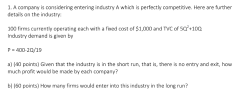 1. A company is considering entering industry A which is perfectly competitive. Here are further details on the industry: 100 firms currently operating each with a fixed cost of $1,000 and TVC of 5Q+100 Industry demand is given by P 400-20/19 a) (40 points) Given that the industry is in the short run, that is, there is no entry and exit, how much profit would be made by each company b) (60 points) How many firms would enter into this...
1. A company is considering entering industry A which is perfectly competitive. Here are further details...
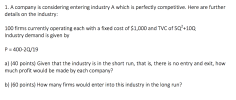 1. A company is considering entering industry A which is perfectly competitive. Here are further details on the industry: 100 firms currently operating each with a fixed cost of $1,000 and TVC of 5Q2+100 Industry demand is given by P = 400-20/19 a) (40 points) Given that the industry is in the short run, that is, there is no entry and exit, how much profit would be made by each company? b) (60 points) How many firms would enter into...
What approach to the Strategy process does Netflix follow and why? What are some challenges with...
What approach to the Strategy process does Netflix follow and why? What are some challenges with this process especially as Netflix continues to grow fast? . How was Netflix able to disrupt the U.S. home entertainment industry? How did Netflix's business change over time? . Netflix growth seems to be maturing. How does Netflix increase its services in the United States? What other services could Netflix offer to drive growth? If you would like to view the case : https://www.studocu.com/row/document/national-university-of-sciences-and-technology/enterprise-management/other/netflix-inc-case-study/3068424/view
When would you expect economic profits in an industry to be zero? When firms are entering...
 When would you expect economic profits in an industry to be zero? When firms are entering the industry. When firms are leaving the industry. When existing firms are growing, U When firms have no incentives to enter or exit.
"What is the point of entering a perfectly competitive industry if it is simply to earn...
"What is the point of entering a perfectly competitive industry if it is simply to earn zero profits anyway?" Discuss this statement with reference to the long and short run, as well as to heterogeneity across firms. (Use appropriate graphs to support your answer).
 1. A company is considering entering industry A which is perfectly competitive. Here are further details on the industry: 100 firms currently operating each with a fixed cost of $1,000 and TVC of 5Q2+100 Industry demand is given by P = 400-20/19 a) (40 points) Given that the industry is in the short run, that is, there is no entry and exit, how much profit would be made by each company? b) (60 points) How many firms would enter into...
 1. A company is considering entering industry A which is perfectly competitive. Here are further details on the industry: 100 firms currently operating each with a fixed cost of $1,000 and TVC of 5Q+100 Industry demand is given by P 400-20/19 a) (40 points) Given that the industry is in the short run, that is, there is no entry and exit, how much profit would be made by each company b) (60 points) How many firms would enter into this...
 1. A company is considering entering industry A which is perfectly competitive. Here are further details on the industry: 100 firms currently operating each with a fixed cost of $1,000 and TVC of 5Q2+100 Industry demand is given by P = 400-20/19 a) (40 points) Given that the industry is in the short run, that is, there is no entry and exit, how much profit would be made by each company? b) (60 points) How many firms would enter into...
 When would you expect economic profits in an industry to be zero? When firms are entering the industry. When firms are leaving the industry. When existing firms are growing, U When firms have no incentives to enter or exit.
Most questions answered within 3 hours.
-
Where is the error in this code sequence?
String s1 = "Hello";
String s2 = "ello";...
asked 10 months ago -
Financial data for Joel de Paris, Inc., for last year
follow:
Joel de Paris, Inc.
Balance...
asked 10 months ago -
Consider this reaction:
Al2(SO4)3 (aq)+ BaCl3
(aq) Al2Cl6 (aq)- +
3BaSO4(s) . What is the...
asked 10 months ago -
Suppose that Savneet is considering increasing her
recent random sample from 20 car rentals to 40...
asked 10 months ago -
Trucks arrive at an unloading terminal at an average rate of 120
per hour.
Trucks arrive...
asked 10 months ago -
Why are methanol and ethanol completely soluble in water while
octanol is not very little soluble....
asked 10 months ago -
A facilities manager at a university reads in a research report
that the mean amount of...
asked 10 months ago -
When the CuSO4 is rehydrated by adding water to the anhydrous
compound, is this an endothermic...
asked 10 months ago -
A ray of sunlight is passing from diamond into crown glass; the
angle of incidence is...
asked 10 months ago -
A block of mass 0.249 kg is placed on top of a light, vertical
spring of...
asked 10 months ago -
how do the kidneys compensate in the presences of acidosis
a) trigger hyperventilate
b) reserve acid...
asked 10 months ago -
Question 501 pts
The rental rate of capital to the firm increases. Which of the
following...
asked 10 months ago