The velocity selector in in a mass spectrometer consists of a uniform magnetic field oriented at...
The velocity selector in in a mass spectrometer consists of a uniform magnetic field oriented at 90 degrees to a uniform electric field so that a charge particle entering the region perpendicular to both fields will experience an electric force and a magnetic force that are oppositely directed.
If the uniform magnetic field has a magnitude of 11.2 mT, then calculate the magnitude of the electric field that will cause a proton entering the velocity selector at 16.1 km/s to be undeflected. Give your answer in units of kV/m.
Homework Answers

Add Answer to:
The velocity selector in in a mass spectrometer consists of a
uniform magnetic field oriented at...
The velocity selector in in a mass spectrometer has a uniform 0.0506 T magnetic field oriented...
The velocity selector in in a mass spectrometer has a uniform 0.0506 T magnetic field oriented in the negative y direction and a uniform 294 kV/m electric field oriented in the positive z direction. What is the kinetic energy (in electron volts) of the electron that will pass through this velocity selector in the +x direction undeflected?
The velocity selector in in a mass spectrometer has a uniform 0.0642 T magnetic field oriented...
The velocity selector in in a mass spectrometer has a uniform 0.0642 T magnetic field oriented in the negative y direction and a uniform 238 kV/m electric field oriented in the positive z direction. What is the kinetic energy (in electron volts) of the electron that will pass through this velocity selector in the +x direction undeflected ?
(a) A velocity selector consists of electric and magnetic fields described by the expressions E =...
 (a) A velocity selector consists of electric and magnetic fields described by the expressions E = Ek and B-BJ, with B = 16.0 mT. Find the value of E (in kV/m) such that a 830 ev electron moving in the negative x-direction is undeflected kV/m (b) What If? For the value of E found in part (a), what would the kinetic energy of a proton have to be (in MeV) for it to move undeflected in the negative x-direction? Mev
Velocity Selector-multiple choice
 The Velocity SelectorIn experiments where all the charged particles in a beam are required to have the same velocity (for example, when entering a mass spectrometer), scientists use a velocity selector. A velocity selector has a region of uniform electric and magnetic fields that are perpendicular to each other and perpendicular to the motion of the charged particles. Both the electric and magnetic fields exert a force on the charged particles. If a particle has precisely the right velocity, the...
In the Bainbridge mass spectrometer (Figure 1) , the magnetic-field magnitude in the velocity selector is...
 In the Bainbridge mass spectrometer (Figure 1) , the
magnetic-field magnitude in the velocity selector is
0.510 T , and ions having a speed of 1.82×10⁶m/s pass through
undeflected.
A) What is the electric-field magnitude in the velocity
selector?
b) If the separation of the plates
is 5.20mm, what is the potential difference between the plates?
Figure 1of 1 ㄧㄨㄨㄨ
In the Bainbridge mass spectrometer (Figure 1) , the
magnetic-field magnitude in the velocity selector is
0.510 T , and ions having a speed of 1.82×10⁶m/s pass through
undeflected.
A) What is the electric-field magnitude in the velocity
selector?
b) If the separation of the plates
is 5.20mm, what is the potential difference between the plates?
Figure 1of 1 ㄧㄨㄨㄨ
A velocity selector consists of electric and magnetic fields described by the expressions = E and...
A velocity selector consists of electric and magnetic fields described by the expressions = E and = B ĵ, with B = 14.0 mT. Find the value of E such that a 810-eV electron moving in the negative x direction is undeflected. Answer must be in Kv/m
A velocity selector consists of electric and magnetic fields described by the expressions E = E...
A velocity selector consists of electric and magnetic fields described by the expressions E = E and B = B ĵ, with B = 24.0 mT. Find the value of E (in kV/m) such that a 800 eV electron moving in the negative x-direction is undeflected. How do you determine the speed of the electron if you know its kinetic energy? kV/m (b) What If? For the value of E found in part (a), what would the kinetic energy of...
A mass spectrometer (see figure below) operates with a uniform magnetic field of 14.0 mT and...
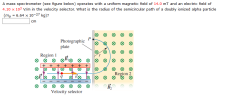 A mass spectrometer (see figure below) operates with a uniform magnetic field of 14.0 mT and an electric field of 4.10x 10³ V/m in the velocity selector. What is the radius of the semicircular path of a doubly ionized alpha particle (ma 6.64 x 10⁻²⁷ kg)? Photographicg plalie Region Region 2 OE в, Velocity selector
home / study / science / physics / physics questions and answers / a velocity selector...
home / study / science / physics / physics questions and answers / a velocity selector consists of electric and magnetic fields described by the expressions e ... Question: A velocity selector consists of electric and magnetic fields described by the expressions E with ... A velocity selector consists of electric and magnetic fields described by the expressions E with arrow = E k and B with arrow = B j, with B = 10.0 mT. Find the value of...
 (a) A velocity selector consists of electric and magnetic fields described by the expressions E = Ek and B-BJ, with B = 16.0 mT. Find the value of E (in kV/m) such that a 830 ev electron moving in the negative x-direction is undeflected kV/m (b) What If? For the value of E found in part (a), what would the kinetic energy of a proton have to be (in MeV) for it to move undeflected in the negative x-direction? Mev
 In the Bainbridge mass spectrometer (Figure 1) , the
magnetic-field magnitude in the velocity selector is
0.510 T , and ions having a speed of 1.82×10⁶m/s pass through
undeflected.
A) What is the electric-field magnitude in the velocity
selector?
b) If the separation of the plates
is 5.20mm, what is the potential difference between the plates?
Figure 1of 1 ㄧㄨㄨㄨ
In the Bainbridge mass spectrometer (Figure 1) , the
magnetic-field magnitude in the velocity selector is
0.510 T , and ions having a speed of 1.82×10⁶m/s pass through
undeflected.
A) What is the electric-field magnitude in the velocity
selector?
b) If the separation of the plates
is 5.20mm, what is the potential difference between the plates?
Figure 1of 1 ㄧㄨㄨㄨ
 A mass spectrometer (see figure below) operates with a uniform magnetic field of 14.0 mT and an electric field of 4.10x 10³ V/m in the velocity selector. What is the radius of the semicircular path of a doubly ionized alpha particle (ma 6.64 x 10⁻²⁷ kg)? Photographicg plalie Region Region 2 OE в, Velocity selector
Most questions answered within 3 hours.
-
Where is the error in this code sequence?
String s1 = "Hello";
String s2 = "ello";...
asked 10 months ago -
Financial data for Joel de Paris, Inc., for last year
follow:
Joel de Paris, Inc.
Balance...
asked 10 months ago -
Consider this reaction:
Al2(SO4)3 (aq)+ BaCl3
(aq) Al2Cl6 (aq)- +
3BaSO4(s) . What is the...
asked 10 months ago -
Suppose that Savneet is considering increasing her
recent random sample from 20 car rentals to 40...
asked 10 months ago -
Trucks arrive at an unloading terminal at an average rate of 120
per hour.
Trucks arrive...
asked 10 months ago -
Why are methanol and ethanol completely soluble in water while
octanol is not very little soluble....
asked 10 months ago -
A facilities manager at a university reads in a research report
that the mean amount of...
asked 10 months ago -
When the CuSO4 is rehydrated by adding water to the anhydrous
compound, is this an endothermic...
asked 10 months ago -
A ray of sunlight is passing from diamond into crown glass; the
angle of incidence is...
asked 10 months ago -
A block of mass 0.249 kg is placed on top of a light, vertical
spring of...
asked 10 months ago -
how do the kidneys compensate in the presences of acidosis
a) trigger hyperventilate
b) reserve acid...
asked 10 months ago -
Question 501 pts
The rental rate of capital to the firm increases. Which of the
following...
asked 10 months ago