For the reaction that is responsible for the formation of peptide bonds, list the by-product that...
- For the reaction that is responsible for the formation of peptide bonds, list the by-product that results.
Homework Answers

Add Answer to:
For the reaction that is responsible for the formation of
peptide bonds, list the by-product that...
During translation, the formation of peptide bonds between amino acids is catalyzed by... ribosome tRNA GTP...
 During translation, the formation of peptide bonds between amino acids is catalyzed by... ribosome tRNA GTP RNA Polymerase
Circle the mechanism (SN2, SN1, E2, or E1) responsible for the formation of each product in...
 Circle the mechanism (SN2, SN1, E2, or E1) responsible for the formation of each product in this reaction. If the product cannot be formed in the reaction, circle "not a product". (2 pts) ГОН SN2 SN1 E2 E1 S N2 SN1 E2 E1 SN2 SN1 E2 E1 S2 Sn1 E2 E1 not a product not a product not a product not a product
Which of the statements about peptide bonds are true? D A tripeptide contains three amino acid...
 Which of the statements about peptide bonds are true? D A tripeptide contains three amino acid residues. Peptide bonds are ester linkages. Peptide bond formation is a hydrolysis reaction. O Peptides are polymers of amino acids. Peptide bonds form from nucleophilic attack by an a-carboxyl carbon atom on an electron pair of an a-amino nitrogen atom of another amino acid.
1. The ribosome is important for catalyzing the formation of peptide bonds. Which of the following...
1. The ribosome is important for catalyzing the formation of peptide bonds. Which of the following statements is true? (a) The number of rRNA molecules that make up a ribosome greatly exceeds the number of protein molecules found in the ribosome. (b) The large subunit of the ribosome is important for binding to the mRNA. (c) The catalytic site for peptide bond formation is formed primarily from an rRNA. (d) Once the large and small subunits of the ribosome assemble,...
QUESTION 12 What is the function of a peptide bond? A peptide bond is responsible for...
 QUESTION 12 What is the function of a peptide bond? A peptide bond is responsible for the secondary structure of a protein. To join the amino group of one amino acid to the carboxy group of another amino acid, A peptide bond is responsible for the tertiary structure of a protein A peptide bond joins the phosphate group at the 6 carbon of a new nucleotide to the hydroxyl (OH) group of the 3' carbon of a nucleotide already in...
Complete the electron pushing mechanism for the formation of the major product in the following reaction...
 Complete the electron pushing mechanism for the formation of the major product in the following reaction by adding any missing charges, atoms, bonds, non-bonding electrons, and curved arrows. Predict all the products of the reaction.
Complete the electron pushing mechanism for the formation of the major product in the following reaction by adding any missing charges, atoms, bonds, non-bonding electrons, and curved arrows. Predict all the products of the reaction.
Complete the electron pushing mechanism for the formation of the major product in the following reaction by adding any missing charges, atoms, bonds, non-bonding electrons, and curved arrows. Predict all the products of the reaction.
Identify the mechanism (S_N 1, S_N2, E1, or E2) responsible for the formation of the major...
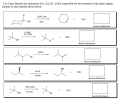 Identify the mechanism (S_N 1, S_N2, E1, or E2) responsible for the formation of the major organic product in each reaction shown below.
3. Which of the following best describes the general reaction type exemplified by peptide bond formation?...
 3. Which of the following best describes the general reaction type exemplified by peptide bond formation? O Electrophilic aromatic substitution O Nucleophilic addition O Proton transfer (Brønsted acid-base reaction) O Nucleophilic acyl substitution O Electrophilic addition
For the reaction in figure 1, label the nucleophile, the electrophile, and the peptide bond. Propose...
 For the reaction in figure 1, label the nucleophile, the
electrophile, and the peptide bond. Propose a mechanism for the
formation of the peptide bond in the above reaction.
For the reaction in figure 1, label the nucleophile, the
electrophile, and the peptide bond. Propose a mechanism for the
formation of the peptide bond in the above reaction.
Complete the electron pushing mechanism for the formation of the major product in the following reaction...
 Complete the electron pushing mechanism for the formation of the major product in the following reaction by adding any missing charges, atoms, bonds, nonbonding electrons, and curved arrows. Predict all the products of the reaction.
 During translation, the formation of peptide bonds between amino acids is catalyzed by... ribosome tRNA GTP RNA Polymerase
 Circle the mechanism (SN2, SN1, E2, or E1) responsible for the formation of each product in this reaction. If the product cannot be formed in the reaction, circle "not a product". (2 pts) ГОН SN2 SN1 E2 E1 S N2 SN1 E2 E1 SN2 SN1 E2 E1 S2 Sn1 E2 E1 not a product not a product not a product not a product
 Which of the statements about peptide bonds are true? D A tripeptide contains three amino acid residues. Peptide bonds are ester linkages. Peptide bond formation is a hydrolysis reaction. O Peptides are polymers of amino acids. Peptide bonds form from nucleophilic attack by an a-carboxyl carbon atom on an electron pair of an a-amino nitrogen atom of another amino acid.
 QUESTION 12 What is the function of a peptide bond? A peptide bond is responsible for the secondary structure of a protein. To join the amino group of one amino acid to the carboxy group of another amino acid, A peptide bond is responsible for the tertiary structure of a protein A peptide bond joins the phosphate group at the 6 carbon of a new nucleotide to the hydroxyl (OH) group of the 3' carbon of a nucleotide already in...
 Complete the electron pushing mechanism for the formation of the major product in the following reaction by adding any missing charges, atoms, bonds, non-bonding electrons, and curved arrows. Predict all the products of the reaction.
Complete the electron pushing mechanism for the formation of the major product in the following reaction by adding any missing charges, atoms, bonds, non-bonding electrons, and curved arrows. Predict all the products of the reaction.
Complete the electron pushing mechanism for the formation of the major product in the following reaction by adding any missing charges, atoms, bonds, non-bonding electrons, and curved arrows. Predict all the products of the reaction.
 Identify the mechanism (S_N 1, S_N2, E1, or E2) responsible for the formation of the major organic product in each reaction shown below.
 3. Which of the following best describes the general reaction type exemplified by peptide bond formation? O Electrophilic aromatic substitution O Nucleophilic addition O Proton transfer (Brønsted acid-base reaction) O Nucleophilic acyl substitution O Electrophilic addition
 For the reaction in figure 1, label the nucleophile, the
electrophile, and the peptide bond. Propose a mechanism for the
formation of the peptide bond in the above reaction.
For the reaction in figure 1, label the nucleophile, the
electrophile, and the peptide bond. Propose a mechanism for the
formation of the peptide bond in the above reaction.
 Complete the electron pushing mechanism for the formation of the major product in the following reaction by adding any missing charges, atoms, bonds, nonbonding electrons, and curved arrows. Predict all the products of the reaction.
Most questions answered within 3 hours.
-
Where is the error in this code sequence?
String s1 = "Hello";
String s2 = "ello";...
asked 10 months ago -
Financial data for Joel de Paris, Inc., for last year
follow:
Joel de Paris, Inc.
Balance...
asked 10 months ago -
Consider this reaction:
Al2(SO4)3 (aq)+ BaCl3
(aq) Al2Cl6 (aq)- +
3BaSO4(s) . What is the...
asked 10 months ago -
Suppose that Savneet is considering increasing her
recent random sample from 20 car rentals to 40...
asked 10 months ago -
Trucks arrive at an unloading terminal at an average rate of 120
per hour.
Trucks arrive...
asked 10 months ago -
Why are methanol and ethanol completely soluble in water while
octanol is not very little soluble....
asked 10 months ago -
A facilities manager at a university reads in a research report
that the mean amount of...
asked 10 months ago -
When the CuSO4 is rehydrated by adding water to the anhydrous
compound, is this an endothermic...
asked 10 months ago -
A ray of sunlight is passing from diamond into crown glass; the
angle of incidence is...
asked 10 months ago -
A block of mass 0.249 kg is placed on top of a light, vertical
spring of...
asked 10 months ago -
how do the kidneys compensate in the presences of acidosis
a) trigger hyperventilate
b) reserve acid...
asked 10 months ago -
Question 501 pts
The rental rate of capital to the firm increases. Which of the
following...
asked 10 months ago