I have a question about nucleophile concentration and the dilution process. Why does 25:75 mix -...
I have a question about nucleophile concentration and the dilution process. Why does 25:75 mix - .25 mL 18% solution of sodium iodide in acetone and .75mL of acetone have a faster reaction rate for 1-bromobutane than 1 mL 18% solution of sodium iodide in acetone ? I would appreciate it
Homework Answers
The reaction proceeds through Sn2 mechanism. The Sn2 reaction is favourable in polar aprotic solvent.
Acetone is a polar aprotic solvent. In 0.25 ml 18% sodium iodide + 0.75 ml of acetone has higher amount of acetone than in 1 ml of 18% NaI in acetone.
Higher amount of acetone dissolves the nucleophile better and hence the reaction is faster for the 1st case.
Add Answer to:
I have a question about nucleophile concentration and the
dilution process. Why does 25:75 mix -...
1. In both the sodium iodide test and the silver nitrate test, why does 2-bromobutane react faster...
 1. In both the sodium iodide
test and the silver nitrate test, why does 2-bromobutane react
faster than 2-chlorobutane?
Bromine is a better leaving group since it is a weaker base than
chlorine is.
2. a. Why does benzyl chloride react under both
SN1 and SN2 conditions?
Benzyl
chloride is a primary alkyl halide, hence reactive under SN2
conditions.
The
primary carbocation formed due to the departure of Cl- is
stabilized by the pi electrons in the benzene ring.
b. Why is...
1. In both the sodium iodide
test and the silver nitrate test, why does 2-bromobutane react
faster than 2-chlorobutane?
Bromine is a better leaving group since it is a weaker base than
chlorine is.
2. a. Why does benzyl chloride react under both
SN1 and SN2 conditions?
Benzyl
chloride is a primary alkyl halide, hence reactive under SN2
conditions.
The
primary carbocation formed due to the departure of Cl- is
stabilized by the pi electrons in the benzene ring.
b. Why is...
What is the SN2 reaction? How does Br attach to which carbon as a nucleophile and...
 What is the SN2 reaction? How does Br attach to which carbon as
a nucleophile and why? Difference between Unimolecular or
Bimolecular? How NaBr and H2SO4 work in the
reaction? Why Water/Sulfuric Acid/Brine/Sodium
Hydroxide/Na2SO4 in Extraction? What does
each layer have inside in each step of the separation?
Please help. Due to corona, this is a theoretical lab and I am
very confused.
Chapter 16. The Sy2 Reaction: 1-Bromobutane Handout by Dr. Zhiyong Wang CH3CH2CH2CH, OH NaBr, H2SO4 ©Dr. Wang...
What is the SN2 reaction? How does Br attach to which carbon as
a nucleophile and why? Difference between Unimolecular or
Bimolecular? How NaBr and H2SO4 work in the
reaction? Why Water/Sulfuric Acid/Brine/Sodium
Hydroxide/Na2SO4 in Extraction? What does
each layer have inside in each step of the separation?
Please help. Due to corona, this is a theoretical lab and I am
very confused.
Chapter 16. The Sy2 Reaction: 1-Bromobutane Handout by Dr. Zhiyong Wang CH3CH2CH2CH, OH NaBr, H2SO4 ©Dr. Wang...
2) Predict the order of reactivity (1=least, 4=most) of primary, secondary, tertiary, and aryl halides toward...
 2) Predict the order of reactivity (1=least, 4=most) of
primary, secondary, tertiary, and aryl halides toward nucleophilic
displacement by an SN1 reaction mechanism. Explain
3) Give a detailed summary of the chemistry in both reactions
SN2 and SN1 in details please for both reactions. include any
general statements about the experiments.
LAB)o Organic Chemistry I Lab CHEM 3512 Nueleophilic Substitution Reactions: Sl vs S2 To review Sul, S2, El and E2 reactions and mechanisms and compare and contrast the effect...
2) Predict the order of reactivity (1=least, 4=most) of
primary, secondary, tertiary, and aryl halides toward nucleophilic
displacement by an SN1 reaction mechanism. Explain
3) Give a detailed summary of the chemistry in both reactions
SN2 and SN1 in details please for both reactions. include any
general statements about the experiments.
LAB)o Organic Chemistry I Lab CHEM 3512 Nueleophilic Substitution Reactions: Sl vs S2 To review Sul, S2, El and E2 reactions and mechanisms and compare and contrast the effect...
Please give detailed answers to the pre and post lab questions. Thank you! NUCLEOPHILIC DISPLACEMENT- FORMATION...
 Please give detailed answers to the pre and post lab questions.
Thank you!
NUCLEOPHILIC DISPLACEMENT- FORMATION OF AN ETHER BY AN SN2 REACTION Bond formation by use of an SN2 reaction is very important for organic and biological synthesis. Many new bonds formed make use of this versatile reaction pathway. In this reaction, one partner is the nucleophile and the other partner is the electrophile. The electrophile will have a leaving group that will be lost in the reaction. In...
Please give detailed answers to the pre and post lab questions.
Thank you!
NUCLEOPHILIC DISPLACEMENT- FORMATION OF AN ETHER BY AN SN2 REACTION Bond formation by use of an SN2 reaction is very important for organic and biological synthesis. Many new bonds formed make use of this versatile reaction pathway. In this reaction, one partner is the nucleophile and the other partner is the electrophile. The electrophile will have a leaving group that will be lost in the reaction. In...
saponification of coconut oil with NaOH 1. What is the nucleophile in this reaction? hydroxide??? 2. Why doesn’t sodium...
 saponification of coconut oil with NaOH
1. What is the nucleophile in this reaction?
hydroxide???
2. Why doesn’t sodium acetate act as soap?
Sodium acetate cannot be used as soap because there is no
non-polar hydrocarbon side component long enough to bind nonpolar
dirt fats or oils. Without this organic component it cannot be used
as soap.???
3. Detergents contain compounds that have a sulfonate group
instead of a carboxylate. Why do detergents work better than soaps
at all pH...
saponification of coconut oil with NaOH
1. What is the nucleophile in this reaction?
hydroxide???
2. Why doesn’t sodium acetate act as soap?
Sodium acetate cannot be used as soap because there is no
non-polar hydrocarbon side component long enough to bind nonpolar
dirt fats or oils. Without this organic component it cannot be used
as soap.???
3. Detergents contain compounds that have a sulfonate group
instead of a carboxylate. Why do detergents work better than soaps
at all pH...
18 15 16 17 7- What is the concentration of DNA whereby a 1:100 dilution has...
 18 15 16 17 7- What is the concentration of DNA whereby a 1:100 dilution has an observance reading of 0.015 at 260 nm? a. 6 ug mL b. 60 ug/mL c. 75 ug/mL d. 750 ug/mL 8- When measuring the concentration of RNA by spectrophotometry at 260 nm, the absorbance reading is multiplied by the dilution and a conversion factor of a. 20 6.30 c. 40 d. 50 9-DNA is isolated from a clinical sample. The absorbance at 260...
I need help with question #1 and 2 under Post Lab based on the Data Table...
 I need help with question #1 and 2 under Post Lab
based on the Data Table 1. I appreciate the help.
4. Complete Data Table 1. The neutralization reaction between HP and NaOH : 1o Espon por Adobe PDF KHC,H,O (aq) + NaOH(aq) + KNBCH40 (aq) + H301) Data Table 1. Standardization of NaOH solution Trial 1 Trial 2 Trial Volume of 0.500 M KHP, ml 41.552mL 41.276m 39.169 mL Buret reading before titration, mi. 2.00 2.00 ML 2.00ml Buret...
I need help with question #1 and 2 under Post Lab
based on the Data Table 1. I appreciate the help.
4. Complete Data Table 1. The neutralization reaction between HP and NaOH : 1o Espon por Adobe PDF KHC,H,O (aq) + NaOH(aq) + KNBCH40 (aq) + H301) Data Table 1. Standardization of NaOH solution Trial 1 Trial 2 Trial Volume of 0.500 M KHP, ml 41.552mL 41.276m 39.169 mL Buret reading before titration, mi. 2.00 2.00 ML 2.00ml Buret...
See What's Hot Imported from New and had Hex Imported from Concentration of S2O32- in each...
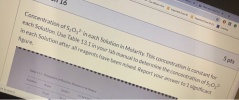 See What's Hot Imported from New and had Hex Imported from Concentration of S2O32- in each Solution in Molarity. This concentration is constant for each Solution. Use Table 13.1 in your lab manual to determine the concentration of S2032- in each Solution after all reagents have been mixed. Report your answer to 1 significant figure. Loading 5 pts Table 13.1. Preparation of Reaction Mastures to be studied Solutions me to search 1 Hofer 75 ml 3M Solution Water Buffer 0.3...
I need to: DETERMINE THE CONCENTRATION OF HYDROGEN PEROXIDE IN THE SOLUTION how ?? THEORY Titrimetry,...
I need to: DETERMINE THE CONCENTRATION OF HYDROGEN PEROXIDE IN THE SOLUTION how ?? THEORY Titrimetry, or titrimetric analysis, is an example of a so-called classical method of analysis. Titrimetry is a convenient method of getting very small amounts of chemicals in to a reaction because the method involves the use of dilute solutions of reactants. Hydrogen peroxide reacts with potassium iodide according to the reaction given below: HB2BOB2B + 2HP+P + 2IP-P = IB2B + 2HB2BO (equation...
 1. In both the sodium iodide
test and the silver nitrate test, why does 2-bromobutane react
faster than 2-chlorobutane?
Bromine is a better leaving group since it is a weaker base than
chlorine is.
2. a. Why does benzyl chloride react under both
SN1 and SN2 conditions?
Benzyl
chloride is a primary alkyl halide, hence reactive under SN2
conditions.
The
primary carbocation formed due to the departure of Cl- is
stabilized by the pi electrons in the benzene ring.
b. Why is...
1. In both the sodium iodide
test and the silver nitrate test, why does 2-bromobutane react
faster than 2-chlorobutane?
Bromine is a better leaving group since it is a weaker base than
chlorine is.
2. a. Why does benzyl chloride react under both
SN1 and SN2 conditions?
Benzyl
chloride is a primary alkyl halide, hence reactive under SN2
conditions.
The
primary carbocation formed due to the departure of Cl- is
stabilized by the pi electrons in the benzene ring.
b. Why is...
 What is the SN2 reaction? How does Br attach to which carbon as
a nucleophile and why? Difference between Unimolecular or
Bimolecular? How NaBr and H2SO4 work in the
reaction? Why Water/Sulfuric Acid/Brine/Sodium
Hydroxide/Na2SO4 in Extraction? What does
each layer have inside in each step of the separation?
Please help. Due to corona, this is a theoretical lab and I am
very confused.
Chapter 16. The Sy2 Reaction: 1-Bromobutane Handout by Dr. Zhiyong Wang CH3CH2CH2CH, OH NaBr, H2SO4 ©Dr. Wang...
What is the SN2 reaction? How does Br attach to which carbon as
a nucleophile and why? Difference between Unimolecular or
Bimolecular? How NaBr and H2SO4 work in the
reaction? Why Water/Sulfuric Acid/Brine/Sodium
Hydroxide/Na2SO4 in Extraction? What does
each layer have inside in each step of the separation?
Please help. Due to corona, this is a theoretical lab and I am
very confused.
Chapter 16. The Sy2 Reaction: 1-Bromobutane Handout by Dr. Zhiyong Wang CH3CH2CH2CH, OH NaBr, H2SO4 ©Dr. Wang...
 2) Predict the order of reactivity (1=least, 4=most) of
primary, secondary, tertiary, and aryl halides toward nucleophilic
displacement by an SN1 reaction mechanism. Explain
3) Give a detailed summary of the chemistry in both reactions
SN2 and SN1 in details please for both reactions. include any
general statements about the experiments.
LAB)o Organic Chemistry I Lab CHEM 3512 Nueleophilic Substitution Reactions: Sl vs S2 To review Sul, S2, El and E2 reactions and mechanisms and compare and contrast the effect...
2) Predict the order of reactivity (1=least, 4=most) of
primary, secondary, tertiary, and aryl halides toward nucleophilic
displacement by an SN1 reaction mechanism. Explain
3) Give a detailed summary of the chemistry in both reactions
SN2 and SN1 in details please for both reactions. include any
general statements about the experiments.
LAB)o Organic Chemistry I Lab CHEM 3512 Nueleophilic Substitution Reactions: Sl vs S2 To review Sul, S2, El and E2 reactions and mechanisms and compare and contrast the effect...
 Please give detailed answers to the pre and post lab questions.
Thank you!
NUCLEOPHILIC DISPLACEMENT- FORMATION OF AN ETHER BY AN SN2 REACTION Bond formation by use of an SN2 reaction is very important for organic and biological synthesis. Many new bonds formed make use of this versatile reaction pathway. In this reaction, one partner is the nucleophile and the other partner is the electrophile. The electrophile will have a leaving group that will be lost in the reaction. In...
Please give detailed answers to the pre and post lab questions.
Thank you!
NUCLEOPHILIC DISPLACEMENT- FORMATION OF AN ETHER BY AN SN2 REACTION Bond formation by use of an SN2 reaction is very important for organic and biological synthesis. Many new bonds formed make use of this versatile reaction pathway. In this reaction, one partner is the nucleophile and the other partner is the electrophile. The electrophile will have a leaving group that will be lost in the reaction. In...
 saponification of coconut oil with NaOH
1. What is the nucleophile in this reaction?
hydroxide???
2. Why doesn’t sodium acetate act as soap?
Sodium acetate cannot be used as soap because there is no
non-polar hydrocarbon side component long enough to bind nonpolar
dirt fats or oils. Without this organic component it cannot be used
as soap.???
3. Detergents contain compounds that have a sulfonate group
instead of a carboxylate. Why do detergents work better than soaps
at all pH...
saponification of coconut oil with NaOH
1. What is the nucleophile in this reaction?
hydroxide???
2. Why doesn’t sodium acetate act as soap?
Sodium acetate cannot be used as soap because there is no
non-polar hydrocarbon side component long enough to bind nonpolar
dirt fats or oils. Without this organic component it cannot be used
as soap.???
3. Detergents contain compounds that have a sulfonate group
instead of a carboxylate. Why do detergents work better than soaps
at all pH...
 18 15 16 17 7- What is the concentration of DNA whereby a 1:100 dilution has an observance reading of 0.015 at 260 nm? a. 6 ug mL b. 60 ug/mL c. 75 ug/mL d. 750 ug/mL 8- When measuring the concentration of RNA by spectrophotometry at 260 nm, the absorbance reading is multiplied by the dilution and a conversion factor of a. 20 6.30 c. 40 d. 50 9-DNA is isolated from a clinical sample. The absorbance at 260...
 I need help with question #1 and 2 under Post Lab
based on the Data Table 1. I appreciate the help.
4. Complete Data Table 1. The neutralization reaction between HP and NaOH : 1o Espon por Adobe PDF KHC,H,O (aq) + NaOH(aq) + KNBCH40 (aq) + H301) Data Table 1. Standardization of NaOH solution Trial 1 Trial 2 Trial Volume of 0.500 M KHP, ml 41.552mL 41.276m 39.169 mL Buret reading before titration, mi. 2.00 2.00 ML 2.00ml Buret...
I need help with question #1 and 2 under Post Lab
based on the Data Table 1. I appreciate the help.
4. Complete Data Table 1. The neutralization reaction between HP and NaOH : 1o Espon por Adobe PDF KHC,H,O (aq) + NaOH(aq) + KNBCH40 (aq) + H301) Data Table 1. Standardization of NaOH solution Trial 1 Trial 2 Trial Volume of 0.500 M KHP, ml 41.552mL 41.276m 39.169 mL Buret reading before titration, mi. 2.00 2.00 ML 2.00ml Buret...
 See What's Hot Imported from New and had Hex Imported from Concentration of S2O32- in each Solution in Molarity. This concentration is constant for each Solution. Use Table 13.1 in your lab manual to determine the concentration of S2032- in each Solution after all reagents have been mixed. Report your answer to 1 significant figure. Loading 5 pts Table 13.1. Preparation of Reaction Mastures to be studied Solutions me to search 1 Hofer 75 ml 3M Solution Water Buffer 0.3...
Most questions answered within 3 hours.
-
Where is the error in this code sequence?
String s1 = "Hello";
String s2 = "ello";...
asked 10 months ago -
Financial data for Joel de Paris, Inc., for last year
follow:
Joel de Paris, Inc.
Balance...
asked 10 months ago -
Consider this reaction:
Al2(SO4)3 (aq)+ BaCl3
(aq) Al2Cl6 (aq)- +
3BaSO4(s) . What is the...
asked 10 months ago -
Suppose that Savneet is considering increasing her
recent random sample from 20 car rentals to 40...
asked 10 months ago -
Trucks arrive at an unloading terminal at an average rate of 120
per hour.
Trucks arrive...
asked 10 months ago -
Why are methanol and ethanol completely soluble in water while
octanol is not very little soluble....
asked 10 months ago -
A facilities manager at a university reads in a research report
that the mean amount of...
asked 10 months ago -
When the CuSO4 is rehydrated by adding water to the anhydrous
compound, is this an endothermic...
asked 10 months ago -
A ray of sunlight is passing from diamond into crown glass; the
angle of incidence is...
asked 10 months ago -
A block of mass 0.249 kg is placed on top of a light, vertical
spring of...
asked 10 months ago -
how do the kidneys compensate in the presences of acidosis
a) trigger hyperventilate
b) reserve acid...
asked 10 months ago -
Question 501 pts
The rental rate of capital to the firm increases. Which of the
following...
asked 10 months ago