Why humid substance affect solubility of non-polar toxic organic compound?
Why humid substance affect solubility of non-polar toxic organic compound?
Homework Answers
Non polar compounds share equal number of electron by the atoms. These are repelled by water and do not dissolve in water, such as oil grease etc which are hydrophobic.
Hydrophobic compounds includes hydrocarbons; except it has an attached ionized functional group such as carboxylic acid (COOH), then the molecule is hydrophilic, the cells are 70-90% water, the degree to which organic molecules interact with water affects their function. Thats the reason humidity affects solubility of non polar toxic organic compound.
Add Answer to:
Why humid substance affect solubility of non-polar toxic organic
compound?
State the solubility properties of lipids and lipoproteins in polar (water and plasma) and non polar...
State the solubility properties of lipids and lipoproteins in polar (water and plasma) and non polar (organic chemicals) solvents.
1. The most polar non-aromatic organic compound ever prepared is an isomer of 1,2,3,4,5,6- hexafluorocyclohexane. It...
1. The most polar non-aromatic organic compound ever prepared is an isomer of 1,2,3,4,5,6- hexafluorocyclohexane. It has an all-cis arrangement of fluorine atoms. a. Draw the line-bond structure for this compound b. Convert the line bond structure to a chair conformation, then draw its flipped chair. c. Is there a preferred conformation? Why or why not? d. Why is this molecule so polar? Use dipole moment arrows to explain.
Part A: Solubility of Organic Compounds in Polar and Nonpolar Solvents Data Table A1: Solubility of...
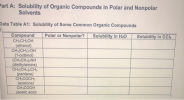 Part A: Solubility of Organic Compounds in Polar and Nonpolar Solvents Data Table A1: Solubility of Some Common Organic Compounds Polar or Nonpolar? Solubility in H20 Solubility in CCIA Compound CH3CH2OH (ethanol) CH3(CH2), OH (1-octanol) (CH3CH2)2NH (diethylamine) CH(CH2),CH (pentane) CH3COCH (acetone) CH3COOH (acetic acid)
An organic compound is largely non-polar and is thus quite soluble in pentane (b.p. 36 C)....
An organic compound is largely non-polar and is thus quite soluble in pentane (b.p. 36 C). Why would pentane be a poor choice for thermal cycling recrystallization? Suggest a different solvent in which the recrystallization would proceed better.
Explain why the most polar compound layer stays in the organic layer, while the less polar...
Explain why the most polar compound layer stays in the organic layer, while the less polar compounds go into the aqueous phase. (This is for a liquid-liquid extraction) The most polar compund is caffeine and the solvent is ethyl acetate. I know it has to do with the caffeine not being able to deprotonate but I’m still confused and would like more information on why is can’t deprotonate.
a) An Organic compound is largely non-polar and thus quite soluble in pentane (b.p. 36 degrees...
a) An Organic compound is largely non-polar and thus quite soluble in pentane (b.p. 36 degrees C). Why would pentane be a poor choice for thermal cycling recrystallization? Suggest a different solvent in which the recrystallization would proceed better? b) What effect on the melting point would be observed if a very high BP solvent (like methylnaphthalene) was used in a recrystallization and traces of it were left unevaporated in the purified material?
in what ways does temperature affect the definiton of a climate as humid or arid. Why?
in what ways does temperature affect the definiton of a climate as humid or arid. Why?
For each of the following substances: Predict if the substance is non-polar or polar; justify your...
 For each of the following substances: Predict if the substance is non-polar or polar; justify your choice. For each of the three possible types of intermolecular forces between two molecules of the same substance, state if that type of force is present or absent in the substance; justify each choice. C_4H_8O (CH_3)_2SO HCON (CH_3)_2
Please help with 2 and 3 1. What factors affect the rate of elution in organic...
 Please help with 2 and 3
1. What factors affect the rate of elution in organic compounds? 2. Explain what is the relationship between polarities of compounds (polar/non- polar compound) and rate of elution (Rf). 3. Explain what is the relationship between solvent polarity (polar/non-polar solvent) and rate of elution (Rf)
Please help with 2 and 3
1. What factors affect the rate of elution in organic compounds? 2. Explain what is the relationship between polarities of compounds (polar/non- polar compound) and rate of elution (Rf). 3. Explain what is the relationship between solvent polarity (polar/non-polar solvent) and rate of elution (Rf)
The column chromatography procedure for the separation of a polar and a non- polar compound calls...
The column chromatography procedure for the separation of a polar and a non- polar compound calls for sequential elution with the following solvents: hexane, 70:30 hexane : acetone, acetone and 80:20 acetone : methanol. Why it is important to follow this solvent order?
 Part A: Solubility of Organic Compounds in Polar and Nonpolar Solvents Data Table A1: Solubility of Some Common Organic Compounds Polar or Nonpolar? Solubility in H20 Solubility in CCIA Compound CH3CH2OH (ethanol) CH3(CH2), OH (1-octanol) (CH3CH2)2NH (diethylamine) CH(CH2),CH (pentane) CH3COCH (acetone) CH3COOH (acetic acid)
 For each of the following substances: Predict if the substance is non-polar or polar; justify your choice. For each of the three possible types of intermolecular forces between two molecules of the same substance, state if that type of force is present or absent in the substance; justify each choice. C_4H_8O (CH_3)_2SO HCON (CH_3)_2
 Please help with 2 and 3
1. What factors affect the rate of elution in organic compounds? 2. Explain what is the relationship between polarities of compounds (polar/non- polar compound) and rate of elution (Rf). 3. Explain what is the relationship between solvent polarity (polar/non-polar solvent) and rate of elution (Rf)
Please help with 2 and 3
1. What factors affect the rate of elution in organic compounds? 2. Explain what is the relationship between polarities of compounds (polar/non- polar compound) and rate of elution (Rf). 3. Explain what is the relationship between solvent polarity (polar/non-polar solvent) and rate of elution (Rf)
Most questions answered within 3 hours.
-
Where is the error in this code sequence?
String s1 = "Hello";
String s2 = "ello";...
asked 10 months ago -
Financial data for Joel de Paris, Inc., for last year
follow:
Joel de Paris, Inc.
Balance...
asked 10 months ago -
Consider this reaction:
Al2(SO4)3 (aq)+ BaCl3
(aq) Al2Cl6 (aq)- +
3BaSO4(s) . What is the...
asked 10 months ago -
Suppose that Savneet is considering increasing her
recent random sample from 20 car rentals to 40...
asked 10 months ago -
Trucks arrive at an unloading terminal at an average rate of 120
per hour.
Trucks arrive...
asked 10 months ago -
Why are methanol and ethanol completely soluble in water while
octanol is not very little soluble....
asked 10 months ago -
A facilities manager at a university reads in a research report
that the mean amount of...
asked 10 months ago -
When the CuSO4 is rehydrated by adding water to the anhydrous
compound, is this an endothermic...
asked 10 months ago -
A ray of sunlight is passing from diamond into crown glass; the
angle of incidence is...
asked 10 months ago -
A block of mass 0.249 kg is placed on top of a light, vertical
spring of...
asked 10 months ago -
how do the kidneys compensate in the presences of acidosis
a) trigger hyperventilate
b) reserve acid...
asked 10 months ago -
Question 501 pts
The rental rate of capital to the firm increases. Which of the
following...
asked 10 months ago