State the solubility properties of lipids and lipoproteins in polar (water and plasma) and non polar...
State the solubility properties of lipids and lipoproteins in polar (water and plasma) and non polar (organic chemicals) solvents.
Homework Answers
Lipids are molecules containing hydrocarbons.
Examples
fats, oils, waxes, some vitamins etc.
Since they are non-polar, they will be soluble in non-polar solvents. And they won't be soluble in polar solvents.
Rule is like dissoves like.
Polar solvents dissoves polar molecule and non-polar solvents dissoves non-polar molecules.
Lipoprotein are aggregates of different molecules. They have hydrophilic groups of phospholipids direct outwards of the aggregation sphere and all non-polar larts are inside this sphere. Since surface of the sphere is hydrophilic- polar, it will be soluble in polar solvents and insoluble in non-polar solvents.
Add Answer to:
State the solubility properties of lipids and lipoproteins in
polar (water and plasma) and non polar...
A characteristic of certain complex lipids that diminishes their solubility in non-polar solvents is: O Glycerol....
 A characteristic of certain complex lipids that diminishes their solubility in non-polar solvents is: O Glycerol. O Phosphates. O All of these enhance solubility in non-polar solvents. O Ester groups. O Long hydrocarbon chains.
Julle molecule. This means it will be high Soluble in non-polar organic solvents. Water is highly...
 Julle molecule. This means it will be high Soluble in non-polar organic solvents. Water is highly polar molecule while CH₂Cl2 is comparatively less polar. T olol because 3. Speculate on the reason why many household hydrocarbons are saturated compounds.
Lipids are transported in the blood as complexes with proteins. These water-soluble complexes are called lipoproteins....
 Lipids are transported in the blood as complexes with proteins. These water-soluble complexes are called lipoproteins. Complete the sentences below by selecting the lipoprotein that transports each lipid.
Part A: Solubility of Organic Compounds in Polar and Nonpolar Solvents Data Table A1: Solubility of...
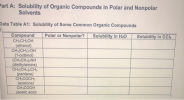 Part A: Solubility of Organic Compounds in Polar and Nonpolar Solvents Data Table A1: Solubility of Some Common Organic Compounds Polar or Nonpolar? Solubility in H20 Solubility in CCIA Compound CH3CH2OH (ethanol) CH3(CH2), OH (1-octanol) (CH3CH2)2NH (diethylamine) CH(CH2),CH (pentane) CH3COCH (acetone) CH3COOH (acetic acid)
Why humid substance affect solubility of non-polar toxic organic compound?
Why humid substance affect solubility of non-polar toxic organic compound?
Indicate which of the following lipids are polar and which are non-polar? 1. Ergosterol 2. Phosphatidylethanolamine...
Indicate which of the following lipids are polar and which are non-polar? 1. Ergosterol 2. Phosphatidylethanolamine 3. Arachidonic acid 4. Coenzyme Q8 5. Rhamnolipid
What non-polar solvent can we use to extract Persistent Organic Pollutants/ non-polar polychlorinated chemicals from edibles...
What non-polar solvent can we use to extract Persistent Organic Pollutants/ non-polar polychlorinated chemicals from edibles (such as seaweed)
A. PHYSICAL PROPERTIES Solubility, Odor, Volatility and Physical Properties Compound Formula Molar Mass Physical State MP/BP...
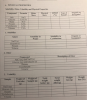 A. PHYSICAL PROPERTIES Solubility, Odor, Volatility and Physical Properties Compound Formula Molar Mass Physical State MP/BP (°C) Type of Bonds? Organic or Inorganic? Salt Glucose Water Hexane Cyclohexane Toluene NaCl C.H206 HO C6H14 C6H12 CH 1. Solubility Solute Solubility in Water Solubility in Cyclohexane Organic or Inorganic? NaCl (s) Glucose (s) Hexane Toluene 2. Odor Description of Odor Compound NaCl (aq) and NaCl (8) Glucose (aq) and Glucose (S) Hexane Cyclohexane Toluene 3. Volatility Sample Weight of Weight of Test...
SOLUTIONS 22. Non-polar compounds are soluble in ionic compounds b) electrolytes c) polar solvents d) non-polar...
 SOLUTIONS 22. Non-polar compounds are soluble in ionic compounds b) electrolytes c) polar solvents d) non-polar solvents 23. Which of the following would increase the solubility of gaseous O2 in water? (there is more than correct answer, mark them all!) Decreasing the temperature of the solution Increasing the temperature of the solution Decreasing the pressure of the solution Increasing the pressure of the solution 24. Which of the following describes an unsaturated solution? A solution that has less than the...
Determine the solubility of lipids in the following solvents as "insoluble" or "soluble"; "miscible" or "immiscible":...
Determine the solubility of lipids in the following solvents as "insoluble" or "soluble"; "miscible" or "immiscible": 1) Corn oil in water: 2) Corn oil in alcohol: 3) Corn oil in CH2Cl2: 4) Lard in water: 5) Lard in alcohol: 6) Lard in CH2Cl2: 7) Wax in water: 8) Wax in alcohol: 9) Wax in CH2Cl2:
 A characteristic of certain complex lipids that diminishes their solubility in non-polar solvents is: O Glycerol. O Phosphates. O All of these enhance solubility in non-polar solvents. O Ester groups. O Long hydrocarbon chains.
 Julle molecule. This means it will be high Soluble in non-polar organic solvents. Water is highly polar molecule while CH₂Cl2 is comparatively less polar. T olol because 3. Speculate on the reason why many household hydrocarbons are saturated compounds.
 Lipids are transported in the blood as complexes with proteins. These water-soluble complexes are called lipoproteins. Complete the sentences below by selecting the lipoprotein that transports each lipid.
 Part A: Solubility of Organic Compounds in Polar and Nonpolar Solvents Data Table A1: Solubility of Some Common Organic Compounds Polar or Nonpolar? Solubility in H20 Solubility in CCIA Compound CH3CH2OH (ethanol) CH3(CH2), OH (1-octanol) (CH3CH2)2NH (diethylamine) CH(CH2),CH (pentane) CH3COCH (acetone) CH3COOH (acetic acid)
 A. PHYSICAL PROPERTIES Solubility, Odor, Volatility and Physical Properties Compound Formula Molar Mass Physical State MP/BP (°C) Type of Bonds? Organic or Inorganic? Salt Glucose Water Hexane Cyclohexane Toluene NaCl C.H206 HO C6H14 C6H12 CH 1. Solubility Solute Solubility in Water Solubility in Cyclohexane Organic or Inorganic? NaCl (s) Glucose (s) Hexane Toluene 2. Odor Description of Odor Compound NaCl (aq) and NaCl (8) Glucose (aq) and Glucose (S) Hexane Cyclohexane Toluene 3. Volatility Sample Weight of Weight of Test...
 SOLUTIONS 22. Non-polar compounds are soluble in ionic compounds b) electrolytes c) polar solvents d) non-polar solvents 23. Which of the following would increase the solubility of gaseous O2 in water? (there is more than correct answer, mark them all!) Decreasing the temperature of the solution Increasing the temperature of the solution Decreasing the pressure of the solution Increasing the pressure of the solution 24. Which of the following describes an unsaturated solution? A solution that has less than the...
Most questions answered within 3 hours.
-
Where is the error in this code sequence?
String s1 = "Hello";
String s2 = "ello";...
asked 10 months ago -
Financial data for Joel de Paris, Inc., for last year
follow:
Joel de Paris, Inc.
Balance...
asked 10 months ago -
Consider this reaction:
Al2(SO4)3 (aq)+ BaCl3
(aq) Al2Cl6 (aq)- +
3BaSO4(s) . What is the...
asked 10 months ago -
Suppose that Savneet is considering increasing her
recent random sample from 20 car rentals to 40...
asked 10 months ago -
Trucks arrive at an unloading terminal at an average rate of 120
per hour.
Trucks arrive...
asked 10 months ago -
Why are methanol and ethanol completely soluble in water while
octanol is not very little soluble....
asked 10 months ago -
A facilities manager at a university reads in a research report
that the mean amount of...
asked 10 months ago -
When the CuSO4 is rehydrated by adding water to the anhydrous
compound, is this an endothermic...
asked 10 months ago -
A ray of sunlight is passing from diamond into crown glass; the
angle of incidence is...
asked 10 months ago -
A block of mass 0.249 kg is placed on top of a light, vertical
spring of...
asked 10 months ago -
how do the kidneys compensate in the presences of acidosis
a) trigger hyperventilate
b) reserve acid...
asked 10 months ago -
Question 501 pts
The rental rate of capital to the firm increases. Which of the
following...
asked 10 months ago