When solutions containing Fe3+(aq) ions and SCN−(aq) ions are mixed together, the following equilibrium is established:...
When solutions containing Fe3+(aq) ions and SCN−(aq) ions are mixed together, the following equilibrium is established: Fe3+(aq)+SCN−(aq)⇌FeSCN2+(aq) At equilibrium at some temperature, in 3.0 liters of total solution, there are 0.653 moles of FeSCN2+(aq), 0.0385 moles of Fe3+(aq) and 0.0465 moles of SCN−(aq) . What is K?
Homework Answers

Add Answer to:
When solutions containing Fe3+(aq) ions and SCN−(aq) ions are
mixed together, the following equilibrium is established:...
1) Consider the following equilibrium: Fe3+(aq) + SCN-(aq) ⇌ FeSCN2+(aq) Initial concentrations: [Fe3+] = 0.590; [SCN-]...
1) Consider the following equilibrium: Fe3+(aq) + SCN-(aq) ⇌ FeSCN2+(aq) Initial concentrations: [Fe3+] = 0.590; [SCN-] = 1.239; [FeSCN2+] = 0 The equilibrium concentration of [FeSCN2+]eq = 0.454 M. What is the numerical value of KC for this equilibrium? KC = __________________ 2) Consider the following equilibrium: Fe3+(aq) + SCN-(aq) ⇌ FeSCN2+(aq) Initial concentrations: [Fe3+] = 0.370; [SCN-] = 0.777; [FeSCN2+] = 0 The equilibrium concentration of [FeSCN2+]eq = 0.285 M. What is the equilibrium concentration of Fe3+? [Fe3+]eq =...
Equilibria can be treated mathematically with the equilibrium constant, K. For the reaction Fe3+ + SCN...
 Equilibria can be treated mathematically with the equilibrium
constant, K. For the reaction Fe3+ + SCN − equilibrium reaction
arrow FeSCN2+, the equilibrium constant expression is [FeSCN2+ ] K
= [Fe3+ ] · [SCN − ] where, for example, [Fe3+ ] is the molar
concentration (mol Fe3+ / L solution) present in an equilibrium
mixture. At some temperature, a chemist found the following
equilibrium concentrations. [Fe3+ ] = 8.17 ✕ 10−3 M, [SCN − ] =
8.60 ✕ 10−3 M,...
Equilibria can be treated mathematically with the equilibrium
constant, K. For the reaction Fe3+ + SCN − equilibrium reaction
arrow FeSCN2+, the equilibrium constant expression is [FeSCN2+ ] K
= [Fe3+ ] · [SCN − ] where, for example, [Fe3+ ] is the molar
concentration (mol Fe3+ / L solution) present in an equilibrium
mixture. At some temperature, a chemist found the following
equilibrium concentrations. [Fe3+ ] = 8.17 ✕ 10−3 M, [SCN − ] =
8.60 ✕ 10−3 M,...
Consider the following reaction: Fe3+(aq)+SCN−(aq)⇌FeSCN2+(aq) A solution is made containing an initial [Fe3+] of 1.2×10⁻³ M...
Consider the following reaction: Fe3+(aq)+SCN−(aq)⇌FeSCN2+(aq) A solution is made containing an initial [Fe3+] of 1.2×10⁻³ M and an initial [SCN−] of 8.2×10⁻⁴ M . At equilibrium, [FeSCN2+]= 1.8×10⁻⁴ M . Calculate the value of the equilibrium constant (Kc)(Kc). Express your answer using two significant figures.
Calculate the equilibrium constant for the reaction Fe3+ (aq0 + SCN (aq)→ FeSCN2+ (aq) given that...
 Calculate the equilibrium constant for the reaction Fe3+ (aq0 + SCN (aq)→ FeSCN2+ (aq) given that the mixture of 5 ml of.00359 M SCN- and 5 ML of .00200 M Fe3+ solutions yield 1.68 x 10A- 4 M FeSCN2+ at a given temperature. a.) 23 . B.) 93 d. 8.06 x 10A-3 c.) 124
Consider the reaction represented by the equation: Fe3+ (aq) + SCN- (aq) FeSCN2+ (aq) What is...
Consider the reaction represented by the equation: Fe3+ (aq) + SCN- (aq) FeSCN2+ (aq) What is the equilibrium concentration of FeSCN2+ (aq) if a solution is prepared that is initially 6.00 M Fe3+ (aq) and 6.00 M SCN− (aq)? if k was determined to be 0.333
2. The reaction Fe3+ (aq) + SCN (aq) → FeSCN2+ (aq) produces a dark red color...
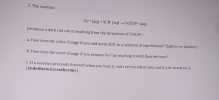 2. The reaction Fe3+ (aq) + SCN (aq) → FeSCN2+ (aq) produces a dark red color resulting from the formation of FeSCN2+. a. How does the color change if you add more SCN to a solution at equilibrium? (lighter or darker) b. How does the color change if you remove Fe3+ by reacting it with fluoride ions? c. If a reaction proceeds forward when you heat it, and reverse when you cool it, the reaction is [endothermic exothermic).
* PLEASE WRITE OUT ANSWER STEP BY STEP! CONSIDER THE FOLLOWING REACTION: Fe3+(aq)+SCN−(aq)⇌FeSCN2+(aq) A solution is...
* PLEASE WRITE OUT ANSWER STEP BY STEP! CONSIDER THE FOLLOWING REACTION: Fe3+(aq)+SCN−(aq)⇌FeSCN2+(aq) A solution is made containing an initial [Fe3+] of 1.2×10⁻³ M and an initial [SCN−] of 8.2×10⁻⁴ M. At equilibrium, [FeSCN2+] = 1.6×10⁻⁴ M . PART A: Calculate the value of the equilibrium constant (Kc): [Express your answer using two significant figures] KC = _____________________________
A 25.0 mL volume of 0.0200 M Fe(NO3)3 is mixed with 50.0 mL of 0.00200 M...
A 25.0 mL volume of 0.0200 M Fe(NO3)3 is mixed with 50.0 mL of 0.00200 M NaSCN and 25.0 mL of 0.100 HNO3. The blood-red FeSCN2+ ion forms and the equilibrium is established: Fe3+(aq) + SCN-(aq) <---> FeSCN2+(aq) The equilibrium concentration of FeSCN2+ ([FeSCN2+]) was measured spectrophotometrically and found to be 7.0 x 10⁻⁴ mol/L. To calculate the equilibrium constant (Kc) for thr equilibrium system, proceed through the following steps: A. Moles of Fe3+, initial B. Moles of SCN-, initial...
After the preparation of a solution with solutions containing Fe3+ and SCN- respectively, the final solution...
After the preparation of a solution with solutions containing Fe3+ and SCN- respectively, the final solution has a concentration of Fe(NCS)2+ 5.0x10⁻⁴ M, 1.0x10⁻³ M Fe3+ and 5.0x10⁻³ M SCN-. Calculate Kc for the following reaction. Fe3+ (aq) + SCN- (aq) ↔ Fe(NCS)2+ (aq) a. 80 b. 100 c. 0.01 d. 0.001
Fe (aq)SCN-(aq) FeSCN (aq) thiocyanate iron(II) thiocyanoiron(il) Introduction When the reactants shown above, are combined, chemical...
 Fe (aq)SCN-(aq) FeSCN (aq) thiocyanate iron(II) thiocyanoiron(il) Introduction When the reactants shown above, are combined, chemical equilibrium is reached rapidly. Once equilibrium is established, the equilibrium constant can be calculated if the concentration of all the ions are known: [FeSCNP.he [SCN-... and (Feng Your task is to prepare three different equilibrium systems that contain different concentrations of these ions. Keep in mind that although the concentrations will be different, the value of the equilibrium constant Ke will be indeed constant...
 Equilibria can be treated mathematically with the equilibrium
constant, K. For the reaction Fe3+ + SCN − equilibrium reaction
arrow FeSCN2+, the equilibrium constant expression is [FeSCN2+ ] K
= [Fe3+ ] · [SCN − ] where, for example, [Fe3+ ] is the molar
concentration (mol Fe3+ / L solution) present in an equilibrium
mixture. At some temperature, a chemist found the following
equilibrium concentrations. [Fe3+ ] = 8.17 ✕ 10−3 M, [SCN − ] =
8.60 ✕ 10−3 M,...
Equilibria can be treated mathematically with the equilibrium
constant, K. For the reaction Fe3+ + SCN − equilibrium reaction
arrow FeSCN2+, the equilibrium constant expression is [FeSCN2+ ] K
= [Fe3+ ] · [SCN − ] where, for example, [Fe3+ ] is the molar
concentration (mol Fe3+ / L solution) present in an equilibrium
mixture. At some temperature, a chemist found the following
equilibrium concentrations. [Fe3+ ] = 8.17 ✕ 10−3 M, [SCN − ] =
8.60 ✕ 10−3 M,...
 Calculate the equilibrium constant for the reaction Fe3+ (aq0 + SCN (aq)→ FeSCN2+ (aq) given that the mixture of 5 ml of.00359 M SCN- and 5 ML of .00200 M Fe3+ solutions yield 1.68 x 10A- 4 M FeSCN2+ at a given temperature. a.) 23 . B.) 93 d. 8.06 x 10A-3 c.) 124
 2. The reaction Fe3+ (aq) + SCN (aq) → FeSCN2+ (aq) produces a dark red color resulting from the formation of FeSCN2+. a. How does the color change if you add more SCN to a solution at equilibrium? (lighter or darker) b. How does the color change if you remove Fe3+ by reacting it with fluoride ions? c. If a reaction proceeds forward when you heat it, and reverse when you cool it, the reaction is [endothermic exothermic).
 Fe (aq)SCN-(aq) FeSCN (aq) thiocyanate iron(II) thiocyanoiron(il) Introduction When the reactants shown above, are combined, chemical equilibrium is reached rapidly. Once equilibrium is established, the equilibrium constant can be calculated if the concentration of all the ions are known: [FeSCNP.he [SCN-... and (Feng Your task is to prepare three different equilibrium systems that contain different concentrations of these ions. Keep in mind that although the concentrations will be different, the value of the equilibrium constant Ke will be indeed constant...
Most questions answered within 3 hours.
-
Where is the error in this code sequence?
String s1 = "Hello";
String s2 = "ello";...
asked 10 months ago -
Financial data for Joel de Paris, Inc., for last year
follow:
Joel de Paris, Inc.
Balance...
asked 10 months ago -
Consider this reaction:
Al2(SO4)3 (aq)+ BaCl3
(aq) Al2Cl6 (aq)- +
3BaSO4(s) . What is the...
asked 10 months ago -
Suppose that Savneet is considering increasing her
recent random sample from 20 car rentals to 40...
asked 10 months ago -
Trucks arrive at an unloading terminal at an average rate of 120
per hour.
Trucks arrive...
asked 10 months ago -
Why are methanol and ethanol completely soluble in water while
octanol is not very little soluble....
asked 10 months ago -
A facilities manager at a university reads in a research report
that the mean amount of...
asked 10 months ago -
When the CuSO4 is rehydrated by adding water to the anhydrous
compound, is this an endothermic...
asked 10 months ago -
A ray of sunlight is passing from diamond into crown glass; the
angle of incidence is...
asked 10 months ago -
A block of mass 0.249 kg is placed on top of a light, vertical
spring of...
asked 10 months ago -
how do the kidneys compensate in the presences of acidosis
a) trigger hyperventilate
b) reserve acid...
asked 10 months ago -
Question 501 pts
The rental rate of capital to the firm increases. Which of the
following...
asked 10 months ago