
Homework Answers
Initial Concentration of Fe3+ and SCN- are to be provided for the calculation of equilibrium concentration.
ICE tables will help you determine these values. Initial
amounts, changes in amounts, and final equilibrium amounts are
shown. These values must be in moles/L.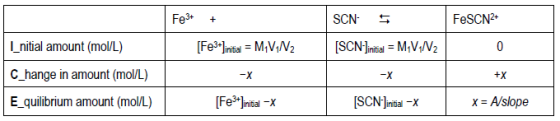
-
initial amounts of reactants (amounts before the reaction begins): determined using the dilution equation
-
To find the initial concentration of SCN–, use the dilution equation: (M1V1)/V2 = M2, where
V2 = 10 mL.
-
To find the initial concentration of Fe3+, use the dilution equation: (M1V1)/V2 = M2, where V2 = 10 mL.
-
-
initial amount of product (the amount before the reaction begins): zero
-
equilibrium concentration of product ([FeSCN2+]eq): determined spectroscopically
[FeSCN2+] at equilibrium is determined using Beer's Law; x is the amount of FeSCN2+ created (determined experimentally).
Add Answer to:
Fe (aq)SCN-(aq) FeSCN (aq) thiocyanate iron(II) thiocyanoiron(il) Introduction When the reactants shown above, are combined, chemical...
Fe3(aq) FESCN (aq) SCN (aq) In this experiment, we'll be examining the temperature-dependence of the rate constant...
 Fe3(aq) FESCN (aq) SCN (aq) In this experiment, we'll be examining the temperature-dependence of the rate constant for the reaction above. 1. Using the UV-Vis instrument, you measured a room temperature absorbance for FESCN2 at 477 nm of 0.815. What is its concentration in molarity (M)? Please show all work. The molar absorptivity for FeSCN2 is 4,258 м"сm1 a. Answer: b. You calculated the [FeSCN2] above from the observed room temperature absorbance. Which one of the following statements about the...
FesCN (aq), and LeChâtelier's Explain in terms of the equation, Fe" (aq) + SCN (aq) Principle...
 FesCN (aq), and LeChâtelier's Explain in terms of the equation, Fe" (aq) + SCN (aq) Principle (4 ) Observation after adding KSCN: turned darker more red like original solution brown Explain in terms of the equation, Fe (aq) + SCN (aq) + FeSCN- (aq), and LeChâtelier's Principle. (ps.) Observation after adding AgNO3: Turned milky white + thieverf less transparent Using the ions present in the solution, write a net ionic equation that would explain the precipitate observed Use the above...
3. In this experiment, you will determine the [FeSCNP at equilibrium by measuring its absorbance at...
 3. In this experiment, you will determine the [FeSCNP at equilibrium by measuring its absorbance at - 450 nm. This is possible due to which of the following statements? Fe+ (aq) + SCN (aq) FeSCN2+ (aq) a. Fe and SCN do not absorb significantly at 450 nm. b. At equilibrium, only FeSCN* is present in the solution. c. [Fe] and [SCN) are too small to absorb light. d. The equilibrium constant, Keq, is small. 4. Give the names for the...
Beers law solve for E3 and E4 showing work Part II. Equilibrium Constant Calculations Calculate the...
 Beers law solve for E3 and E4 showing work
Part II. Equilibrium Constant Calculations
Calculate the initial moles of Fe3+ and SCN- for solutions E2
through E6 and record these values in the table on your Data Sheet.
You obtain the moles of the reactants by multiplying their molarity
by the volume (in L) of their solution used.
Determine the equilibrium concentration of FeSCN2+ for each of
the solutions E2-E6 from your Beer’s Law plot. Using these
equilibrium concentrations, the...
Beers law solve for E3 and E4 showing work
Part II. Equilibrium Constant Calculations
Calculate the initial moles of Fe3+ and SCN- for solutions E2
through E6 and record these values in the table on your Data Sheet.
You obtain the moles of the reactants by multiplying their molarity
by the volume (in L) of their solution used.
Determine the equilibrium concentration of FeSCN2+ for each of
the solutions E2-E6 from your Beer’s Law plot. Using these
equilibrium concentrations, the...
STANDARD ENTHALPY AND ENTROPY CHANGES OF A REACTION INTRODUCTION (1) Part 3, Mes Consider the following...
 STANDARD ENTHALPY AND ENTROPY CHANGES OF A REACTION INTRODUCTION (1) Part 3, Mes Consider the following equilibrium system sscc Fe(a)SCNag) FeSCNP(o) The equilibrium constant, K of this system is (2) resCN KTeSCN Finding K for this system using a colouurimeter and absorhance values has already been described in the "Determination of an Equilibrium Constant" experiment. A similar method is used in this experiment, but the temperature is varied so give values of the equilibrium constant at different temperatures. From the...
the guiding questions. the max absorbance is 460. Guiding questions complex turque . Compare the molar...
 the
guiding questions. the max absorbance is 460.
Guiding questions complex turque . Compare the molar absorptivity coefficients you obtained with SCN and Fe" as limiting reagents. Would you expect them to be the same? Why or why not? (Week 1) • The accepted molar absorptivity coefficient for FeSCN is 7.0x10' M'cm''. Find the bias and relative bias of your values and suggest possible sources of errors. (Week 1) • Which molar absorptivity coefficient will you use to calculate the...
the
guiding questions. the max absorbance is 460.
Guiding questions complex turque . Compare the molar absorptivity coefficients you obtained with SCN and Fe" as limiting reagents. Would you expect them to be the same? Why or why not? (Week 1) • The accepted molar absorptivity coefficient for FeSCN is 7.0x10' M'cm''. Find the bias and relative bias of your values and suggest possible sources of errors. (Week 1) • Which molar absorptivity coefficient will you use to calculate the...
3. Iron(II) nitrate and hydrocyanic acid react to form the hexacyanoferrate(II) ion, [Fe(CN).]*(aq), with a formation...
 3. Iron(II) nitrate and hydrocyanic acid react to form the hexacyanoferrate(II) ion, [Fe(CN).]*(aq), with a formation constant of 1.438x10's. This complex ion has an intense blue color in solution. a. If you add 182.734g of iron(II) nitrate solid to 750.0mL of 0.8324M CN'(aq) solution, what is the concentration of CN'(aq) still in solution when the reaction reaches equilibrium? b. Copper(II) also forms a complex ion with cyanide ions, tetracyanocuprate(II)ion, [Cu(CN).] (aq), with a formation constant of 1.028x10”. This complex ion...
can you please help me with this Data and Calculations Trial 0:29 Absorbance 0.378 Je 0.086...
 can you please help me with this
Data and Calculations Trial 0:29 Absorbance 0.378 Je 0.086 Trial 2 0.47 Trial 3 0.632 Trial 4 0.729 0.686 Absorbance of standard Triw. 329 0.6 6 Temperature ke [Fe(SCN) 2+]/([Fe3+] [SCN-]) Ferrag) + SCN Cag) 2 FescN2t (ag) Absorbance of standard (Trial) Temperature 0.3 Ke expression: [Fe] 0.0010 [SCN) 10.00040 [FeSCN? Jeg [Fe [SCN ] Ke value Average of Ke values Percent error (see pg 7): (Discuss this result as part of your...
can you please help me with this
Data and Calculations Trial 0:29 Absorbance 0.378 Je 0.086 Trial 2 0.47 Trial 3 0.632 Trial 4 0.729 0.686 Absorbance of standard Triw. 329 0.6 6 Temperature ke [Fe(SCN) 2+]/([Fe3+] [SCN-]) Ferrag) + SCN Cag) 2 FescN2t (ag) Absorbance of standard (Trial) Temperature 0.3 Ke expression: [Fe] 0.0010 [SCN) 10.00040 [FeSCN? Jeg [Fe [SCN ] Ke value Average of Ke values Percent error (see pg 7): (Discuss this result as part of your...
Iron(II) nitrate and hydrocyanic acid react to form the hexacyanoferrate(II) ion, [Fe(CN)6] -4 (aq), with a...
Iron(II) nitrate and hydrocyanic acid react to form the hexacyanoferrate(II) ion, [Fe(CN)6] -4 (aq), with a formation constant of 1.438x1035 . This complex ion has an intense blue color in solution . a. If you add 182.734g of iron(II) nitrate solid to 750.0mL of 0.8324M CN-1 (aq) solution, what is the concentration of CN-1 (aq) still in solution when the reaction reaches equilibrium? b. Copper(II) also forms a complex ion with cyanide ions, tetracyanocuprate(II) ion, [Cu(CN)4] -2 (aq), with a...
Iron(II) nitrate and hydrocyanic acid react to form the hexacyanoferrate(II) ion, [Fe(CN)6] -4 (aq), with a...
Iron(II) nitrate and hydrocyanic acid react to form the hexacyanoferrate(II) ion, [Fe(CN)6] -4 (aq), with a formation constant of 1.438x1035 . This complex ion has an intense blue color in solution . a. If you add 182.734g of iron(II) nitrate solid to 750.0mL of 0.8324M CN-1 (aq) solution, what is the concentration of CN-1 (aq) still in solution when the reaction reaches equilibrium? b. Copper(II) also forms a complex ion with cyanide ions, tetracyanocuprate(II) ion, [Cu(CN)4] -2 (aq), with a...
 Fe3(aq) FESCN (aq) SCN (aq) In this experiment, we'll be examining the temperature-dependence of the rate constant for the reaction above. 1. Using the UV-Vis instrument, you measured a room temperature absorbance for FESCN2 at 477 nm of 0.815. What is its concentration in molarity (M)? Please show all work. The molar absorptivity for FeSCN2 is 4,258 м"сm1 a. Answer: b. You calculated the [FeSCN2] above from the observed room temperature absorbance. Which one of the following statements about the...
 FesCN (aq), and LeChâtelier's Explain in terms of the equation, Fe" (aq) + SCN (aq) Principle (4 ) Observation after adding KSCN: turned darker more red like original solution brown Explain in terms of the equation, Fe (aq) + SCN (aq) + FeSCN- (aq), and LeChâtelier's Principle. (ps.) Observation after adding AgNO3: Turned milky white + thieverf less transparent Using the ions present in the solution, write a net ionic equation that would explain the precipitate observed Use the above...
 3. In this experiment, you will determine the [FeSCNP at equilibrium by measuring its absorbance at - 450 nm. This is possible due to which of the following statements? Fe+ (aq) + SCN (aq) FeSCN2+ (aq) a. Fe and SCN do not absorb significantly at 450 nm. b. At equilibrium, only FeSCN* is present in the solution. c. [Fe] and [SCN) are too small to absorb light. d. The equilibrium constant, Keq, is small. 4. Give the names for the...
 Beers law solve for E3 and E4 showing work
Part II. Equilibrium Constant Calculations
Calculate the initial moles of Fe3+ and SCN- for solutions E2
through E6 and record these values in the table on your Data Sheet.
You obtain the moles of the reactants by multiplying their molarity
by the volume (in L) of their solution used.
Determine the equilibrium concentration of FeSCN2+ for each of
the solutions E2-E6 from your Beer’s Law plot. Using these
equilibrium concentrations, the...
Beers law solve for E3 and E4 showing work
Part II. Equilibrium Constant Calculations
Calculate the initial moles of Fe3+ and SCN- for solutions E2
through E6 and record these values in the table on your Data Sheet.
You obtain the moles of the reactants by multiplying their molarity
by the volume (in L) of their solution used.
Determine the equilibrium concentration of FeSCN2+ for each of
the solutions E2-E6 from your Beer’s Law plot. Using these
equilibrium concentrations, the...
 STANDARD ENTHALPY AND ENTROPY CHANGES OF A REACTION INTRODUCTION (1) Part 3, Mes Consider the following equilibrium system sscc Fe(a)SCNag) FeSCNP(o) The equilibrium constant, K of this system is (2) resCN KTeSCN Finding K for this system using a colouurimeter and absorhance values has already been described in the "Determination of an Equilibrium Constant" experiment. A similar method is used in this experiment, but the temperature is varied so give values of the equilibrium constant at different temperatures. From the...
 the
guiding questions. the max absorbance is 460.
Guiding questions complex turque . Compare the molar absorptivity coefficients you obtained with SCN and Fe" as limiting reagents. Would you expect them to be the same? Why or why not? (Week 1) • The accepted molar absorptivity coefficient for FeSCN is 7.0x10' M'cm''. Find the bias and relative bias of your values and suggest possible sources of errors. (Week 1) • Which molar absorptivity coefficient will you use to calculate the...
the
guiding questions. the max absorbance is 460.
Guiding questions complex turque . Compare the molar absorptivity coefficients you obtained with SCN and Fe" as limiting reagents. Would you expect them to be the same? Why or why not? (Week 1) • The accepted molar absorptivity coefficient for FeSCN is 7.0x10' M'cm''. Find the bias and relative bias of your values and suggest possible sources of errors. (Week 1) • Which molar absorptivity coefficient will you use to calculate the...
 3. Iron(II) nitrate and hydrocyanic acid react to form the hexacyanoferrate(II) ion, [Fe(CN).]*(aq), with a formation constant of 1.438x10's. This complex ion has an intense blue color in solution. a. If you add 182.734g of iron(II) nitrate solid to 750.0mL of 0.8324M CN'(aq) solution, what is the concentration of CN'(aq) still in solution when the reaction reaches equilibrium? b. Copper(II) also forms a complex ion with cyanide ions, tetracyanocuprate(II)ion, [Cu(CN).] (aq), with a formation constant of 1.028x10”. This complex ion...
 can you please help me with this
Data and Calculations Trial 0:29 Absorbance 0.378 Je 0.086 Trial 2 0.47 Trial 3 0.632 Trial 4 0.729 0.686 Absorbance of standard Triw. 329 0.6 6 Temperature ke [Fe(SCN) 2+]/([Fe3+] [SCN-]) Ferrag) + SCN Cag) 2 FescN2t (ag) Absorbance of standard (Trial) Temperature 0.3 Ke expression: [Fe] 0.0010 [SCN) 10.00040 [FeSCN? Jeg [Fe [SCN ] Ke value Average of Ke values Percent error (see pg 7): (Discuss this result as part of your...
can you please help me with this
Data and Calculations Trial 0:29 Absorbance 0.378 Je 0.086 Trial 2 0.47 Trial 3 0.632 Trial 4 0.729 0.686 Absorbance of standard Triw. 329 0.6 6 Temperature ke [Fe(SCN) 2+]/([Fe3+] [SCN-]) Ferrag) + SCN Cag) 2 FescN2t (ag) Absorbance of standard (Trial) Temperature 0.3 Ke expression: [Fe] 0.0010 [SCN) 10.00040 [FeSCN? Jeg [Fe [SCN ] Ke value Average of Ke values Percent error (see pg 7): (Discuss this result as part of your...
Most questions answered within 3 hours.
-
Where is the error in this code sequence?
String s1 = "Hello";
String s2 = "ello";...
asked 11 months ago -
Financial data for Joel de Paris, Inc., for last year
follow:
Joel de Paris, Inc.
Balance...
asked 11 months ago -
Consider this reaction:
Al2(SO4)3 (aq)+ BaCl3
(aq) Al2Cl6 (aq)- +
3BaSO4(s) . What is the...
asked 11 months ago -
Suppose that Savneet is considering increasing her
recent random sample from 20 car rentals to 40...
asked 11 months ago -
Trucks arrive at an unloading terminal at an average rate of 120
per hour.
Trucks arrive...
asked 11 months ago -
Why are methanol and ethanol completely soluble in water while
octanol is not very little soluble....
asked 11 months ago -
A facilities manager at a university reads in a research report
that the mean amount of...
asked 11 months ago -
When the CuSO4 is rehydrated by adding water to the anhydrous
compound, is this an endothermic...
asked 11 months ago -
A ray of sunlight is passing from diamond into crown glass; the
angle of incidence is...
asked 11 months ago -
A block of mass 0.249 kg is placed on top of a light, vertical
spring of...
asked 11 months ago -
how do the kidneys compensate in the presences of acidosis
a) trigger hyperventilate
b) reserve acid...
asked 11 months ago -
Question 501 pts
The rental rate of capital to the firm increases. Which of the
following...
asked 11 months ago