An Atwood machine can be used to measure the acceleration of gravity. On planet X, mass...
An Atwood machine can be used to measure the acceleration of gravity. On planet X, mass 1 is 15 grams and mass 2 is 10 grams. After taking readings the astronaut measures the acceleration of the moving masses to be 2.4 m/s2 Calculate the acceleration of gravity of planet X.
Homework Answers
Concept: we apply Newton’s law of motion to to form equations of motion and solve them to find the acceleration due to gravity on the planet
 ***************************************************************************************************
Check the answer and let me know immediately if you
find something wrong or missing... I will rectify the mistakes asap
if any
Add Answer to:
An Atwood
machine can be used to measure the acceleration of gravity. On
planet X, mass...
An astronaut on a distant planet wants to determine its acceleration due to gravity
 An astronaut on a distant planet wants to determine its acceleration due to gravity. The astronaut throws a rock straight up with a velocity of +15 m/s and measures a time of 20.0 s before the rock returns to his hand. What is the acceleration (magnitude and direction) due to gravity on this planet? See Diagram below: Show your work below:
Very confused on how to solve 013 10.0 points An Atwood machine is constructed using two...
 Very confused on how to solve
013 10.0 points An Atwood machine is constructed using two wheels (with the masses concentrated at the rims). The left wheel has a mass of 2.4 kg and radius 20.32 cm. The right wheel has a mass of 2.6 kg and radius 26.4 cm. The hanging mass on the left is 1.74 kg and on the right 1.53 kg. m. 4 What is the acceleration of the system? The acceleration of gravity is 9.8...
Very confused on how to solve
013 10.0 points An Atwood machine is constructed using two wheels (with the masses concentrated at the rims). The left wheel has a mass of 2.4 kg and radius 20.32 cm. The right wheel has a mass of 2.6 kg and radius 26.4 cm. The hanging mass on the left is 1.74 kg and on the right 1.53 kg. m. 4 What is the acceleration of the system? The acceleration of gravity is 9.8...
What is the magnitude of the acceleration of a modified Atwood machine if the mass of...
What is the magnitude of the acceleration of a modified Atwood machine if the mass of the cart is 3 kg and the hanging mass is 16 kg? (Use g = 9.8 m/s2. Express your answer to one decimal point.)
What is the magnitude of the acceleration of a modified Atwood machine if the mass of...
What is the magnitude of the acceleration of a modified Atwood machine if the mass of the cart is 5 kg and the hanging mass is 7 kg? (Use g = 9.8 m/s2. Express your answer to one decimal point.)
Please help me with this question. Thanks A*36. An Atwood machine (Fig. 6.7) is used to...
 Please help me with this question. Thanks
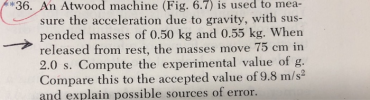
A*36. An Atwood machine (Fig. 6.7) is used to mea- sure the acceleration due to gravity, with sus- pended masses of 0.50 kg and 0.55 kg. When released from rest, the masses move 75 cm in 2.0 s. Compute the experimental value of g. Compare this to the accepted value of 9.8 m/s2 and explain possible sources of error.
Please help me with this question. Thanks
A*36. An Atwood machine (Fig. 6.7) is used to mea- sure the acceleration due to gravity, with sus- pended masses of 0.50 kg and 0.55 kg. When released from rest, the masses move 75 cm in 2.0 s. Compute the experimental value of g. Compare this to the accepted value of 9.8 m/s2 and explain possible sources of error.
The acceleration of gravity on the surface of planet X is 2.85 times the acceleration of...
The acceleration of gravity on the surface of planet X is 2.85 times the acceleration of gravity on the surface of Earth and the radius of planet X is 4.5 times the radius of Earth. What is the mass of planet X? Earth Mass = 5.98x10^24 kg Earth Radius = 6.37x10^6 m please show work!
An Atwood machine is constructed using a hoop with spokes of negligible mass. The 2.3 kg...
 An Atwood machine is constructed using a hoop with spokes of negligible mass. The 2.3 kg mass of the pulley is concentrated on its rim, which is a distance 23.5 cm from the axle. The mass on the right is 1 kg and on the left is 1.65 kg. The acceleration of gravity is 9.8 m/s^2. What is the magnitude of the linear acceleration a of the hanging masses?
The Atwood machine consists of two masses hanging from the ends of a rope that passes...
 The Atwood machine consists of two masses hanging from the ends of a rope that passes over a pulley. The pulley can be approximated by a uniform disk with mass m, = 5.53 kg and radius rp = 0.150 m. The hanging masses are m = 17.1 kg and mp = 12.1 kg. Calculate the magnitude of the masses' acceleration a and the tension in the left and right ends of the rope, T and Tr, respectively. m m/s2 a...
suppose an astronaut has landed on Planet X. Fully equipped, the astronaut has a mass of...
 suppose an astronaut has landed on Planet X. Fully equipped,
the astronaut has a mass of 135 kg and when the astronaut gets on a
scale, the reading is 47 N. what is the acceleration due to gravity
on Planet X.
Suppose an astronaut has landed on Planet X. Fully equipped, the astronaut has a mass of 135 kg and when the astronaut gets on a scale, the reading is 47 N. what is the acceleration due to gravity on...
suppose an astronaut has landed on Planet X. Fully equipped,
the astronaut has a mass of 135 kg and when the astronaut gets on a
scale, the reading is 47 N. what is the acceleration due to gravity
on Planet X.
Suppose an astronaut has landed on Planet X. Fully equipped, the astronaut has a mass of 135 kg and when the astronaut gets on a scale, the reading is 47 N. what is the acceleration due to gravity on...
The Atwood machine consists of two masses hanging from the ends of a rope that passes...
 The Atwood machine consists of two masses hanging from the ends of a rope that passes over a pulley. The pulley can be approximated by a uniform disk with mass m = 5.13 kg and radius rp = 0.350 m. The hanging masses are m. = 19.7 kg and mx = 13.3 kg. Calculate the magnitude of the masses' acceleration a and the tension in the left and right ends of the rope, Ti, and Tr, respectively. mL m/s2 a...
 Very confused on how to solve
013 10.0 points An Atwood machine is constructed using two wheels (with the masses concentrated at the rims). The left wheel has a mass of 2.4 kg and radius 20.32 cm. The right wheel has a mass of 2.6 kg and radius 26.4 cm. The hanging mass on the left is 1.74 kg and on the right 1.53 kg. m. 4 What is the acceleration of the system? The acceleration of gravity is 9.8...
Very confused on how to solve
013 10.0 points An Atwood machine is constructed using two wheels (with the masses concentrated at the rims). The left wheel has a mass of 2.4 kg and radius 20.32 cm. The right wheel has a mass of 2.6 kg and radius 26.4 cm. The hanging mass on the left is 1.74 kg and on the right 1.53 kg. m. 4 What is the acceleration of the system? The acceleration of gravity is 9.8...
 Please help me with this question. Thanks
A*36. An Atwood machine (Fig. 6.7) is used to mea- sure the acceleration due to gravity, with sus- pended masses of 0.50 kg and 0.55 kg. When released from rest, the masses move 75 cm in 2.0 s. Compute the experimental value of g. Compare this to the accepted value of 9.8 m/s2 and explain possible sources of error.
Please help me with this question. Thanks
A*36. An Atwood machine (Fig. 6.7) is used to mea- sure the acceleration due to gravity, with sus- pended masses of 0.50 kg and 0.55 kg. When released from rest, the masses move 75 cm in 2.0 s. Compute the experimental value of g. Compare this to the accepted value of 9.8 m/s2 and explain possible sources of error.
 An Atwood machine is constructed using a hoop with spokes of negligible mass. The 2.3 kg mass of the pulley is concentrated on its rim, which is a distance 23.5 cm from the axle. The mass on the right is 1 kg and on the left is 1.65 kg. The acceleration of gravity is 9.8 m/s^2. What is the magnitude of the linear acceleration a of the hanging masses?
 The Atwood machine consists of two masses hanging from the ends of a rope that passes over a pulley. The pulley can be approximated by a uniform disk with mass m, = 5.53 kg and radius rp = 0.150 m. The hanging masses are m = 17.1 kg and mp = 12.1 kg. Calculate the magnitude of the masses' acceleration a and the tension in the left and right ends of the rope, T and Tr, respectively. m m/s2 a...
 suppose an astronaut has landed on Planet X. Fully equipped,
the astronaut has a mass of 135 kg and when the astronaut gets on a
scale, the reading is 47 N. what is the acceleration due to gravity
on Planet X.
Suppose an astronaut has landed on Planet X. Fully equipped, the astronaut has a mass of 135 kg and when the astronaut gets on a scale, the reading is 47 N. what is the acceleration due to gravity on...
suppose an astronaut has landed on Planet X. Fully equipped,
the astronaut has a mass of 135 kg and when the astronaut gets on a
scale, the reading is 47 N. what is the acceleration due to gravity
on Planet X.
Suppose an astronaut has landed on Planet X. Fully equipped, the astronaut has a mass of 135 kg and when the astronaut gets on a scale, the reading is 47 N. what is the acceleration due to gravity on...
 The Atwood machine consists of two masses hanging from the ends of a rope that passes over a pulley. The pulley can be approximated by a uniform disk with mass m = 5.13 kg and radius rp = 0.350 m. The hanging masses are m. = 19.7 kg and mx = 13.3 kg. Calculate the magnitude of the masses' acceleration a and the tension in the left and right ends of the rope, Ti, and Tr, respectively. mL m/s2 a...
Most questions answered within 3 hours.
-
Where is the error in this code sequence?
String s1 = "Hello";
String s2 = "ello";...
asked 11 months ago -
Financial data for Joel de Paris, Inc., for last year
follow:
Joel de Paris, Inc.
Balance...
asked 11 months ago -
Consider this reaction:
Al2(SO4)3 (aq)+ BaCl3
(aq) Al2Cl6 (aq)- +
3BaSO4(s) . What is the...
asked 11 months ago -
Suppose that Savneet is considering increasing her
recent random sample from 20 car rentals to 40...
asked 11 months ago -
Trucks arrive at an unloading terminal at an average rate of 120
per hour.
Trucks arrive...
asked 11 months ago -
Why are methanol and ethanol completely soluble in water while
octanol is not very little soluble....
asked 11 months ago -
A facilities manager at a university reads in a research report
that the mean amount of...
asked 11 months ago -
When the CuSO4 is rehydrated by adding water to the anhydrous
compound, is this an endothermic...
asked 11 months ago -
A ray of sunlight is passing from diamond into crown glass; the
angle of incidence is...
asked 11 months ago -
A block of mass 0.249 kg is placed on top of a light, vertical
spring of...
asked 11 months ago -
how do the kidneys compensate in the presences of acidosis
a) trigger hyperventilate
b) reserve acid...
asked 11 months ago -
Question 501 pts
The rental rate of capital to the firm increases. Which of the
following...
asked 11 months ago