Two people proposed mechanisms for this reaction. One proposed mechanism for the reaction is: CH3COCH3 +...
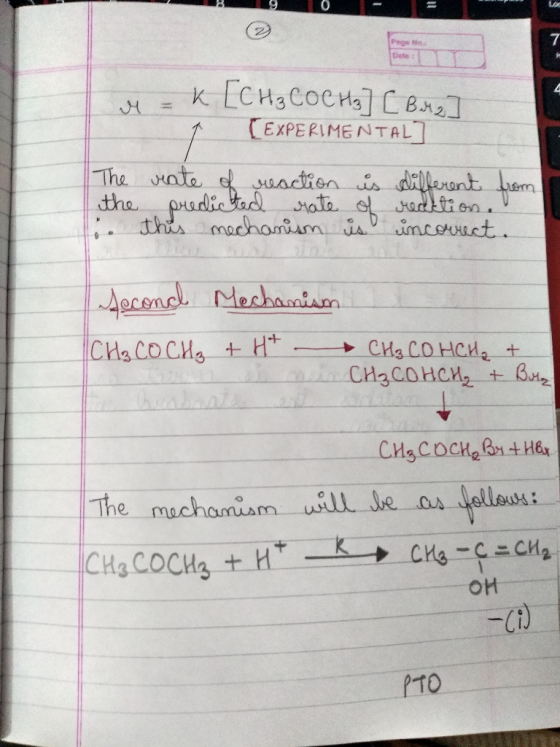
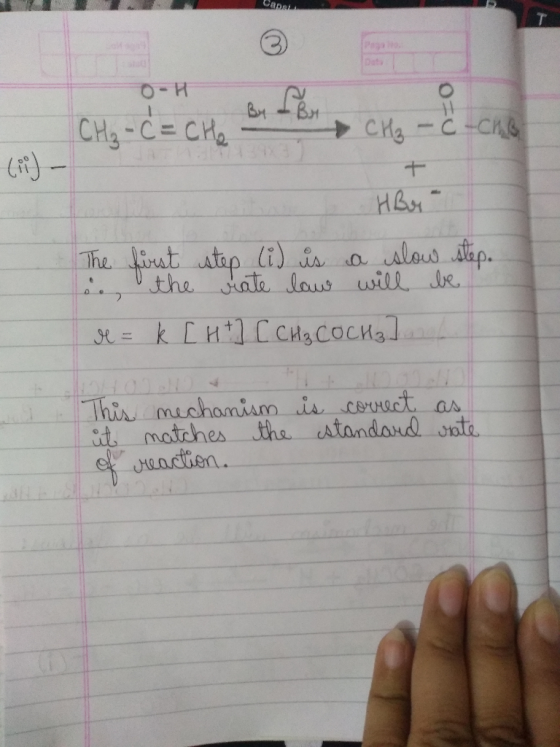
Two people proposed mechanisms for this reaction. One proposed mechanism for the reaction is: CH3COCH3 + Br2 CH3COCH2Br + H+ + Br- The other proposed mechanism for the reaction is: CH3COCH3 + H+ CH3COHCH2+ CH3COHCH2+ + Br2 CH3COCH2Br + HBr Based on the data collected in the above problem, which mechanism is supported as most likely correct? Explain your reasoning. Determine the limiting reagent for the above reaction(52) Determine the rate constant for the first reaction above.(52)
Homework Answers
Hey,
I don't know reaction 52.
so I can't say
But if it follows the reaction of acetone with bromine, then
limiting reagent is bromine.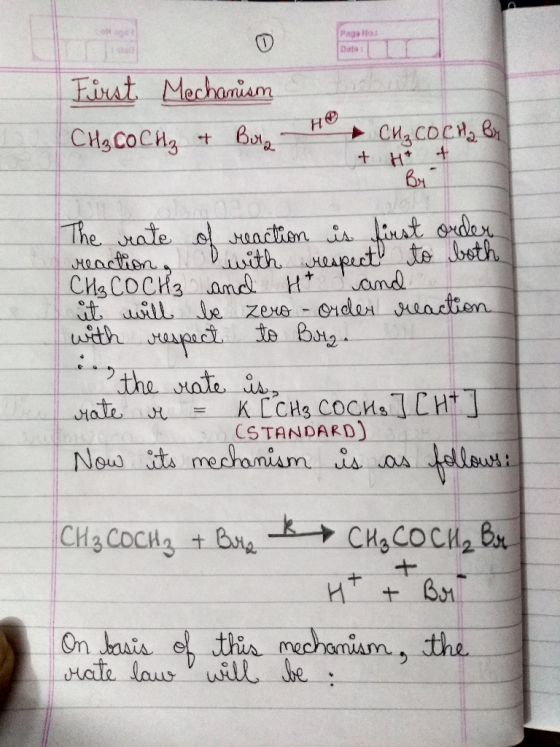
Add Answer to:
Two people proposed mechanisms for this reaction. One proposed
mechanism for the reaction is: CH3COCH3 +...
The bromination of acetone is acid catalyzed: H+ catalyst CH3COCH3 + Br2 = CH3COCH2Br + H+...
The bromination of acetone is acid catalyzed: H+ catalyst CH3COCH3 + Br2 = CH3COCH2Br + H+ + Br– The rates of reaction were determined by measuring the rates of disappearance of bromine using different concentrations of acetone, bromine, and H+ ions, and the following data were obtained at a certain temperature. Rate of disappearance Expt# [CH3COCH3] [Br2] [H+] of Br2 (mol · L–1 · s–1) (M) (M) (M) _ 1 0.30 0.050 0.050 5.9 x 10⁻⁵ 2 0.30 0.10 0.050...
Temperature, Question 7 (13 marks) Acetone is brominated in acidic solution according to the following reaction:...
 Temperature, Question 7 (13 marks) Acetone is brominated in acidic solution according to the following reaction: CH3COCH3(aq) + Br2(aq) - CH3COCH_Br(aq) + H" (aq) + Br" (aq) Student A proposed the following four-step mechanism for the decomposition of Bra: CH3COCH3 + H + CH3C(OH)CH3 ki, ki CH,C(OH)CH3 -CH:C(OH)-CH2 + H+ ka, slow CH;C(OH)=CH2 + Br2 - CH3C(OH)CH2Br* + Br k3 CH:C(OH)CH2Br* - CH3COCH2Br + H+ k4 Deduce the rate law for the above reaction by assuming a pre-equilibrium (7 marks)...
Given the following reaction mixtures and the reaction: CH3COCH3 + Br2 -- > CH3COCH2Br + H+...
Given the following reaction mixtures and the reaction: CH3COCH3 + Br2 -- > CH3COCH2Br + H+ + Br- Reaction Mixture Temperature º C Water (ml) 4 M Acetone 1 M Hydrochloric Acid 0.005 M Br2 1 25 20 10 10 10 2 25 10 20 10 10 3 25 25 10 10 5 4 25 10 10 20 10 The following reaction measurements were made: Reaction Mixture Times (s) 1 116 2 58 3 118 4 232 Calculate the reaction...
The table below shows the initial rate of reaction (by measuring the rate of loss of...
The table below shows the initial rate of reaction (by measuring the rate of loss of Br2) for the following reaction at several different initial concentrations of reactants at 25oC: CH3COCH3 + Br2 H+(above arrow) → CH3COCH2Br + HBr Experiment [CH3COCH3] / M [Br2] /M [H+] /M Rate of loss of Br2 (M/s) 1 0.25 0.050 0.050 6.3 x 10⁻⁵ 2 0.25 0.100 0.050 6.3 x 10⁻⁵ 3 0.25 0.050 0.100 1.3 x 10⁻⁴ 4 0.40 0.050 0.200 4.0 x...
please answer these questions Given the following complex reaction mechanism for the reaction H2(g) + Br2(g)...
 please answer these
questions
Given the following complex reaction mechanism for the reaction H2(g) + Br2(g) → 2 HBr (g): Br2 → 2 Brº (rate constant ka) Br + H2 → HBr +H* (rate constant kb) Hø + Br2 → HBr + Br" (rate constant ke) H + HBr → H2 + Brº (rate constant kd) Br + Brº Br2 (rate constant ke) Which of the following is true? The rate constant for the termination step is ka. The steady-state...
please answer these
questions
Given the following complex reaction mechanism for the reaction H2(g) + Br2(g) → 2 HBr (g): Br2 → 2 Brº (rate constant ka) Br + H2 → HBr +H* (rate constant kb) Hø + Br2 → HBr + Br" (rate constant ke) H + HBr → H2 + Brº (rate constant kd) Br + Brº Br2 (rate constant ke) Which of the following is true? The rate constant for the termination step is ka. The steady-state...
Q3: Determine the rate of formation of HBr considering the mechanism of chain reaction: Initiation: Br2...
 Q3: Determine the rate of formation of HBr considering the mechanism of chain reaction: Initiation: Br2 -R1→2Br Propagation: H-+ Br2-3→ HBr + Br. -K, Br2 Termination: 2Br
PART A) Consider the following three-step mechanism for a reaction: Br2 (g) ⇌ 2 Br (g)...
PART A) Consider the following three-step mechanism for a reaction: Br2 (g) ⇌ 2 Br (g) Fast Br (g) + CHBr3 (g) → HBr (g) + CBr3 (g) Slow Br (g) + CBr3 (g) → CBr4 (g) Fast Based on this mechanism, determine the rate law for the overall reaction. PART B) Consider the overall reaction: AB(g) + CB(g) ⟶ A(g) + CB2(g) A proposed mechanism for this reaction is 2 AB(g) ⇌ AB2(g) + A(g) (fast) AB2(g) + CB(g) ⟶...
Bromination of (E)-Cinnamic Acid OChem Lab: Here are the two proposed mechanisms for the reaction. These are very rough...
 Bromination of (E)-Cinnamic Acid OChem Lab: Here are the two
proposed mechanisms for the reaction. These are very rough sketches
which may have some errors, but they capture the general idea.
Which of the two mechanisms is more plausible for this experiment
and how do you know?
Produrt OH 202-2049 130 Mech dert Mech 2 TO H Br S n OH Padet 93.5-95 Br AN O Padia 202-269°C Br
Produrt OH 202-2049 130 Mech dert Mech 2 TO H Br...
Bromination of (E)-Cinnamic Acid OChem Lab: Here are the two
proposed mechanisms for the reaction. These are very rough sketches
which may have some errors, but they capture the general idea.
Which of the two mechanisms is more plausible for this experiment
and how do you know?
Produrt OH 202-2049 130 Mech dert Mech 2 TO H Br S n OH Padet 93.5-95 Br AN O Padia 202-269°C Br
Produrt OH 202-2049 130 Mech dert Mech 2 TO H Br...
For the following reaction give the detailed mechanism in terms of: electron flow energy diagram, put...
For the following reaction give the detailed mechanism in terms of: electron flow energy diagram, put both propagation step 1 and step 2 on the same diagram CH3--CH3 + Br2 ------> CH3CH2--Br + HBr This is what I have so far, and I think I'm correct. Im having trouble with the energy diagram. Initiation Br--Br ---> 2 Br . (dot symbolizes radical) Propagation (step 1) Br . + H--CH2--CH3 ---><---- Br-H + . CH2--CH3 Propagation (step 2) . CH2--CH3 +...
Please answer each part with work shown. Thank you. 6. The following three mechanisms have been proposed for a particular reaction. Mechanism II Mechanism III Mechanisml H2 +NO-H2O+N (slow) N +...
 Please answer each part with work shown. Thank you.
6. The following three mechanisms have been proposed for a particular reaction. Mechanism II Mechanism III Mechanisml H2 +NO-H2O+N (slow) N +NON2+0 (fast) O+H2-> H2O (fast) 2 NO-N202 (fast equilibrium) H2-N202-H20+ N3O (slow) H2+N20-H2O+N2 (fast) H2 + 2 NO- H2O+N2O (slow) N20+ H2N2+ H2O (fast) a) What is the overall reaction that each proposed mechanism supports? b) Calculate the ΔΗ'm for the overall reaction. c) For each mechanism, draw an energy...
Please answer each part with work shown. Thank you.
6. The following three mechanisms have been proposed for a particular reaction. Mechanism II Mechanism III Mechanisml H2 +NO-H2O+N (slow) N +NON2+0 (fast) O+H2-> H2O (fast) 2 NO-N202 (fast equilibrium) H2-N202-H20+ N3O (slow) H2+N20-H2O+N2 (fast) H2 + 2 NO- H2O+N2O (slow) N20+ H2N2+ H2O (fast) a) What is the overall reaction that each proposed mechanism supports? b) Calculate the ΔΗ'm for the overall reaction. c) For each mechanism, draw an energy...
 Temperature, Question 7 (13 marks) Acetone is brominated in acidic solution according to the following reaction: CH3COCH3(aq) + Br2(aq) - CH3COCH_Br(aq) + H" (aq) + Br" (aq) Student A proposed the following four-step mechanism for the decomposition of Bra: CH3COCH3 + H + CH3C(OH)CH3 ki, ki CH,C(OH)CH3 -CH:C(OH)-CH2 + H+ ka, slow CH;C(OH)=CH2 + Br2 - CH3C(OH)CH2Br* + Br k3 CH:C(OH)CH2Br* - CH3COCH2Br + H+ k4 Deduce the rate law for the above reaction by assuming a pre-equilibrium (7 marks)...
 please answer these
questions
Given the following complex reaction mechanism for the reaction H2(g) + Br2(g) → 2 HBr (g): Br2 → 2 Brº (rate constant ka) Br + H2 → HBr +H* (rate constant kb) Hø + Br2 → HBr + Br" (rate constant ke) H + HBr → H2 + Brº (rate constant kd) Br + Brº Br2 (rate constant ke) Which of the following is true? The rate constant for the termination step is ka. The steady-state...
please answer these
questions
Given the following complex reaction mechanism for the reaction H2(g) + Br2(g) → 2 HBr (g): Br2 → 2 Brº (rate constant ka) Br + H2 → HBr +H* (rate constant kb) Hø + Br2 → HBr + Br" (rate constant ke) H + HBr → H2 + Brº (rate constant kd) Br + Brº Br2 (rate constant ke) Which of the following is true? The rate constant for the termination step is ka. The steady-state...
 Q3: Determine the rate of formation of HBr considering the mechanism of chain reaction: Initiation: Br2 -R1→2Br Propagation: H-+ Br2-3→ HBr + Br. -K, Br2 Termination: 2Br
 Bromination of (E)-Cinnamic Acid OChem Lab: Here are the two
proposed mechanisms for the reaction. These are very rough sketches
which may have some errors, but they capture the general idea.
Which of the two mechanisms is more plausible for this experiment
and how do you know?
Produrt OH 202-2049 130 Mech dert Mech 2 TO H Br S n OH Padet 93.5-95 Br AN O Padia 202-269°C Br
Produrt OH 202-2049 130 Mech dert Mech 2 TO H Br...
Bromination of (E)-Cinnamic Acid OChem Lab: Here are the two
proposed mechanisms for the reaction. These are very rough sketches
which may have some errors, but they capture the general idea.
Which of the two mechanisms is more plausible for this experiment
and how do you know?
Produrt OH 202-2049 130 Mech dert Mech 2 TO H Br S n OH Padet 93.5-95 Br AN O Padia 202-269°C Br
Produrt OH 202-2049 130 Mech dert Mech 2 TO H Br...
 Please answer each part with work shown. Thank you.
6. The following three mechanisms have been proposed for a particular reaction. Mechanism II Mechanism III Mechanisml H2 +NO-H2O+N (slow) N +NON2+0 (fast) O+H2-> H2O (fast) 2 NO-N202 (fast equilibrium) H2-N202-H20+ N3O (slow) H2+N20-H2O+N2 (fast) H2 + 2 NO- H2O+N2O (slow) N20+ H2N2+ H2O (fast) a) What is the overall reaction that each proposed mechanism supports? b) Calculate the ΔΗ'm for the overall reaction. c) For each mechanism, draw an energy...
Please answer each part with work shown. Thank you.
6. The following three mechanisms have been proposed for a particular reaction. Mechanism II Mechanism III Mechanisml H2 +NO-H2O+N (slow) N +NON2+0 (fast) O+H2-> H2O (fast) 2 NO-N202 (fast equilibrium) H2-N202-H20+ N3O (slow) H2+N20-H2O+N2 (fast) H2 + 2 NO- H2O+N2O (slow) N20+ H2N2+ H2O (fast) a) What is the overall reaction that each proposed mechanism supports? b) Calculate the ΔΗ'm for the overall reaction. c) For each mechanism, draw an energy...
Most questions answered within 3 hours.
-
Where is the error in this code sequence?
String s1 = "Hello";
String s2 = "ello";...
asked 10 months ago -
Financial data for Joel de Paris, Inc., for last year
follow:
Joel de Paris, Inc.
Balance...
asked 10 months ago -
Consider this reaction:
Al2(SO4)3 (aq)+ BaCl3
(aq) Al2Cl6 (aq)- +
3BaSO4(s) . What is the...
asked 10 months ago -
Suppose that Savneet is considering increasing her
recent random sample from 20 car rentals to 40...
asked 10 months ago -
Trucks arrive at an unloading terminal at an average rate of 120
per hour.
Trucks arrive...
asked 10 months ago -
Why are methanol and ethanol completely soluble in water while
octanol is not very little soluble....
asked 10 months ago -
A facilities manager at a university reads in a research report
that the mean amount of...
asked 10 months ago -
When the CuSO4 is rehydrated by adding water to the anhydrous
compound, is this an endothermic...
asked 10 months ago -
A ray of sunlight is passing from diamond into crown glass; the
angle of incidence is...
asked 10 months ago -
A block of mass 0.249 kg is placed on top of a light, vertical
spring of...
asked 10 months ago -
how do the kidneys compensate in the presences of acidosis
a) trigger hyperventilate
b) reserve acid...
asked 10 months ago -
Question 501 pts
The rental rate of capital to the firm increases. Which of the
following...
asked 10 months ago