The bromination of acetone is acid catalyzed: H+ catalyst CH3COCH3 + Br2 = CH3COCH2Br + H+...
The bromination of acetone is acid catalyzed:
H+ catalyst
CH3COCH3 + Br2 = CH3COCH2Br + H+ + Br–
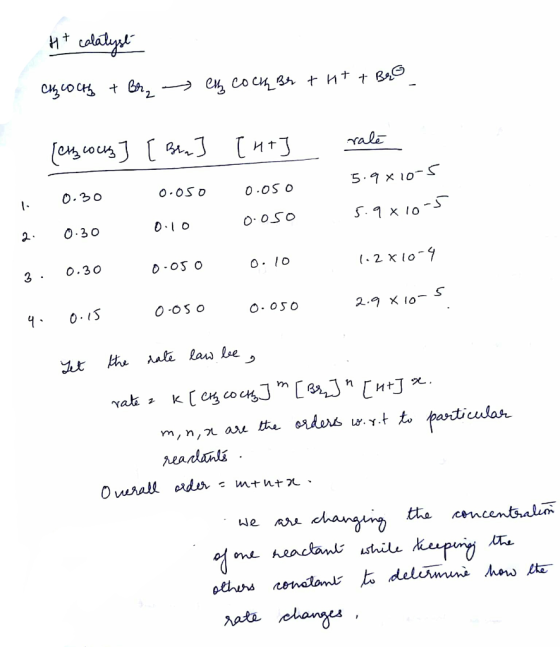
The rates of reaction were determined by measuring the rates of disappearance of bromine using different concentrations of acetone, bromine, and H+ ions, and the following data were obtained at a certain temperature.
Rate of disappearance
Expt# [CH3COCH3] [Br2] [H+] of Br2 (mol · L–1 · s–1)
(M) (M) (M) _
1 0.30 0.050 0.050 5.9 x 10⁻⁵
2 0.30 0.10 0.050 5.9 x 10⁻⁵
3 0.30 0.050 0.10 1.2 x 10⁻⁴
4 0.15 0.050 0.050 2.9 x 10⁻⁵
———————————————————————————
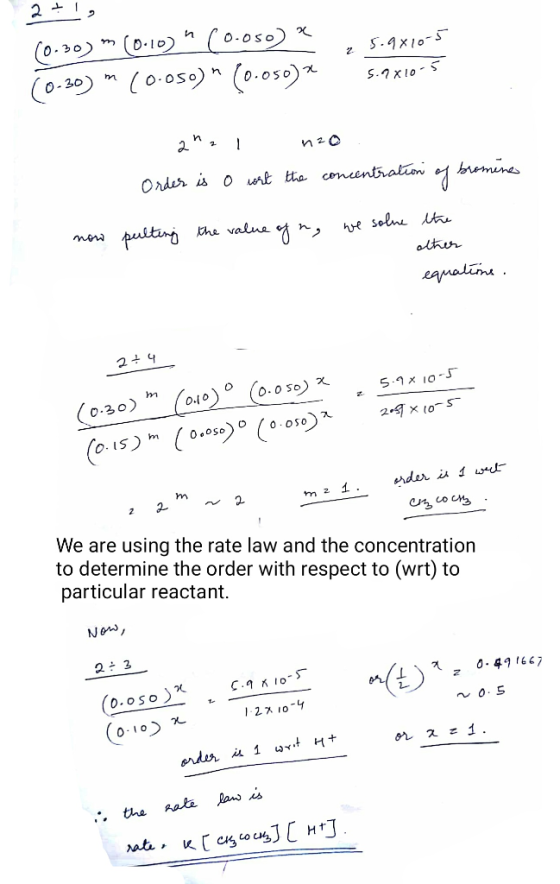
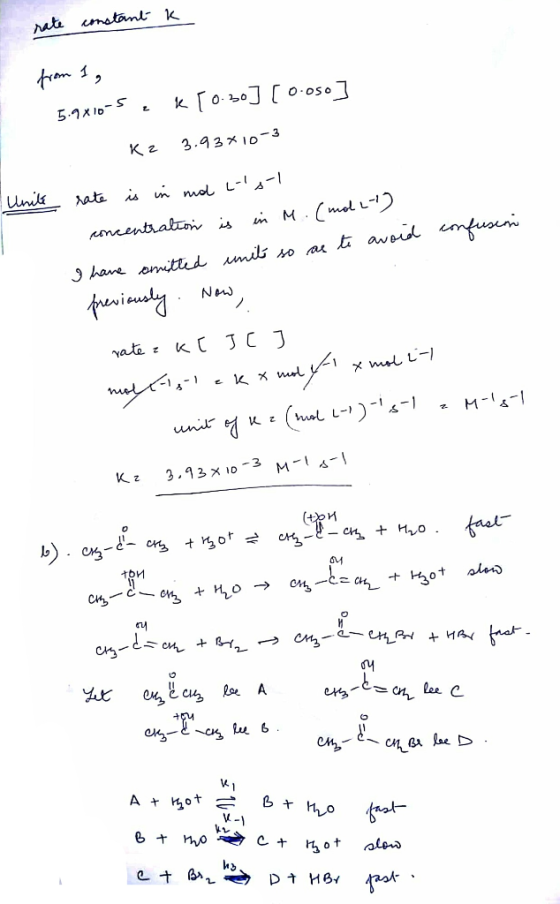
(a) Determine the rate law for the reaction and calculate the rate constant.
(b) The following mechanism has been proposed for the reaction:
O OH+
║ ║
Step-1: CH3-C-CH3 + H3O+ ⇌ CH3-C-CH3 + H2O (fast equilibrium)
OH
│
Step-2: (CH3)2C═OH+ + H2O = CH3-C═CH2 + H3O+ (slow)
OH O
│ ║
Step-3: CH3-C═CH2 + Br2 = CH3-C-CH2Br + HBr (fast)
Show that the rate law deduced from the mechanism is consistent with that shown in part (a).
(Answer: (a) Rate = k[CH3COCH3][H3O+]; k = 3.9 x 10⁻³ M–1 ∙ s–1)
Homework Answers
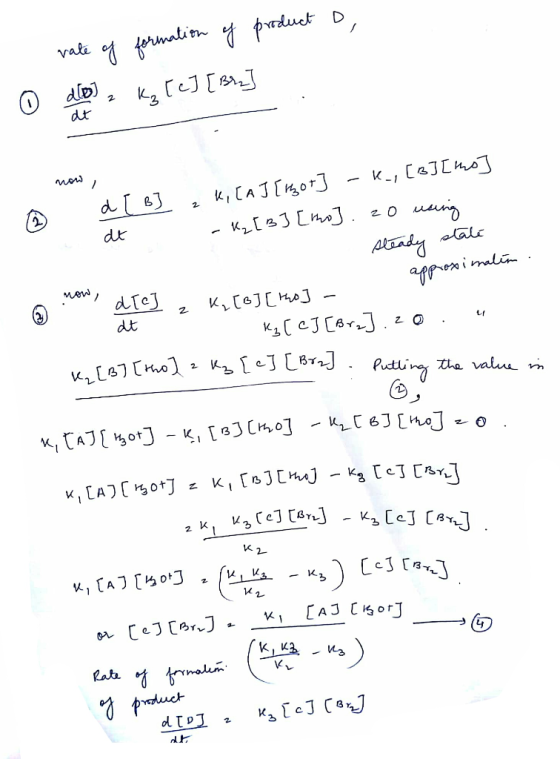
 Steady state approximation is
used to determine rate law in a multistep reaction mechanism. It
assumes that the rate of change of concentration of intermediates
in a multi-step reaction are constant. d[C]/dt is 0 in this
case.
Steady state approximation is
used to determine rate law in a multistep reaction mechanism. It
assumes that the rate of change of concentration of intermediates
in a multi-step reaction are constant. d[C]/dt is 0 in this
case.
Add Answer to:
The bromination of acetone is acid catalyzed:
H+ catalyst
CH3COCH3 + Br2 =
CH3COCH2Br + H+...
Temperature, Question 7 (13 marks) Acetone is brominated in acidic solution according to the following reaction:...
 Temperature, Question 7 (13 marks) Acetone is brominated in acidic solution according to the following reaction: CH3COCH3(aq) + Br2(aq) - CH3COCH_Br(aq) + H" (aq) + Br" (aq) Student A proposed the following four-step mechanism for the decomposition of Bra: CH3COCH3 + H + CH3C(OH)CH3 ki, ki CH,C(OH)CH3 -CH:C(OH)-CH2 + H+ ka, slow CH;C(OH)=CH2 + Br2 - CH3C(OH)CH2Br* + Br k3 CH:C(OH)CH2Br* - CH3COCH2Br + H+ k4 Deduce the rate law for the above reaction by assuming a pre-equilibrium (7 marks)...
The Bromination of acetone is acid catalyzed; The rate of disappearance of bromine as measured for...
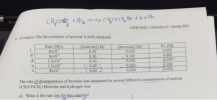 The Bromination of acetone is acid catalyzed; The rate of disappearance of bromine as measured for several different concentrations of acetone (CH3COCH3) Bromine and hydrogen ions a) What is the rate law for this reaction?
Given the following reaction mixtures and the reaction: CH3COCH3 + Br2 -- > CH3COCH2Br + H+...
Given the following reaction mixtures and the reaction: CH3COCH3 + Br2 -- > CH3COCH2Br + H+ + Br- Reaction Mixture Temperature º C Water (ml) 4 M Acetone 1 M Hydrochloric Acid 0.005 M Br2 1 25 20 10 10 10 2 25 10 20 10 10 3 25 25 10 10 5 4 25 10 10 20 10 The following reaction measurements were made: Reaction Mixture Times (s) 1 116 2 58 3 118 4 232 Calculate the reaction...
26. Questions 26-27 refer to the following information. The reaction of acetone and bromine can be...
 26. Questions 26-27 refer to the following information. The reaction of acetone and bromine can be acid catalyzed as shown in the above reaction. The following initial rates of the bromination of acetone using an acid catalyst were measured at various initial concentrations as recorded in the table below. Trial [CH, COCH] Br] [H'] Initial Rate (Ms) catalyst 0.30 0.30 0.30 0.40 0.40 0.0500.050 0.10 0.050 0.050 0.050 0.050 0.050 0.10 0.20 5.7 x10- 5.7 x10 1.2 x10⁴ 3.I x10...
The table below shows the initial rate of reaction (by measuring the rate of loss of...
The table below shows the initial rate of reaction (by measuring the rate of loss of Br2) for the following reaction at several different initial concentrations of reactants at 25oC: CH3COCH3 + Br2 H+(above arrow) → CH3COCH2Br + HBr Experiment [CH3COCH3] / M [Br2] /M [H+] /M Rate of loss of Br2 (M/s) 1 0.25 0.050 0.050 6.3 x 10⁻⁵ 2 0.25 0.100 0.050 6.3 x 10⁻⁵ 3 0.25 0.050 0.100 1.3 x 10⁻⁴ 4 0.40 0.050 0.200 4.0 x...
Consider the following reaction on acetone (CH3COCH3), the mechanism is believed to involve four elementary steps:...
 Consider the following reaction on acetone (CH3COCH3), the mechanism is believed to involve four elementary steps: CH3COCH; 4+ CH3 + CH3CO CH3 + CH3COCH; CH4 + CH3COCH, CH;COCH2 _ky → CH3 + CH2CO CH3 + CH3COCH, ko > CH3COCZH (a) Write down an expression for the rate of disappearance of CH3COCHz. (3 marks) Assume kz >> k[CH3), apply the steady-state approximation and work out an expression for (CH3) in term of kį, kz, kz and ke. Show all of your...
H3 C H2Br Br2, H30* HC X CH3 HzC CH3 H3C CH3 Aldehydes and ketones can...
 H3 C H2Br Br2, H30* HC X CH3 HzC CH3 H3C CH3 Aldehydes and ketones can be halogenated at their a-position by reaction with Cl, Br, or 12, under acidic conditions. Using Br2 under acidic conditions, an intermediate enol is formed which adds bromine at the a-position. The reaction stops after the addition of one bromine because the electron-withdrawing halogen decreases the basicity of the carbonyl oxygen, making the protonation less favorable. Not started curved arrows to show the movement...
3. Draw the product for the following reactions H₂Cro4 H3O* & acetone (Jones' reagent) 1. OH...
 3. Draw the product for the following reactions H₂Cro4 H3O* & acetone (Jones' reagent) 1. OH H2Cro4 H3O+ acetone (Jones' reagent) 2. CH3-CH2-OH 3. OH PCC CH2Cl2 H3C PCC CH2Cl2 4. OH НО" CH3
What is the rate of disappearance of Br2 when [NO]= 8.6×10⁻² M and [Br2]= 0.31 M...
What is the rate of disappearance of Br2 when [NO]= 8.6×10⁻² M and [Br2]= 0.31 M ? Express your answer using two significant figures. The rate of disappearance of Br2 is half the rate of appearance of NOBr, and the initial problem was: Consider the gas-phase reaction between nitric oxide and bromine at 273 ∘C 2NO(g)+Br2(g)→2NOBr(g). The following data for the initial rate of appearance of NOBr were obtained: Experiment [NO](M) [Br2](M) Initial Rate of Appearance of NOBr(M/s) 1 0.10...
2NO(g) + Br2(g) = 2NOBr(g) Experiment [NO-] (M) [Br2] (M) Initial Rate (M s-1) 1 0.10...
2NO(g) + Br2(g) = 2NOBr(g) Experiment [NO-] (M) [Br2] (M) Initial Rate (M s-1) 1 0.10 0.20 24 2 0.25 0.20 150 3 0.10 0.50 60 4 0.35 0.50 735 1.) Determine the rate law equation for the reaction. 2.) What is the overall order of the reaction? 3.) What are the value and the units of the rate constant, k? 4.) Write the expression to show how is the rate of disappearance of bromine, Br2, related to the rate...
 Temperature, Question 7 (13 marks) Acetone is brominated in acidic solution according to the following reaction: CH3COCH3(aq) + Br2(aq) - CH3COCH_Br(aq) + H" (aq) + Br" (aq) Student A proposed the following four-step mechanism for the decomposition of Bra: CH3COCH3 + H + CH3C(OH)CH3 ki, ki CH,C(OH)CH3 -CH:C(OH)-CH2 + H+ ka, slow CH;C(OH)=CH2 + Br2 - CH3C(OH)CH2Br* + Br k3 CH:C(OH)CH2Br* - CH3COCH2Br + H+ k4 Deduce the rate law for the above reaction by assuming a pre-equilibrium (7 marks)...
 The Bromination of acetone is acid catalyzed; The rate of disappearance of bromine as measured for several different concentrations of acetone (CH3COCH3) Bromine and hydrogen ions a) What is the rate law for this reaction?
 26. Questions 26-27 refer to the following information. The reaction of acetone and bromine can be acid catalyzed as shown in the above reaction. The following initial rates of the bromination of acetone using an acid catalyst were measured at various initial concentrations as recorded in the table below. Trial [CH, COCH] Br] [H'] Initial Rate (Ms) catalyst 0.30 0.30 0.30 0.40 0.40 0.0500.050 0.10 0.050 0.050 0.050 0.050 0.050 0.10 0.20 5.7 x10- 5.7 x10 1.2 x10⁴ 3.I x10...
 Consider the following reaction on acetone (CH3COCH3), the mechanism is believed to involve four elementary steps: CH3COCH; 4+ CH3 + CH3CO CH3 + CH3COCH; CH4 + CH3COCH, CH;COCH2 _ky → CH3 + CH2CO CH3 + CH3COCH, ko > CH3COCZH (a) Write down an expression for the rate of disappearance of CH3COCHz. (3 marks) Assume kz >> k[CH3), apply the steady-state approximation and work out an expression for (CH3) in term of kį, kz, kz and ke. Show all of your...
 H3 C H2Br Br2, H30* HC X CH3 HzC CH3 H3C CH3 Aldehydes and ketones can be halogenated at their a-position by reaction with Cl, Br, or 12, under acidic conditions. Using Br2 under acidic conditions, an intermediate enol is formed which adds bromine at the a-position. The reaction stops after the addition of one bromine because the electron-withdrawing halogen decreases the basicity of the carbonyl oxygen, making the protonation less favorable. Not started curved arrows to show the movement...
 3. Draw the product for the following reactions H₂Cro4 H3O* & acetone (Jones' reagent) 1. OH H2Cro4 H3O+ acetone (Jones' reagent) 2. CH3-CH2-OH 3. OH PCC CH2Cl2 H3C PCC CH2Cl2 4. OH НО" CH3
Most questions answered within 3 hours.
-
Where is the error in this code sequence?
String s1 = "Hello";
String s2 = "ello";...
asked 11 months ago -
Financial data for Joel de Paris, Inc., for last year
follow:
Joel de Paris, Inc.
Balance...
asked 11 months ago -
Consider this reaction:
Al2(SO4)3 (aq)+ BaCl3
(aq) Al2Cl6 (aq)- +
3BaSO4(s) . What is the...
asked 11 months ago -
Suppose that Savneet is considering increasing her
recent random sample from 20 car rentals to 40...
asked 11 months ago -
Trucks arrive at an unloading terminal at an average rate of 120
per hour.
Trucks arrive...
asked 11 months ago -
Why are methanol and ethanol completely soluble in water while
octanol is not very little soluble....
asked 11 months ago -
A facilities manager at a university reads in a research report
that the mean amount of...
asked 11 months ago -
When the CuSO4 is rehydrated by adding water to the anhydrous
compound, is this an endothermic...
asked 11 months ago -
A ray of sunlight is passing from diamond into crown glass; the
angle of incidence is...
asked 11 months ago -
A block of mass 0.249 kg is placed on top of a light, vertical
spring of...
asked 11 months ago -
how do the kidneys compensate in the presences of acidosis
a) trigger hyperventilate
b) reserve acid...
asked 11 months ago -
Question 501 pts
The rental rate of capital to the firm increases. Which of the
following...
asked 11 months ago