For each of the following, give the Big-O time and explain your answer: a. Breadth-first search/traversal...
For each of the following, give the Big-O time and explain your
answer:
a. Breadth-first search/traversal using an adjacency matrix.
b. Breadth-first search/traversal using an adjacency list.
c. Depth-first search/traversal using an adjacency matrix.
d. Depth-first search/traversal using an adjacency list.
Homework Answers
a. Breadth-first search/traversal using an adjacency matrix.
in adjacency matrix graph is represented by using n*n Matrix where n is number of vertex in graph.
for loop runs two times in the logic. So complexity is O(V2)
============================================================================================
b. Breadth-first search/traversal using an adjacency list.
Complexity using an adjacency list is O(V+E) where V is vertices of the graph and E is edges of the graph.
BFS using adjacency list takes O(V) time to initialize the distance and predecessor for each vertex. then it traverse only the vertices reachable from a given source vertex so it takes max O(E) . so we get O(V+E).
if |E| >= |V| then ∣V∣ + ∣E∣ <= ∣E∣+ ∣E∣ <= 2.|E| igonre constant then O(V+E) = O(E)
if |V| >= |E| then ∣V∣ + ∣E∣ <= ∣V∣+ ∣V∣ <= 2.|V| igonre constant then O(V+E) = O(V)
============================================================================================
c. Depth-first search/traversal using an adjacency matrix.
in adjacency matrix graph is represented by using n*n Matrix where n is number of vertex in graph.
for loop runs two times in the logic. So complexity is O(V2)
============================================================================================
d. Depth-first search/traversal using an adjacency list.
Complexity using an adjacency list is O(V+E) where V is vertices of the graph and E is edges of the graph.
if |E| >= |V| then ∣V∣ + ∣E∣ <= ∣E∣+ ∣E∣ <= 2.|E| igonre constant then O(V+E) = O(E)
if |V| >= |E| then ∣V∣ + ∣E∣ <= ∣V∣+ ∣V∣ <= 2.|V| igonre constant then O(V+E) = O(V)
============================================================================================
Add Answer to:
For each of the following, give the Big-O time and explain your
answer:
a. Breadth-first search/traversal...
Breadth-First search traversal. 100% Upvote/Thumbs up. Thank you in advance QUESTION 20 Consider an undirected, unweighted...
 Breadth-First search traversal. 100% Upvote/Thumbs up. Thank you
in advance
QUESTION 20 Consider an undirected, unweighted graph G = (V,E) with V = {1,2,3,4,5,6) and E = {(1,2),(1,3), (1,4),(2,3),(2,5),(3,5),(4,6).(5,6)}. What is the Breadth-First Search traversal starting at vertex 67 Build your adjacency list in ascending order. List the values separated by spaces.
Breadth-First search traversal. 100% Upvote/Thumbs up. Thank you
in advance
QUESTION 20 Consider an undirected, unweighted graph G = (V,E) with V = {1,2,3,4,5,6) and E = {(1,2),(1,3), (1,4),(2,3),(2,5),(3,5),(4,6).(5,6)}. What is the Breadth-First Search traversal starting at vertex 67 Build your adjacency list in ascending order. List the values separated by spaces.
Consider the following directed graph for each of the problems: 1. Perform a breadth-first search on...
 Consider the following directed graph for each of the
problems:
1. Perform a breadth-first search on the graph assuming that the
vertices and adjacency lists
are listed in alphabetical order. Show the breadth-first search
tree that is generated.
2. Perform a depth-first search on the graph assuming that the
vertices and adjacency lists
are listed in alphabetical order. Classify each edge as tree, back
or cross edge. Label each
vertex with its start and finish time.
3. Remove all the...
Consider the following directed graph for each of the
problems:
1. Perform a breadth-first search on the graph assuming that the
vertices and adjacency lists
are listed in alphabetical order. Show the breadth-first search
tree that is generated.
2. Perform a depth-first search on the graph assuming that the
vertices and adjacency lists
are listed in alphabetical order. Classify each edge as tree, back
or cross edge. Label each
vertex with its start and finish time.
3. Remove all the...
For Dijkstra’s shortest path algorithm: a. Give the Big-O time for Dijkstra’s shortest path algorithm and...
For Dijkstra’s shortest path algorithm: a. Give the Big-O time for Dijkstra’s shortest path algorithm and explain your answer. b. Does the answer to (a) depend on whether we use an adjacency matrix or list? Explain your answer.
For Dijkstra’s shortest path algorithm: a. Give the Big-O time for Dijkstra’s shortest path algorithm and...
For Dijkstra’s shortest path algorithm: a. Give the Big-O time for Dijkstra’s shortest path algorithm and explain your answer. b. Does the answer to (a) depend on whether we use an adjacency matrix or list? Explain your answer.
For the following graph, give the result of any one breadth-first traversal beginning at D, where...
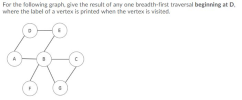 For the following graph, give the result of any one breadth-first traversal beginning at D, where the label of a vertex is printed when the vertex is visited. D E A B с F G
1. Explain the significance of Breadth-First Search in graphs and its time complexity. List down any...
 1. Explain the significance of Breadth-First Search in graphs and its time complexity. List down any 4 (four) applications of Breadth-First Search in details. (6 marks) 2. Do you agree to use Stack data structure in backtracking technique for game development? Justify your answer with an example. (6 marks)
For the following graph, give the result of any one breadth-first traversal beginning at A, where...
 For the following graph, give the result of any one breadth-first traversal beginning at A, where the label of a vertex is printed when the vertex is visited. A 00 4 7 B с D 2 2 3 E F
For the following graph, give the result of any one breadth-first traversal beginning at A, where...
 For the following graph, give the result of any one breadth-first traversal beginning at A, where the label of a vertex is printed when the vertex is visited. A 8 4 7 1 D 2 3 N E F
a) Perform a depth first traversal of the graph provided with source node d. (Write your...
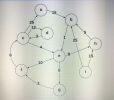 a) Perform a depth first traversal of the graph provided with
source node d.
(Write your answer as node identifiers separated by commas and
spaces. Ex: a, b, c, d)
b) Perform a breadth first traversal of the graph provided
with source node e.
(Write your
answer as node identifiers separated by commas and spaces. Ex: a,
b, c, d)
25 12
a) Perform a depth first traversal of the graph provided with
source node d.
(Write your answer as node identifiers separated by commas and
spaces. Ex: a, b, c, d)
b) Perform a breadth first traversal of the graph provided
with source node e.
(Write your
answer as node identifiers separated by commas and spaces. Ex: a,
b, c, d)
25 12
(8) Consider the following problem space with the node "A" as the starting state and the node "H" as the goal state. Please describe how breadth-first search and depth-first search is...
 (8) Consider the following problem space with the node "A" as the starting state and the node "H" as the goal state. Please describe how breadth-first search and depth-first search is working with your problem space, and list the order that the nodes are traversed under these two search algorithms.
(8) Consider the following problem space with the node "A" as the starting state and the node "H" as the goal state. Please describe how breadth-first search and depth-first search...
(8) Consider the following problem space with the node "A" as the starting state and the node "H" as the goal state. Please describe how breadth-first search and depth-first search is working with your problem space, and list the order that the nodes are traversed under these two search algorithms.
(8) Consider the following problem space with the node "A" as the starting state and the node "H" as the goal state. Please describe how breadth-first search and depth-first search...
 Breadth-First search traversal. 100% Upvote/Thumbs up. Thank you
in advance
QUESTION 20 Consider an undirected, unweighted graph G = (V,E) with V = {1,2,3,4,5,6) and E = {(1,2),(1,3), (1,4),(2,3),(2,5),(3,5),(4,6).(5,6)}. What is the Breadth-First Search traversal starting at vertex 67 Build your adjacency list in ascending order. List the values separated by spaces.
Breadth-First search traversal. 100% Upvote/Thumbs up. Thank you
in advance
QUESTION 20 Consider an undirected, unweighted graph G = (V,E) with V = {1,2,3,4,5,6) and E = {(1,2),(1,3), (1,4),(2,3),(2,5),(3,5),(4,6).(5,6)}. What is the Breadth-First Search traversal starting at vertex 67 Build your adjacency list in ascending order. List the values separated by spaces.
 Consider the following directed graph for each of the
problems:
1. Perform a breadth-first search on the graph assuming that the
vertices and adjacency lists
are listed in alphabetical order. Show the breadth-first search
tree that is generated.
2. Perform a depth-first search on the graph assuming that the
vertices and adjacency lists
are listed in alphabetical order. Classify each edge as tree, back
or cross edge. Label each
vertex with its start and finish time.
3. Remove all the...
Consider the following directed graph for each of the
problems:
1. Perform a breadth-first search on the graph assuming that the
vertices and adjacency lists
are listed in alphabetical order. Show the breadth-first search
tree that is generated.
2. Perform a depth-first search on the graph assuming that the
vertices and adjacency lists
are listed in alphabetical order. Classify each edge as tree, back
or cross edge. Label each
vertex with its start and finish time.
3. Remove all the...
 For the following graph, give the result of any one breadth-first traversal beginning at D, where the label of a vertex is printed when the vertex is visited. D E A B с F G
 1. Explain the significance of Breadth-First Search in graphs and its time complexity. List down any 4 (four) applications of Breadth-First Search in details. (6 marks) 2. Do you agree to use Stack data structure in backtracking technique for game development? Justify your answer with an example. (6 marks)
 For the following graph, give the result of any one breadth-first traversal beginning at A, where the label of a vertex is printed when the vertex is visited. A 00 4 7 B с D 2 2 3 E F
 For the following graph, give the result of any one breadth-first traversal beginning at A, where the label of a vertex is printed when the vertex is visited. A 8 4 7 1 D 2 3 N E F
 a) Perform a depth first traversal of the graph provided with
source node d.
(Write your answer as node identifiers separated by commas and
spaces. Ex: a, b, c, d)
b) Perform a breadth first traversal of the graph provided
with source node e.
(Write your
answer as node identifiers separated by commas and spaces. Ex: a,
b, c, d)
25 12
a) Perform a depth first traversal of the graph provided with
source node d.
(Write your answer as node identifiers separated by commas and
spaces. Ex: a, b, c, d)
b) Perform a breadth first traversal of the graph provided
with source node e.
(Write your
answer as node identifiers separated by commas and spaces. Ex: a,
b, c, d)
25 12
 (8) Consider the following problem space with the node "A" as the starting state and the node "H" as the goal state. Please describe how breadth-first search and depth-first search is working with your problem space, and list the order that the nodes are traversed under these two search algorithms.
(8) Consider the following problem space with the node "A" as the starting state and the node "H" as the goal state. Please describe how breadth-first search and depth-first search...
(8) Consider the following problem space with the node "A" as the starting state and the node "H" as the goal state. Please describe how breadth-first search and depth-first search is working with your problem space, and list the order that the nodes are traversed under these two search algorithms.
(8) Consider the following problem space with the node "A" as the starting state and the node "H" as the goal state. Please describe how breadth-first search and depth-first search...
Most questions answered within 3 hours.
-
Where is the error in this code sequence?
String s1 = "Hello";
String s2 = "ello";...
asked 11 months ago -
Financial data for Joel de Paris, Inc., for last year
follow:
Joel de Paris, Inc.
Balance...
asked 11 months ago -
Consider this reaction:
Al2(SO4)3 (aq)+ BaCl3
(aq) Al2Cl6 (aq)- +
3BaSO4(s) . What is the...
asked 11 months ago -
Suppose that Savneet is considering increasing her
recent random sample from 20 car rentals to 40...
asked 11 months ago -
Trucks arrive at an unloading terminal at an average rate of 120
per hour.
Trucks arrive...
asked 11 months ago -
Why are methanol and ethanol completely soluble in water while
octanol is not very little soluble....
asked 11 months ago -
A facilities manager at a university reads in a research report
that the mean amount of...
asked 11 months ago -
When the CuSO4 is rehydrated by adding water to the anhydrous
compound, is this an endothermic...
asked 11 months ago -
A ray of sunlight is passing from diamond into crown glass; the
angle of incidence is...
asked 11 months ago -
A block of mass 0.249 kg is placed on top of a light, vertical
spring of...
asked 11 months ago -
how do the kidneys compensate in the presences of acidosis
a) trigger hyperventilate
b) reserve acid...
asked 11 months ago -
Question 501 pts
The rental rate of capital to the firm increases. Which of the
following...
asked 11 months ago