Fatty acids are the building blocks of? cholesterol phospholipids glycolipids phospholipids and glycolipids.
Fatty acids are the building blocks of?
cholesterol
phospholipids
glycolipids
phospholipids and glycolipids.
Homework Answers
Phospholipids and glycolipid.
Fatty acids is a long hydrocarbon chain and along with glycerol it forms the phospholipids and glycolipid .
These two are the amphipathic molecules because they consists of both hydrophobic and hydrophilic part .
They are also an important part of cell membrane.
Add Answer to:
Fatty acids are the building blocks of?
cholesterol
phospholipids
glycolipids
phospholipids and glycolipids.
You are given a sample that contains phospholipids, cholesterol, triglycerides, sphingolipids, and fatty acids. Describe a...
You are given a sample that contains phospholipids, cholesterol, triglycerides, sphingolipids, and fatty acids. Describe a method by which you could separate and quantify the different lipid classes.
What type of lipid contains either a glycerol or sphingosine molecule as the platform molecule? Fatty acids Triacyl...
 What type of lipid contains either a glycerol or sphingosine molecule as the platform molecule? Fatty acids Triacylglycerols Phospholipids Glycolipids Steroids Question 5 1pl What type of lipid is not built from fatty acids? Fatty acids Triacylglycerols Phospholipids Glycolipids Steroids
159. Which of the following are the building blocks of protein? A. B. C. Fatty acids...
 159. Which of the following are the building blocks of protein? A. B. C. Fatty acids Amino acids Ribonucleic acids Alpha-linolenic acids D. CLLLC
1. Linoleic and linolenic acid are both: A. Phospholipids B. Trans fat C. Essential fatty acids...
1. Linoleic and linolenic acid are both: A. Phospholipids B. Trans fat C. Essential fatty acids D. Monosaturated fatty acids 2. EPA and DHA are: A. Made from linoleic acid B. Omega 3 fatty acids C. Found primarily in plant oils and seeds. D. Omega 6 fatty acids 3. All of the following are example of omega-3 fatty acids except: A. EPA B. linoleic acid C. DHA D. Linolenic acid 4. Glycogen is stored in the liver and muscles when:...
4) How is cholesterol different from triglycerides and phospholipids? A) It is synthesized in the body....
 4) How is cholesterol different from triglycerides and phospholipids? A) It is synthesized in the body. B) It does not have a glycerol backbone. C) It is made of fatty acids. D) It cannot be stored in the body
Fatty Acids Give a detailed description (figures/narratives) of the structure and function of fatty acids as...
 Fatty Acids Give a detailed description (figures/narratives) of the structure and function of fatty acids as it relates to the structure and function of biological membranes Membrane Lipids Give a detailed description (figures/narratives of the structure and function of membrane lipids as it relates to the structure and function of biological membranes Phospholipids & Glycolipids Give a detailed description (figures/narratives) of the structure and function of phospholipids and glycolipids as it relates to the structure and function of biological membranes....
please answer ALL 1. Describe the structure of fatty acids (in general). 2. Olive oil and...
 please answer ALL
1. Describe the structure of fatty acids (in general). 2. Olive oil and margarine are both lipid-based food products. Why is olive oil liquid at room temperature, and margarine solid? 3. Why are phospholipids amphipathic? 4. Which cell organelles have a double membrane? 5. What is similar between the structure of phosphoglycerides and sphingolipids? 6. What is different between the structure of phosphoglycerides and sphingolipids? 7. What is similar between the structure of sphingolipids and glycolipids? 8....
please answer ALL
1. Describe the structure of fatty acids (in general). 2. Olive oil and margarine are both lipid-based food products. Why is olive oil liquid at room temperature, and margarine solid? 3. Why are phospholipids amphipathic? 4. Which cell organelles have a double membrane? 5. What is similar between the structure of phosphoglycerides and sphingolipids? 6. What is different between the structure of phosphoglycerides and sphingolipids? 7. What is similar between the structure of sphingolipids and glycolipids? 8....
Lipoproteins are like suitcases that move cholesterol, fatty acid remnants, triglycerides, and phospholipids from one place...
Lipoproteins are like suitcases that move cholesterol, fatty acid remnants, triglycerides, and phospholipids from one place to another. Given what you know about the insolubility of lipids in water and the unique structures of each of these molecules, which of the 4 kinds of aforementioned lipids would you predict to be on the outside of a lipoprotein clump, bathed in the water-based fluid portion of blood and why?
Which of the following is a steroid? solid fat O cholesterol oils O fatty acids Show...
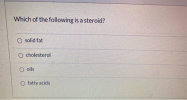 Which of the following is a steroid? solid fat O cholesterol oils O fatty acids
WHICH OF THE FOLLOWING ARE DEEMED “ESSENTIAL” NUTRIENT: MONOUNSATURATED FATTY ACIDS, CHOLESTEROL, STEARIC ACID, LINOLEIC ACID,...
WHICH OF THE FOLLOWING ARE DEEMED “ESSENTIAL” NUTRIENT: MONOUNSATURATED FATTY ACIDS, CHOLESTEROL, STEARIC ACID, LINOLEIC ACID, PHOSPHOLIPS
 What type of lipid contains either a glycerol or sphingosine molecule as the platform molecule? Fatty acids Triacylglycerols Phospholipids Glycolipids Steroids Question 5 1pl What type of lipid is not built from fatty acids? Fatty acids Triacylglycerols Phospholipids Glycolipids Steroids
 159. Which of the following are the building blocks of protein? A. B. C. Fatty acids Amino acids Ribonucleic acids Alpha-linolenic acids D. CLLLC
 4) How is cholesterol different from triglycerides and phospholipids? A) It is synthesized in the body. B) It does not have a glycerol backbone. C) It is made of fatty acids. D) It cannot be stored in the body
 Fatty Acids Give a detailed description (figures/narratives) of the structure and function of fatty acids as it relates to the structure and function of biological membranes Membrane Lipids Give a detailed description (figures/narratives of the structure and function of membrane lipids as it relates to the structure and function of biological membranes Phospholipids & Glycolipids Give a detailed description (figures/narratives) of the structure and function of phospholipids and glycolipids as it relates to the structure and function of biological membranes....
 please answer ALL
1. Describe the structure of fatty acids (in general). 2. Olive oil and margarine are both lipid-based food products. Why is olive oil liquid at room temperature, and margarine solid? 3. Why are phospholipids amphipathic? 4. Which cell organelles have a double membrane? 5. What is similar between the structure of phosphoglycerides and sphingolipids? 6. What is different between the structure of phosphoglycerides and sphingolipids? 7. What is similar between the structure of sphingolipids and glycolipids? 8....
please answer ALL
1. Describe the structure of fatty acids (in general). 2. Olive oil and margarine are both lipid-based food products. Why is olive oil liquid at room temperature, and margarine solid? 3. Why are phospholipids amphipathic? 4. Which cell organelles have a double membrane? 5. What is similar between the structure of phosphoglycerides and sphingolipids? 6. What is different between the structure of phosphoglycerides and sphingolipids? 7. What is similar between the structure of sphingolipids and glycolipids? 8....
 Which of the following is a steroid? solid fat O cholesterol oils O fatty acids
Most questions answered within 3 hours.
-
Where is the error in this code sequence?
String s1 = "Hello";
String s2 = "ello";...
asked 10 months ago -
Financial data for Joel de Paris, Inc., for last year
follow:
Joel de Paris, Inc.
Balance...
asked 10 months ago -
Consider this reaction:
Al2(SO4)3 (aq)+ BaCl3
(aq) Al2Cl6 (aq)- +
3BaSO4(s) . What is the...
asked 10 months ago -
Suppose that Savneet is considering increasing her
recent random sample from 20 car rentals to 40...
asked 10 months ago -
Trucks arrive at an unloading terminal at an average rate of 120
per hour.
Trucks arrive...
asked 10 months ago -
Why are methanol and ethanol completely soluble in water while
octanol is not very little soluble....
asked 10 months ago -
A facilities manager at a university reads in a research report
that the mean amount of...
asked 10 months ago -
When the CuSO4 is rehydrated by adding water to the anhydrous
compound, is this an endothermic...
asked 10 months ago -
A ray of sunlight is passing from diamond into crown glass; the
angle of incidence is...
asked 10 months ago -
A block of mass 0.249 kg is placed on top of a light, vertical
spring of...
asked 10 months ago -
how do the kidneys compensate in the presences of acidosis
a) trigger hyperventilate
b) reserve acid...
asked 10 months ago -
Question 501 pts
The rental rate of capital to the firm increases. Which of the
following...
asked 10 months ago