Using any transfer function as an example (e.g. a linear transfer function), explain why for a...
Using any transfer function as an example (e.g. a linear transfer function), explain why for a sensor, the higher the sensitivity, the better.
Write your answers and graphs of transfer functions.
Homework Answers
What is the transfer function:
In physics, the transfer function
may be defined as mathematical representation (in terms of
frequency) of interrelation between input and output in linear time
uninterrupted systems with zero pint equilibrium and zero initial
conditions. If talking particularly about control systems then it
can be defined as the ratio of the Laplace transform of the output
variable to the Laplace transform of the input variable, with all
zero initial conditions.
A transfer function is a function of complex variables. The
transfer function can be obtained by simple algebraic jugglery of
differential equations that illustrates the system. A transfer
function can represent higher-order systems also, even infinite
dimensionless systems which regulate on partial differential
equations.
For sensors higher sensitivity is better because the sensors are
fully based on sensing its environment. So more the sensitivity of
a sensor more will be the accurate results that it can give. This
leads the sensor better for future implementation also.
Transfer Function of a Linear System: The Transfer Function An input-output description of a system is essentially a table of all possible input-output pairs. For linear systems, the table can be characterized by one input pair only, for example, the impulse response or the step response. In this section, we will consider another interesting pair of signals.
Consider the linear input-output system, the differential equation (1) that express it will be:

Where u is the input and y is the output the differential equation is completely described by two polynomials:

The characteristic polynomial of the system is polynomial a(s). Taking u (t) = est as input to find transfer function so the output will also be an exponential function that will be y (t) = y0 est. Inserting signals in equation (1), we get:

If a,  , it will give,

The transfer function of this linear system thus will be a rational function,

Note that, a(s) and b(s) are given above as polynomial of system.
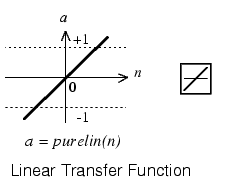
The graphical representation of Transfer Function of a Linear System,
Add Answer to:
Using any transfer function as an example (e.g. a linear
transfer function), explain why for a...
Question 1 a) Define the term transfer function in relation to a linear control system. [5...
 Question 1 a) Define the term transfer function in relation to a
linear control system. [5 marks] Figure Q1 shows a block diagram of
a feedback control system, with a plant with transfer function G(s)
, a controller with transfer function C(s) , and a sensor with
transfer function H(s) . b) Derive from first principles the closed
loop transfer function G (s) cl from the reference signal r(t) , to
the output signal y(t) . [5 marks] c) Give...
Question 1 a) Define the term transfer function in relation to a
linear control system. [5 marks] Figure Q1 shows a block diagram of
a feedback control system, with a plant with transfer function G(s)
, a controller with transfer function C(s) , and a sensor with
transfer function H(s) . b) Derive from first principles the closed
loop transfer function G (s) cl from the reference signal r(t) , to
the output signal y(t) . [5 marks] c) Give...
3. Write the expressions for the shape functions for a linear truss element. Explain the followin...
 3. Write the expressions for the shape functions for a linear truss element. Explain the following properties (what they are and what they mean): delta function property, partitions of unity property, and property of linear field reproduction. Does the shape function for the linear truss element satisfy these three properties? Why or why not?
3. Write the expressions for the shape functions for a linear truss element. Explain the following properties (what they are and what they mean): delta function...
3. Write the expressions for the shape functions for a linear truss element. Explain the following properties (what they are and what they mean): delta function property, partitions of unity property, and property of linear field reproduction. Does the shape function for the linear truss element satisfy these three properties? Why or why not?
3. Write the expressions for the shape functions for a linear truss element. Explain the following properties (what they are and what they mean): delta function...
Using diagram(s) explain why a simple linear regression with a constant term will generally provide a...
Using diagram(s) explain why a simple linear regression with a constant term will generally provide a better fit than a simple linear regression which excludes a constant.
1 a the system stable. For example, in Chapter 2 we derived the transfer function for the inverte...
 1 a the system stable. For example, in Chapter 2 we derived the transfer function for the inverted pendulum, which, for simple values, might be G(s) for which we have bs)1 and as)-s2-1-(s+)(s 1). Suppose we try Dcl (s) = K Istn . The characteristic equation that results for the system is (4.17) This is the problem that Maxwell faced in his study of governors: Under what conditions on the parameters will all the roots of this equation be in...
b) The transfer function of a causal linear time-invariant (LTI) discrete-time system is given by: 1+0.6z1-0.5z1 i Does...
 b) The transfer function of a causal linear time-invariant (LTI) discrete-time system is given by: 1+0.6z1-0.5z1 i Does the system have a finite impulse response (FIR) or infinite 3 impulse response (IIR)? Explain why. ii Determine the impulse response h[n] of the above system iii) Suppose that the system above was designed using the bilinear transformation method with sampling period T-0.5 s. Determine its original analogue transfer function.
b) The transfer function of a causal linear time-invariant (LTI) discrete-time system...
b) The transfer function of a causal linear time-invariant (LTI) discrete-time system is given by: 1+0.6z1-0.5z1 i Does the system have a finite impulse response (FIR) or infinite 3 impulse response (IIR)? Explain why. ii Determine the impulse response h[n] of the above system iii) Suppose that the system above was designed using the bilinear transformation method with sampling period T-0.5 s. Determine its original analogue transfer function.
b) The transfer function of a causal linear time-invariant (LTI) discrete-time system...
1. Complete the two activities below. 1. To create the equation of a linear function in...
 1. Complete the two activities below. 1. To create the equation of a linear function in standard form, pick two coordinate points to be the x-intercept and y-intercept. o Write the equation in standard form and graph the equation using the intercepts. • Determine the slope and y-intercept of your line. Explain how to graph the line using the slope and y-intercept. • Discuss which method of graphing is easier and why you chose that one. • Is there a...
Provide an Example for each of the followings. If there is Not any example explain why....
 Provide an Example for each of the followings. If there is Not any example explain why. A subgroup of (Z,-): A non-commutative ring with a multiplicative identity : • An integral domain that is not a subset of the complex numbers : A subgroup of Z40 that has order 7 : .
Develop a piecewise linear transfer function for the calibration data shown below (and on your ha...
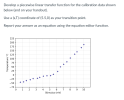 Develop a piecewise linear transfer function for the calibration data shown below (and on your handout) Use a (s,T) coordinate of (5.5,0) as your transition point. Report your answer as an equation using the equation editor function. 225 200 175 150 U 125 2 100 O 75 50 - 25 ト + ト + 25 75 89 10 Stimulus (mV)
Develop a piecewise linear transfer function for the calibration data shown below (and on your handout) Use a (s,T) coordinate...
Develop a piecewise linear transfer function for the calibration data shown below (and on your handout) Use a (s,T) coordinate of (5.5,0) as your transition point. Report your answer as an equation using the equation editor function. 225 200 175 150 U 125 2 100 O 75 50 - 25 ト + ト + 25 75 89 10 Stimulus (mV)
Develop a piecewise linear transfer function for the calibration data shown below (and on your handout) Use a (s,T) coordinate...
In Matlab and not using any built in functions write a function that will take in...
In Matlab and not using any built in functions write a function that will take in a word and a specific letter. It will then return a list of all the positions in the word where that letter exists. function indexes = find_letter_positions( word, letter ) Example of output. >> find_letter_positions('hello', 'h') ans = [ 1 ]; >> find_letter_positions('hello', 'l') ans = [ 3 4 ]; >> find_letter_positions('hello', 'z') ans = [ ]; % an empty array
Give an example of a 2x2 system of linear equations which is inconsistent and independent. Explain...
 Give an example of a 2x2 system of linear equations which is inconsistent and independent. Explain why your example is inconsistent and independent.
 Question 1 a) Define the term transfer function in relation to a
linear control system. [5 marks] Figure Q1 shows a block diagram of
a feedback control system, with a plant with transfer function G(s)
, a controller with transfer function C(s) , and a sensor with
transfer function H(s) . b) Derive from first principles the closed
loop transfer function G (s) cl from the reference signal r(t) , to
the output signal y(t) . [5 marks] c) Give...
Question 1 a) Define the term transfer function in relation to a
linear control system. [5 marks] Figure Q1 shows a block diagram of
a feedback control system, with a plant with transfer function G(s)
, a controller with transfer function C(s) , and a sensor with
transfer function H(s) . b) Derive from first principles the closed
loop transfer function G (s) cl from the reference signal r(t) , to
the output signal y(t) . [5 marks] c) Give...
 3. Write the expressions for the shape functions for a linear truss element. Explain the following properties (what they are and what they mean): delta function property, partitions of unity property, and property of linear field reproduction. Does the shape function for the linear truss element satisfy these three properties? Why or why not?
3. Write the expressions for the shape functions for a linear truss element. Explain the following properties (what they are and what they mean): delta function...
3. Write the expressions for the shape functions for a linear truss element. Explain the following properties (what they are and what they mean): delta function property, partitions of unity property, and property of linear field reproduction. Does the shape function for the linear truss element satisfy these three properties? Why or why not?
3. Write the expressions for the shape functions for a linear truss element. Explain the following properties (what they are and what they mean): delta function...
 1 a the system stable. For example, in Chapter 2 we derived the transfer function for the inverted pendulum, which, for simple values, might be G(s) for which we have bs)1 and as)-s2-1-(s+)(s 1). Suppose we try Dcl (s) = K Istn . The characteristic equation that results for the system is (4.17) This is the problem that Maxwell faced in his study of governors: Under what conditions on the parameters will all the roots of this equation be in...
 b) The transfer function of a causal linear time-invariant (LTI) discrete-time system is given by: 1+0.6z1-0.5z1 i Does the system have a finite impulse response (FIR) or infinite 3 impulse response (IIR)? Explain why. ii Determine the impulse response h[n] of the above system iii) Suppose that the system above was designed using the bilinear transformation method with sampling period T-0.5 s. Determine its original analogue transfer function.
b) The transfer function of a causal linear time-invariant (LTI) discrete-time system...
b) The transfer function of a causal linear time-invariant (LTI) discrete-time system is given by: 1+0.6z1-0.5z1 i Does the system have a finite impulse response (FIR) or infinite 3 impulse response (IIR)? Explain why. ii Determine the impulse response h[n] of the above system iii) Suppose that the system above was designed using the bilinear transformation method with sampling period T-0.5 s. Determine its original analogue transfer function.
b) The transfer function of a causal linear time-invariant (LTI) discrete-time system...
 1. Complete the two activities below. 1. To create the equation of a linear function in standard form, pick two coordinate points to be the x-intercept and y-intercept. o Write the equation in standard form and graph the equation using the intercepts. • Determine the slope and y-intercept of your line. Explain how to graph the line using the slope and y-intercept. • Discuss which method of graphing is easier and why you chose that one. • Is there a...
 Provide an Example for each of the followings. If there is Not any example explain why. A subgroup of (Z,-): A non-commutative ring with a multiplicative identity : • An integral domain that is not a subset of the complex numbers : A subgroup of Z40 that has order 7 : .
 Develop a piecewise linear transfer function for the calibration data shown below (and on your handout) Use a (s,T) coordinate of (5.5,0) as your transition point. Report your answer as an equation using the equation editor function. 225 200 175 150 U 125 2 100 O 75 50 - 25 ト + ト + 25 75 89 10 Stimulus (mV)
Develop a piecewise linear transfer function for the calibration data shown below (and on your handout) Use a (s,T) coordinate...
Develop a piecewise linear transfer function for the calibration data shown below (and on your handout) Use a (s,T) coordinate of (5.5,0) as your transition point. Report your answer as an equation using the equation editor function. 225 200 175 150 U 125 2 100 O 75 50 - 25 ト + ト + 25 75 89 10 Stimulus (mV)
Develop a piecewise linear transfer function for the calibration data shown below (and on your handout) Use a (s,T) coordinate...
 Give an example of a 2x2 system of linear equations which is inconsistent and independent. Explain why your example is inconsistent and independent.
Most questions answered within 3 hours.
-
Where is the error in this code sequence?
String s1 = "Hello";
String s2 = "ello";...
asked 10 months ago -
Financial data for Joel de Paris, Inc., for last year
follow:
Joel de Paris, Inc.
Balance...
asked 10 months ago -
Consider this reaction:
Al2(SO4)3 (aq)+ BaCl3
(aq) Al2Cl6 (aq)- +
3BaSO4(s) . What is the...
asked 10 months ago -
Suppose that Savneet is considering increasing her
recent random sample from 20 car rentals to 40...
asked 10 months ago -
Trucks arrive at an unloading terminal at an average rate of 120
per hour.
Trucks arrive...
asked 10 months ago -
Why are methanol and ethanol completely soluble in water while
octanol is not very little soluble....
asked 10 months ago -
A facilities manager at a university reads in a research report
that the mean amount of...
asked 10 months ago -
When the CuSO4 is rehydrated by adding water to the anhydrous
compound, is this an endothermic...
asked 10 months ago -
A ray of sunlight is passing from diamond into crown glass; the
angle of incidence is...
asked 10 months ago -
A block of mass 0.249 kg is placed on top of a light, vertical
spring of...
asked 10 months ago -
how do the kidneys compensate in the presences of acidosis
a) trigger hyperventilate
b) reserve acid...
asked 10 months ago -
Question 501 pts
The rental rate of capital to the firm increases. Which of the
following...
asked 10 months ago