Laser light with a wavelength λ = 670 nm illuminates a pair of slits at normal...
Laser light with a wavelength λ = 670 nm illuminates a pair of slits at normal incidence
What slit separation will produce first-order maxima at angles of ±± 25 ∘∘ from the incident direction?
Homework Answers

Add Answer to:
Laser light with a wavelength λ = 670 nm illuminates a pair of
slits at normal...
Laser light with a wavelength 1 = 715 nm illuminates a pair of slits at normal...
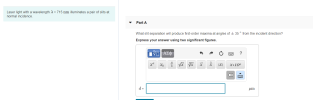 Laser light with a wavelength 1 = 715 nm illuminates a pair of slits at normal incidence. Part A What slit separation will produce first-order maxima at angles of +35 ° from the incident direction? Express your answer using two significant figures. B V AE xa x 9 A x O B ? î xxl x.10r V x V x um
Constants Periodic Table 675 nm illuminates a pair Part A Laser light with a wavelength of...
 Constants Periodic Table 675 nm illuminates a pair Part A Laser light with a wavelength of slits at normal incidence. What slit separation will produce first-order maxima at angles of ± 25° from the incident direction? Express your answer using two significant figures Submit uest Ans Provide Feedback
< Homework 10 Problem 28.16 (< 5 of 11 ( II Reviev Laser light with a...
 < Homework 10 Problem 28.16 (< 5 of 11 ( II Reviev Laser light with a wavelength 1 = 665 nm illuminates a pair of slits at normal incidence. Part A What slit separation will produce first-order maxima at angles of +35 ° from the incident direction? Express your answer using two significant figures. IVO AD 0 2 ? um Submit Previous Answers Request Answer
A pair of narrow slits is illuminated with light of wavelength λ= 566.1 nm. The resulting...
A pair of narrow slits is illuminated with light of wavelength λ= 566.1 nm. The resulting interference maxima are found to be separated by 0.90 mm on a screen 1.18 m from the slits. What is the separation of the slits? (mm)
A pair of narrow slits is illuminated with light of wavelength λ= 542.1 nm. The resulting...
A pair of narrow slits is illuminated with light of wavelength λ= 542.1 nm. The resulting interference maxima are found to be separated by 0.92 mm on a screen 0.86 m from the slits. What is the separation of the slits? (mm) Please show your work!
a.) Light with wavelength 650 nm illuminates a double slit where the spacing between the slits...
a.) Light with wavelength 650 nm illuminates a double slit where the spacing between the slits is 6500 nm. Determine the angles at which all the bright fringes that appear. b.) Light with wavelength λ illuminates a double slit with split spacing and 8.1λ. Determine the number of bright fringes that appear.
Green light of wavelength 540 nm is incident on two slits that are separated by 0.50...
Green light of wavelength 540 nm is incident on two slits that are separated by 0.50 mm. 1) Determine the angles of the first two maxima of the interference pattern (not including the central band). 2) What can you change (keeping the other parameters constant) in order to double the distance between the 0th order and the first order maximum on the screen? (CHOOSE ALL THAT APPLY) A) Double the wavelength B) Reduce by one-half the separation between the screen...
The wavelength of light emitted by a particular laser is 497nm. This laser light illuminates two...
 The wavelength of light emitted by a particular laser is 497nm. This laser light illuminates two slits that are 42 um apart. (a) What is the angular separation between the n = 2 and n = -2 maxima? (b) If a screen is placed 1.10 m from the slits, what is the distance between these two maxima? (c) If you want these two maxima to be 1.00 cm apart, how far from the slits do you need to place the...
Monochromatic light from a helium-neon laser of wavelength 632.8 nm is incident normally on a pair...
Monochromatic light from a helium-neon laser of wavelength 632.8 nm is incident normally on a pair of parallel slits separated by 0.25 mm. If the laser is replaced by the microwave transmitter in your experimental setup transmitting 3 cm waves, what slit separation will be needed to maintain the same angle for the first bright fringe? Give the number only with 2 significant digits after the decimal point, assuming units are in meters.
5. You have a screen with 100 parallel slits. Each slit is 0.5 microns wide, and...
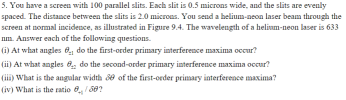 5. You have a screen with 100 parallel slits. Each slit is 0.5 microns wide, and the slits are evenly spaced. The distance between the slits is 2.0 microns. You send a helium-neon laser beam through the screen at normal incidence, as illustrated in Figure 9.4. The wavelength of a helium-neon laser is 633 nm. Answer each of the following questions. (i) At what angles 0. do the first-order primary interference maxima occur? (ii) At what angles 0.2 do the...
 Laser light with a wavelength 1 = 715 nm illuminates a pair of slits at normal incidence. Part A What slit separation will produce first-order maxima at angles of +35 ° from the incident direction? Express your answer using two significant figures. B V AE xa x 9 A x O B ? î xxl x.10r V x V x um
 Constants Periodic Table 675 nm illuminates a pair Part A Laser light with a wavelength of slits at normal incidence. What slit separation will produce first-order maxima at angles of ± 25° from the incident direction? Express your answer using two significant figures Submit uest Ans Provide Feedback
 < Homework 10 Problem 28.16 (< 5 of 11 ( II Reviev Laser light with a wavelength 1 = 665 nm illuminates a pair of slits at normal incidence. Part A What slit separation will produce first-order maxima at angles of +35 ° from the incident direction? Express your answer using two significant figures. IVO AD 0 2 ? um Submit Previous Answers Request Answer
 The wavelength of light emitted by a particular laser is 497nm. This laser light illuminates two slits that are 42 um apart. (a) What is the angular separation between the n = 2 and n = -2 maxima? (b) If a screen is placed 1.10 m from the slits, what is the distance between these two maxima? (c) If you want these two maxima to be 1.00 cm apart, how far from the slits do you need to place the...
 5. You have a screen with 100 parallel slits. Each slit is 0.5 microns wide, and the slits are evenly spaced. The distance between the slits is 2.0 microns. You send a helium-neon laser beam through the screen at normal incidence, as illustrated in Figure 9.4. The wavelength of a helium-neon laser is 633 nm. Answer each of the following questions. (i) At what angles 0. do the first-order primary interference maxima occur? (ii) At what angles 0.2 do the...
Most questions answered within 3 hours.
-
Where is the error in this code sequence?
String s1 = "Hello";
String s2 = "ello";...
asked 10 months ago -
Financial data for Joel de Paris, Inc., for last year
follow:
Joel de Paris, Inc.
Balance...
asked 10 months ago -
Consider this reaction:
Al2(SO4)3 (aq)+ BaCl3
(aq) Al2Cl6 (aq)- +
3BaSO4(s) . What is the...
asked 10 months ago -
Suppose that Savneet is considering increasing her
recent random sample from 20 car rentals to 40...
asked 10 months ago -
Trucks arrive at an unloading terminal at an average rate of 120
per hour.
Trucks arrive...
asked 10 months ago -
Why are methanol and ethanol completely soluble in water while
octanol is not very little soluble....
asked 10 months ago -
A facilities manager at a university reads in a research report
that the mean amount of...
asked 10 months ago -
When the CuSO4 is rehydrated by adding water to the anhydrous
compound, is this an endothermic...
asked 10 months ago -
A ray of sunlight is passing from diamond into crown glass; the
angle of incidence is...
asked 10 months ago -
A block of mass 0.249 kg is placed on top of a light, vertical
spring of...
asked 10 months ago -
how do the kidneys compensate in the presences of acidosis
a) trigger hyperventilate
b) reserve acid...
asked 10 months ago -
Question 501 pts
The rental rate of capital to the firm increases. Which of the
following...
asked 10 months ago