This is also for the Unknown 3 I am doing for microbiology. If you could please...
This is also for the Unknown 3 I am doing for microbiology. If you could please help in detail thanks.
A. Now that you have confirmed that PCR product is of correct size, using agarose gel electrophoresis, how will you find out that the amplified DNA fragment is our desired target region?
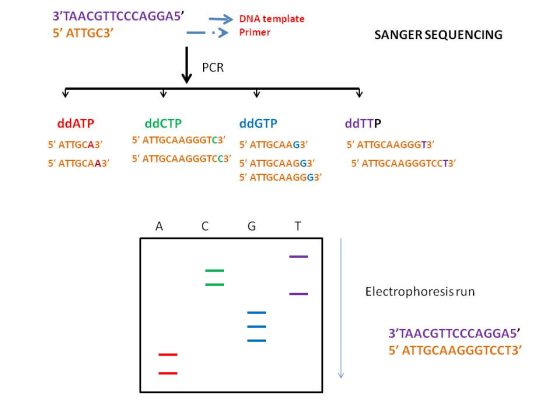
B. What is the principle of Sangers’ sequencing technique? Use a labeled diagram (may copy & paste image from internet) to briefly describe the technique. Write two differences between the reaction mixes for PCR and Sanger sequencing. Name any other sequencing techniques that can be used to obtain nucleotide sequence of your PCR product.
C. Will you be able to identify your unknown organism(s) if you used DNA sequence for conserved regions (instead of variable regions) from your PCR product? (Yes or No)
Homework Answers
A. In order to analyze whether the PCR product is the target region, the PCR product can be excised from the gel. In gel digestion is performed to extract the DNA in the extraction buffer. This DNA can then be sent for DNA sequencing using a Sanger’s sequencer. This sequence is aligned with the known sequence of target desired DNA to know whether PCR amplification was successful.
B. The Sangers sequencing technique uses dideoxynucleotides to interrupt the PCR. Wherever a ddNTP is added there is chain termination as there is no 3’ OH group on ddNTPs for Taq polymerase to add it to the newly synthesized strand. This will result in chain termination. Only one type of ddNTP (ddATP/ddCTP/ddTTP/ddGTP) is added to one of the four reaction tubes. The ddNTPs are labeled with different fluorescent dyes. Based on where chain termination occurs, fragments of different lengths are obtained. Image is attached.
These sequences can be aligned and the sequence can be deduced.
|
PCR |
Sangers Sequencing |
|
Only one product is formed of a fixed length determined by the PCR primers |
Fragments of different lengths are obtained depending on where chain termination occurs. |
|
ddNTPs are not used |
ddNTPs are added and there is excess of dNTPs. |
|
Both DNA strands are used for amplification. |
There is linear amplification with only one DNA strand. |
|
Detection is by Ethidium bromide method. |
Fluorescence tags are used for detecting the fragments. The ddNTPs are tagged with fluorescent dyes. |
Other sequencing method is the Maxim-Gilbert method in which the 5’ end of DNA is radiolabeled. Chemical degradation will remove single or 2-4 nucleotides in four tubes, by techniques such as hydrolysis, depurination etc. The sequence is then identified depending on fragments obtained on the gel by autoradiography. Nowadays next generation DNA sequencing methods are also used.
C. No.
Variable regions differ in nucleotide sequence between species. Conserved regions are the ones that will have same nucleotide sequence in all species of a genus and sometimes even in families. If variable regions are used for comparison, the species is easily identified. As conserved sequence will be same in many species, it will be difficult to identify the target organism. Hence, only variable sequence should be used.
Add Answer to:
This is also for the Unknown 3 I am doing for microbiology. If
you could please...
This is for an a 3 unknown I am doing in Microbiology. And I don't quite...
This is for an a 3 unknown I am doing in Microbiology. And I don't quite understand it, if you could please help thanks A. How did you prepare the template DNA? B. Name the gene that we will be sequencing in order to identify the unknown. C. Explain why this region is considered to be the target for identification instead of sequencing the entire genome? D. What is the size (in bp) of target DNA in E. coli? B....
Identification of unknown Bacteria by sequencing rDNA Having a little trouble understanding the PCR process. This...
Identification of unknown Bacteria by sequencing rDNA Having a little trouble understanding the PCR process. This is a lab we did and some homework questions regarding the sequencing rDNA to find unknown bacteria. I hope by answering these I can have better understanding of the process. The more descriptive the better. Thank you! 2. A. List the reagents used in preparing master mix for PCR and write one sentence about why each one was necessary. B. Now that you have...
Suppose you want to sequence the following DNA segment: 5’-GATCTCTTGAAATG-primer site-3’ You clone the fragment into...
Suppose you want to sequence the following DNA segment: 5’-GATCTCTTGAAATG-primer site-3’ You clone the fragment into a plasmid, transform it into bacterial cells and isolate DNA from one of the bacterial colonies. You use the Sanger sequencing method to determine the sequence, separating the products from the sequencing reactions by gel electrophoresis. Draw the bands that should appear on the gel from the four sequencing reactions.
Identification of unknown Bacteria by sequencing rDNA Having a little trouble understanding the PCR process. This...
Identification of unknown Bacteria by sequencing rDNA Having a little trouble understanding the PCR process. This is a lab we did and some homework questions regarding the sequencing rDNA to find unknown bacteria. I hope by answering these I can have better understanding of the process. The more descriptive the better. Thank you! 1. A. Name the gene that we will be sequencing in order to identify the unknown. Explain why this region is considered to be the target for...
You are studying a disease that is known to be caused by a single nucleotide change...
You are studying a disease that is known to be caused by a single nucleotide change in a single gene, although the effect this change ultimately has on the protein's structure and function is unknown. You have DNA samples from multiple patients that you suspect of having this disease. What is the most efficient way to test the samples for the relevant mutation? Select one: a. PCR amplification followed by Sanger DNA sequencing b. PCR amplification followed by gel electrophoresis...
find three errors in the pragraph and reconstruct the gel DI Succuleluujective vi, a 16 points)...
 find three errors in the pragraph and reconstruct the gel
DI Succuleluujective vi, a 16 points) PCR is a powerful tool used to isolate and make large quantities of a defined DNA fragment from a complex genome. PCR takes advantage of electrophoresis and synthetic oligonucleotides. Its starting material can be as small as a single cell. Because amplification is exponential, a single DNA molecule can be copied into hundreds of copies in a single day. Once a reference DNA sequence...
find three errors in the pragraph and reconstruct the gel
DI Succuleluujective vi, a 16 points) PCR is a powerful tool used to isolate and make large quantities of a defined DNA fragment from a complex genome. PCR takes advantage of electrophoresis and synthetic oligonucleotides. Its starting material can be as small as a single cell. Because amplification is exponential, a single DNA molecule can be copied into hundreds of copies in a single day. Once a reference DNA sequence...
Once a bacterial 16s rRNA gene has been amplified, it is possible to have the nucleotide...
Once a bacterial 16s rRNA gene has been amplified, it is possible to have the nucleotide sequence of the DNA determined. There are many different techniques for this. In lab, you isolated and amplified DNA from a known organism (Escherichia coli), but what if you had to identify an unknown organism? You would send the sample away for sequencing and then once you got the results you would “BLAST” the sequence. Using the Standard Nucleotide BLAST on NCBI and the...
Write true or false ______ 1. The DNA sequence of one human being is on average...
Write true or false ______ 1. The DNA sequence of one human being is on average 99.9% identical to another random human being. ______ 2. As of 2009, all living human beings have had their entire genome sequenced. ______ 3. The nucleotide bases present in a DNA sequence are A, U, G, C. ______ 4. Techniques that enabled scientists to clone genes were developed in the 1970s. ______ 5. A restriction enzyme is useful because it is a generic enzyme...
Luestion 3 1 pts Review: You have the DNA that is radioactively labeled at the S'ends...
 Luestion 3 1 pts Review: You have the DNA that is radioactively labeled at the S'ends of DNA as shown below. But you want DNA that is labeled only at one end of the DNA, not both ends. One of the other undergraduate students in the lab suggests that you use a restriction enzyme to cut the DNA, then electrophorese the DNA in an agarose gel, then cut out the region of the gel with radioactive DNA fragment you want,...
NEED HELP WITH THESE QUESTIONS. PLEASE ANSWER ALL AND EXPLAIN AS WELL. THANKSSSSSSS 1. You want...
 NEED HELP WITH THESE QUESTIONS. PLEASE ANSWER ALL AND EXPLAIN AS
WELL. THANKSSSSSSS
1. You want to clone a gene from a donor vector to a host vector. List the correct order of events in the process of cloning a. Perform ligation reaction of cloned gene and host vector. b. Perform double digestion of both donor and host vectors with the 2 restriction enzymes c. Examine donor and host vectors for restriction sites d. Purify cloned gene from donor vector...
NEED HELP WITH THESE QUESTIONS. PLEASE ANSWER ALL AND EXPLAIN AS
WELL. THANKSSSSSSS
1. You want to clone a gene from a donor vector to a host vector. List the correct order of events in the process of cloning a. Perform ligation reaction of cloned gene and host vector. b. Perform double digestion of both donor and host vectors with the 2 restriction enzymes c. Examine donor and host vectors for restriction sites d. Purify cloned gene from donor vector...
 find three errors in the pragraph and reconstruct the gel
DI Succuleluujective vi, a 16 points) PCR is a powerful tool used to isolate and make large quantities of a defined DNA fragment from a complex genome. PCR takes advantage of electrophoresis and synthetic oligonucleotides. Its starting material can be as small as a single cell. Because amplification is exponential, a single DNA molecule can be copied into hundreds of copies in a single day. Once a reference DNA sequence...
find three errors in the pragraph and reconstruct the gel
DI Succuleluujective vi, a 16 points) PCR is a powerful tool used to isolate and make large quantities of a defined DNA fragment from a complex genome. PCR takes advantage of electrophoresis and synthetic oligonucleotides. Its starting material can be as small as a single cell. Because amplification is exponential, a single DNA molecule can be copied into hundreds of copies in a single day. Once a reference DNA sequence...
 Luestion 3 1 pts Review: You have the DNA that is radioactively labeled at the S'ends of DNA as shown below. But you want DNA that is labeled only at one end of the DNA, not both ends. One of the other undergraduate students in the lab suggests that you use a restriction enzyme to cut the DNA, then electrophorese the DNA in an agarose gel, then cut out the region of the gel with radioactive DNA fragment you want,...
 NEED HELP WITH THESE QUESTIONS. PLEASE ANSWER ALL AND EXPLAIN AS
WELL. THANKSSSSSSS
1. You want to clone a gene from a donor vector to a host vector. List the correct order of events in the process of cloning a. Perform ligation reaction of cloned gene and host vector. b. Perform double digestion of both donor and host vectors with the 2 restriction enzymes c. Examine donor and host vectors for restriction sites d. Purify cloned gene from donor vector...
NEED HELP WITH THESE QUESTIONS. PLEASE ANSWER ALL AND EXPLAIN AS
WELL. THANKSSSSSSS
1. You want to clone a gene from a donor vector to a host vector. List the correct order of events in the process of cloning a. Perform ligation reaction of cloned gene and host vector. b. Perform double digestion of both donor and host vectors with the 2 restriction enzymes c. Examine donor and host vectors for restriction sites d. Purify cloned gene from donor vector...
Most questions answered within 3 hours.
-
Where is the error in this code sequence?
String s1 = "Hello";
String s2 = "ello";...
asked 10 months ago -
Financial data for Joel de Paris, Inc., for last year
follow:
Joel de Paris, Inc.
Balance...
asked 10 months ago -
Consider this reaction:
Al2(SO4)3 (aq)+ BaCl3
(aq) Al2Cl6 (aq)- +
3BaSO4(s) . What is the...
asked 10 months ago -
Suppose that Savneet is considering increasing her
recent random sample from 20 car rentals to 40...
asked 10 months ago -
Trucks arrive at an unloading terminal at an average rate of 120
per hour.
Trucks arrive...
asked 10 months ago -
Why are methanol and ethanol completely soluble in water while
octanol is not very little soluble....
asked 10 months ago -
A facilities manager at a university reads in a research report
that the mean amount of...
asked 10 months ago -
When the CuSO4 is rehydrated by adding water to the anhydrous
compound, is this an endothermic...
asked 10 months ago -
A ray of sunlight is passing from diamond into crown glass; the
angle of incidence is...
asked 10 months ago -
A block of mass 0.249 kg is placed on top of a light, vertical
spring of...
asked 10 months ago -
how do the kidneys compensate in the presences of acidosis
a) trigger hyperventilate
b) reserve acid...
asked 10 months ago -
Question 501 pts
The rental rate of capital to the firm increases. Which of the
following...
asked 10 months ago