Your task is to add code to this function in common_elements.c: int common_elements(int length, int source1[length],...
Your task is to add code to this function in common_elements.c:
int common_elements(int length, int source1[length], int source2[length], int destination[length]) {
    // PUT YOUR CODE HERE (you must change the next line!)
    return 42;
}
common_elements should copy the values in the first source array which are also found in the second source array, into the third array.
Homework Answers
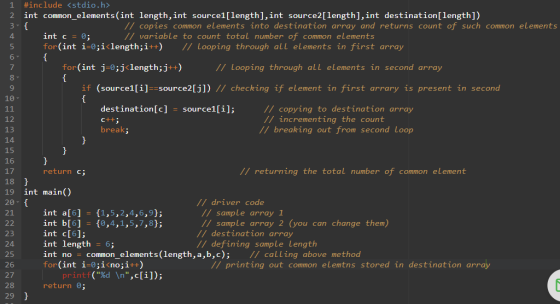
#include <stdio.h>
int common_elements(int length,int source1[length],int
source2[length],int destination[length])
{ // copies common elements into destination array and returns
count of such common elements
int c = 0; // variable to count total number of common
elements
for(int i=0;i<length;i++) // looping through all elements in
first array
{
for(int j=0;j<length;j++) // looping through all elements in
second array
{
if (source1[i]==source2[j]) // checking if element in first arrary
is present in second
{
destination[c] = source1[i]; // copying to destination array
c++; // incrementing the count
break; // breaking out from second loop
}
}
}
return c; // returning the total number of common element
}
int main()
{ // driver code
int a[6] = {1,5,2,4,6,9}; // sample array 1
int b[6] = {0,4,1,5,7,8}; // sample array 2 (you can change
them)
int c[6]; // destination array
int length = 6; // defining sample length
int no = common_elements(length,a,b,c); // calling above
method
for(int i=0;i<no;i++) // printing out common elemtns stored in
destination array
printf("%d \n",c[i]);
return 0;
}
Sample output:

Add Answer to:
Your task is to add code to this function in
common_elements.c:
int common_elements(int length, int source1[length],...
Consider the following code segment: int main() cons int SIZE -20; int values [SIZE] - f0,...
 Consider the following code segment: int main() cons int SIZE -20; int values [SIZE] - f0, 23, 34, -7, 110, 42,-350, 424, 25, 99, 10, 05, 50, -5, 1, 200, -350, 437, 25, 147}; // your code goes here Write a complete program to display the values from each of the following four steps All displays must be done in main. Use separate functions for each step below, passing the array to each function. 1.1) Provide the sum of the...
Programming language C Please go through this carefully. Needs function void add(int *a1, int n, int...
Programming language C Please go through this carefully. Needs function void add(int *a1, int n, int *a2) Write a program addition.c that reads in an array (a1) of numbers, and creates a new array (a2) of numbers such that the first and last numbers of a1 are added and stored as the first number, the second and second-to-last numbers are added and stored as the second number, and so on. You need to check for even and odd length of...
// PLACE YOUR NAME HERE #include <iostream> using namespace std; float findAverage (int [], int); //...
// PLACE YOUR NAME HERE #include <iostream> using namespace std; float findAverage (int [], int); // finds average of all //grades int findHighest (int [], int); // finds highest of all //grades int findFirstFail( int[]); int main() { int grades[100]; // the array holding 100 grades. int numberOfGrades; // the number of grades read. int pos; // index to the array. float avgOfGrades; // contains the average of the grades. int highestGrade; // contains the highest grade. int inderOfFail; //...
Your task is to develop a large hexadecimal integer calculator that works with hexadecimal integers of...
Your task is to develop a large hexadecimal integer calculator that works with hexadecimal integers of up to 100 digits (plus a sign). The calculator has a simple user interface, and 10 \variables" (n0, n1, ..., n9) into which hexadecimal integers can be stored. For example a session with your calculator might look like: mac: ./assmt1 > n0=0x2147483647 > n0+0x3 > n0? 0x214748364A > n1=0x1000000000000000000 > n1+n0 > n1? 0x100000000214748364A > n0? 0x214748364A > exit mac: Note: \mac: " is...
complete in C++ code Lists Many programming languages have some kind list data structure, which allows...
complete in C++ code Lists Many programming languages have some kind list data structure, which allows for insertion and deletion of elements, essentially an array that changes size. C++ has vectors, Java has the ArrayList, Python has lists (which is what they're called generically anyway). But how do they really work? All of these actually use arrays, which naturally have immutable lengths. Your Task Your task is to write a function, insert, which inserts a new item into an existing...
PLEASE HELP ME WITH THIS TASK 3.1 (FLOWCHART) AND TASK 3.2 (SOURCE PROGRAM). THANK YOU! Hint:...
 PLEASE HELP ME WITH THIS TASK 3.1 (FLOWCHART)
AND TASK 3.2 (SOURCE PROGRAM). THANK YOU!
Hint: the number array in task 2 is work for task 3 in
figure 1.
Given below is a partially completed C program, which you will use as a start to complete the given tasks. #define SIZE 9 #include <stdio.h> int compareAndCount (int[], int[]); double averageDifference (int[], int[]); void main() { } int compareAndCount(int arr1[SIZE], int arr2[SIZE]) { int count = 0; for (int i...
PLEASE HELP ME WITH THIS TASK 3.1 (FLOWCHART)
AND TASK 3.2 (SOURCE PROGRAM). THANK YOU!
Hint: the number array in task 2 is work for task 3 in
figure 1.
Given below is a partially completed C program, which you will use as a start to complete the given tasks. #define SIZE 9 #include <stdio.h> int compareAndCount (int[], int[]); double averageDifference (int[], int[]); void main() { } int compareAndCount(int arr1[SIZE], int arr2[SIZE]) { int count = 0; for (int i...
Arrays C++ #include <iostream> using namespace std; int main() { int tests[6]; // array declaration...
Arrays C++ #include <iostream> using namespace std; int main() { int tests[6]; // array declaration int sum = 0; float avg; //input test scores cout << " Enter " << 6 << " test scores: " << endl; for (int i = 0; i < 6; i++) { cout << "Enter Test " << i + 1 << ": "; cin >> tests[i]; } return 0; } Type...
c++, we have to write functions for the code given below and other instructions for it...
 c++, we have to write functions for the code given below and other
instructions for it to compile. I am having issues understanding
how to confront the problem and how to write functions and read the
program so it can eventually be solved so it can be compiled
7/ * INSTRUCTIONS: Write two functions in the space // * indicated below. // * // * #1 => Find index of maximum value: Write a function that will // * find...
c++, we have to write functions for the code given below and other
instructions for it to compile. I am having issues understanding
how to confront the problem and how to write functions and read the
program so it can eventually be solved so it can be compiled
7/ * INSTRUCTIONS: Write two functions in the space // * indicated below. // * // * #1 => Find index of maximum value: Write a function that will // * find...
in c++ You must implement the function: string get_ap_terms(int a, int d, size_t n); which returns...
in c++ You must implement the function: string get_ap_terms(int a, int d, size_t n); which returns a string containing the first n terms of the arithmetic progression (AP) as a sequence of comma-separated values. Recall that an AP is specified by two terms a and d. The first term is a, and the d is how much you add to each term to get the next term. So the first N terms of the above AP will be: a, a+d,...
/* Array expander: Write a function that accepts an int array as argument. The function should...
/* Array expander: Write a function that accepts an int array as argument. The function should create a new array that is n times the size of the argument array, where n is a user input. The function should copy the contents of the argument array to the new array, and initialize the unused elements of the second array with 0. The function should return a pointer to the new array */ #include <iostream> using namespace std; const int NUM_ELEM...
 Consider the following code segment: int main() cons int SIZE -20; int values [SIZE] - f0, 23, 34, -7, 110, 42,-350, 424, 25, 99, 10, 05, 50, -5, 1, 200, -350, 437, 25, 147}; // your code goes here Write a complete program to display the values from each of the following four steps All displays must be done in main. Use separate functions for each step below, passing the array to each function. 1.1) Provide the sum of the...
 PLEASE HELP ME WITH THIS TASK 3.1 (FLOWCHART)
AND TASK 3.2 (SOURCE PROGRAM). THANK YOU!
Hint: the number array in task 2 is work for task 3 in
figure 1.
Given below is a partially completed C program, which you will use as a start to complete the given tasks. #define SIZE 9 #include <stdio.h> int compareAndCount (int[], int[]); double averageDifference (int[], int[]); void main() { } int compareAndCount(int arr1[SIZE], int arr2[SIZE]) { int count = 0; for (int i...
PLEASE HELP ME WITH THIS TASK 3.1 (FLOWCHART)
AND TASK 3.2 (SOURCE PROGRAM). THANK YOU!
Hint: the number array in task 2 is work for task 3 in
figure 1.
Given below is a partially completed C program, which you will use as a start to complete the given tasks. #define SIZE 9 #include <stdio.h> int compareAndCount (int[], int[]); double averageDifference (int[], int[]); void main() { } int compareAndCount(int arr1[SIZE], int arr2[SIZE]) { int count = 0; for (int i...
 c++, we have to write functions for the code given below and other
instructions for it to compile. I am having issues understanding
how to confront the problem and how to write functions and read the
program so it can eventually be solved so it can be compiled
7/ * INSTRUCTIONS: Write two functions in the space // * indicated below. // * // * #1 => Find index of maximum value: Write a function that will // * find...
c++, we have to write functions for the code given below and other
instructions for it to compile. I am having issues understanding
how to confront the problem and how to write functions and read the
program so it can eventually be solved so it can be compiled
7/ * INSTRUCTIONS: Write two functions in the space // * indicated below. // * // * #1 => Find index of maximum value: Write a function that will // * find...
Most questions answered within 3 hours.
-
Where is the error in this code sequence?
String s1 = "Hello";
String s2 = "ello";...
asked 10 months ago -
Financial data for Joel de Paris, Inc., for last year
follow:
Joel de Paris, Inc.
Balance...
asked 10 months ago -
Consider this reaction:
Al2(SO4)3 (aq)+ BaCl3
(aq) Al2Cl6 (aq)- +
3BaSO4(s) . What is the...
asked 10 months ago -
Suppose that Savneet is considering increasing her
recent random sample from 20 car rentals to 40...
asked 10 months ago -
Trucks arrive at an unloading terminal at an average rate of 120
per hour.
Trucks arrive...
asked 10 months ago -
Why are methanol and ethanol completely soluble in water while
octanol is not very little soluble....
asked 10 months ago -
A facilities manager at a university reads in a research report
that the mean amount of...
asked 10 months ago -
When the CuSO4 is rehydrated by adding water to the anhydrous
compound, is this an endothermic...
asked 10 months ago -
A ray of sunlight is passing from diamond into crown glass; the
angle of incidence is...
asked 10 months ago -
A block of mass 0.249 kg is placed on top of a light, vertical
spring of...
asked 10 months ago -
how do the kidneys compensate in the presences of acidosis
a) trigger hyperventilate
b) reserve acid...
asked 10 months ago -
Question 501 pts
The rental rate of capital to the firm increases. Which of the
following...
asked 10 months ago