The zinc within a copper-plated penny will dissolve in hydrochloric acid if the copper coating is...
The zinc within a copper-plated penny will dissolve in
hydrochloric acid if the copper coating is filed down in several
spots (so that the hydrochloric acid can get to the zinc). The
reaction between the acid and the zinc is
2H+(aq)+Zn(s)→H2(g)+Zn2+(aq)2H+(aq)+Zn(s)→H2(g)+Zn2+(aq).
When the zinc in a certain penny dissolves, the total volume of gas
collected over water at 25 ∘C∘C was 0.961 L L at a total
pressure of 0.995 bar bar .
What mass of hydrogen gas was collected? The vapour pressure of water at 25 ∘C∘C is 0.03171 bar.
Homework Answers
Solution-
The equation can be written as
2H+(aq) + Zn(s) ------> H2(g) + Zn2+(aq)
pressure = 743 - 23.78
= 719.22 mm og Hg
So the pressure = (719.22 / 760)
= 0.9463 atm
PV = nRT
=>0.9463 * 0.961 = n * 0.0821 * 298
=>0.9093/24.4658=n
=>n = 0.037 moles
So the mass of H2 = 0.037 * 2
=0.074 g
Add Answer to:
The zinc within a copper-plated penny will dissolve in
hydrochloric acid if the copper coating is...
Part A The zinc within a copper-plated penny will dissolve in hydrochloric acid if the copper...
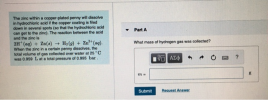 Part A The zinc within a copper-plated penny will dissolve in hydrochloric acid if the copper coating is filed down in several spots (so that the hydrochloric acid can get to the zinc). The reaction between the acid and the zinc is 2H+ (aq) + Zn(8) ► H,(9) + Zn2+ (aq). When the zinc in a certain penny dissolves, the total volume of gas collected over water at 25°C was 0.959 L at a total pressure of 0.995 bar. What...
The zinc within a copper-plated penny will dissolve inhydrochloric acid if the copper coating is...
The zinc within a copper-plated penny will dissolve in hydrochloric acid if the copper coating is filed down in several spots (so that the hydrochloric acid can get to the zinc). The reaction between the acid and the zinc is 2H+(aq)+Zn(s)→H2(g)+Zn2+(aq).When the zinc in a certain penny dissolves, the total volume of gas collected over water at 25 ∘C was 0.957 L at a total pressure of 0.993 bar.What mass of hydrogen gas was collected? (g)
A Review | Const Part A The zinc within a copper-plated penny will dissolve in hydrochloric...
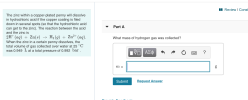 A Review | Const Part A The zinc within a copper-plated penny will dissolve in hydrochloric acid if the copper coating is filed down in several spots (so that the hydrochloric acid can get to the zinc). The reaction between the acid and the zinc is 2H+ (aq) + Zn(s) + H2(g) + Zn2+ (aq). When the zinc in a certain penny dissolves, the total volume of gas collected over water at 25°C was 0.949 L at a total pressure...
69. The zinc in a copper-plated penny will dissolve in hydrochloric acid if the copper coating is filed down in...
 69. The zinc in a copper-plated penny will dissolve in hydrochloric acid if the copper coating is filed down in several spots (so that the hydrochloric acid can get to the zinc). The reaction between the acid and the zinc is 2 H+ (aq) + Zn(s) -> H2(g) + Zn (aq). When the zinc in a certain penny dissolves, the total volume of gas collected over water at 25 °C is 0.951 L at a total pressure of 748 mmHg....
circle answers Exercise 5.71 R The zine within a copper-plated penny will dissolve in hydrochloric acid...
 circle answers
Exercise 5.71 R The zine within a copper-plated penny will dissolve in hydrochloric acid if the copper coating is filed down in several spots (so that the hydrochloric acid can get to the zinc). The reaction between the acid and the zinc is Part A 2H (aq) + Zn(s) -H2 (g) +Zn' (aq) When the zinc in a certain penny dissolves, the total volume of gas collected over water at 25 C was 0.957 L at a total...
circle answers
Exercise 5.71 R The zine within a copper-plated penny will dissolve in hydrochloric acid if the copper coating is filed down in several spots (so that the hydrochloric acid can get to the zinc). The reaction between the acid and the zinc is Part A 2H (aq) + Zn(s) -H2 (g) +Zn' (aq) When the zinc in a certain penny dissolves, the total volume of gas collected over water at 25 C was 0.957 L at a total...
Exercise 5.71 < 9 of 10 > 1 Review Constants Periodic Table Part A The zinc...
 Exercise 5.71 < 9 of 10 > 1 Review Constants Periodic Table Part A The zinc within a copper-plated penny will dissolve in hydrochloric acid if the copper coating is filed down in several spots (so that the hydrochloric acid can get to the zinc). The reaction between the acid and the zinc is 2H+ (aq) + Zn(s) + H2(g) + Zn2+ (aq). When the zinc in a certain penny dissolves, the total volume of gas collected over water at...
please solve for me as always! Thanks you very much. Exercise 5.71 9 of 10 > Review Constants Periodi...
 please solve for me as always!
Thanks you very much.
Exercise 5.71 9 of 10 > Review Constants Periodic Table Part A The zinc within a copper-plated penny will dissolve in hydrochloric acid if the copper coating is filed down in several spots (so that the hydrochloric acid can get to the zinc). The reaction between the acid and the zinc is 2H+ (aq) + Zn(s) + H2(g) + Zn²+ (aq). When the zinc in a certain penny dissolves, the...
please solve for me as always!
Thanks you very much.
Exercise 5.71 9 of 10 > Review Constants Periodic Table Part A The zinc within a copper-plated penny will dissolve in hydrochloric acid if the copper coating is filed down in several spots (so that the hydrochloric acid can get to the zinc). The reaction between the acid and the zinc is 2H+ (aq) + Zn(s) + H2(g) + Zn²+ (aq). When the zinc in a certain penny dissolves, the...
Modern pennies are composed of zinc coated with copper. A student determines the mass of a...
Modern pennies are composed of zinc coated with copper. A student determines the mass of a penny to be 2.484 g and then makes several scratches in the copper coating (to expose the underlying zinc). The student puts the scratched penny in hydrochloric acid, where the following reaction occurs between the zinc and the HCl (the copper remains undissolved): Zn(s)+2HCl(aq)→H2(g)+ZnCl2(aq) The student collects the hydrogen produced over water at 25 ∘C. The collected gas occupies a volume of 0.899 L...
Hydrogen gas is produced by the reaction of hydrochloric acid on zinc metal: Zn (s) +...
Hydrogen gas is produced by the reaction of hydrochloric acid on zinc metal: Zn (s) + HCl (aq) --> ZnCl (aq) + H2 (g) If 155ml of gas was collected at 26℃ and the total pressure was 1.12 bar how many milli-moles (mmol) of hydrogen was produced? Vapour pressure of water at 26℃: 0.0233 barr, R = 0.08314 L*bar/mol*K MM's: Zn = 65.39 g/mol, H = 1.008 g/mol, Cl = 35.35g/mol
A sample of zinc metal is allowed to react completely with an excess of hydrochloric acid:...
 A sample of zinc metal is allowed to react completely with an excess of hydrochloric acid: Zn(s) + 2 HCl(aq) → ZnCl2(aq) + H2(8) look GO The hydrogen gas produced is collected over water at 25.0°C. The volume of the gas is 8.90 L, and the atmospheric pressure is 0.951 atm. Calculate the amount of zinc metal in grams consumed in the reaction. rint rences (Vapor pressure of water at 25°C = 23.8 mmHg.) gZn
 Part A The zinc within a copper-plated penny will dissolve in hydrochloric acid if the copper coating is filed down in several spots (so that the hydrochloric acid can get to the zinc). The reaction between the acid and the zinc is 2H+ (aq) + Zn(8) ► H,(9) + Zn2+ (aq). When the zinc in a certain penny dissolves, the total volume of gas collected over water at 25°C was 0.959 L at a total pressure of 0.995 bar. What...
 A Review | Const Part A The zinc within a copper-plated penny will dissolve in hydrochloric acid if the copper coating is filed down in several spots (so that the hydrochloric acid can get to the zinc). The reaction between the acid and the zinc is 2H+ (aq) + Zn(s) + H2(g) + Zn2+ (aq). When the zinc in a certain penny dissolves, the total volume of gas collected over water at 25°C was 0.949 L at a total pressure...
 69. The zinc in a copper-plated penny will dissolve in hydrochloric acid if the copper coating is filed down in several spots (so that the hydrochloric acid can get to the zinc). The reaction between the acid and the zinc is 2 H+ (aq) + Zn(s) -> H2(g) + Zn (aq). When the zinc in a certain penny dissolves, the total volume of gas collected over water at 25 °C is 0.951 L at a total pressure of 748 mmHg....
 circle answers
Exercise 5.71 R The zine within a copper-plated penny will dissolve in hydrochloric acid if the copper coating is filed down in several spots (so that the hydrochloric acid can get to the zinc). The reaction between the acid and the zinc is Part A 2H (aq) + Zn(s) -H2 (g) +Zn' (aq) When the zinc in a certain penny dissolves, the total volume of gas collected over water at 25 C was 0.957 L at a total...
circle answers
Exercise 5.71 R The zine within a copper-plated penny will dissolve in hydrochloric acid if the copper coating is filed down in several spots (so that the hydrochloric acid can get to the zinc). The reaction between the acid and the zinc is Part A 2H (aq) + Zn(s) -H2 (g) +Zn' (aq) When the zinc in a certain penny dissolves, the total volume of gas collected over water at 25 C was 0.957 L at a total...
 Exercise 5.71 < 9 of 10 > 1 Review Constants Periodic Table Part A The zinc within a copper-plated penny will dissolve in hydrochloric acid if the copper coating is filed down in several spots (so that the hydrochloric acid can get to the zinc). The reaction between the acid and the zinc is 2H+ (aq) + Zn(s) + H2(g) + Zn2+ (aq). When the zinc in a certain penny dissolves, the total volume of gas collected over water at...
 please solve for me as always!
Thanks you very much.
Exercise 5.71 9 of 10 > Review Constants Periodic Table Part A The zinc within a copper-plated penny will dissolve in hydrochloric acid if the copper coating is filed down in several spots (so that the hydrochloric acid can get to the zinc). The reaction between the acid and the zinc is 2H+ (aq) + Zn(s) + H2(g) + Zn²+ (aq). When the zinc in a certain penny dissolves, the...
please solve for me as always!
Thanks you very much.
Exercise 5.71 9 of 10 > Review Constants Periodic Table Part A The zinc within a copper-plated penny will dissolve in hydrochloric acid if the copper coating is filed down in several spots (so that the hydrochloric acid can get to the zinc). The reaction between the acid and the zinc is 2H+ (aq) + Zn(s) + H2(g) + Zn²+ (aq). When the zinc in a certain penny dissolves, the...
 A sample of zinc metal is allowed to react completely with an excess of hydrochloric acid: Zn(s) + 2 HCl(aq) → ZnCl2(aq) + H2(8) look GO The hydrogen gas produced is collected over water at 25.0°C. The volume of the gas is 8.90 L, and the atmospheric pressure is 0.951 atm. Calculate the amount of zinc metal in grams consumed in the reaction. rint rences (Vapor pressure of water at 25°C = 23.8 mmHg.) gZn
Most questions answered within 3 hours.
-
Where is the error in this code sequence?
String s1 = "Hello";
String s2 = "ello";...
asked 10 months ago -
Financial data for Joel de Paris, Inc., for last year
follow:
Joel de Paris, Inc.
Balance...
asked 10 months ago -
Consider this reaction:
Al2(SO4)3 (aq)+ BaCl3
(aq) Al2Cl6 (aq)- +
3BaSO4(s) . What is the...
asked 10 months ago -
Suppose that Savneet is considering increasing her
recent random sample from 20 car rentals to 40...
asked 10 months ago -
Trucks arrive at an unloading terminal at an average rate of 120
per hour.
Trucks arrive...
asked 10 months ago -
Why are methanol and ethanol completely soluble in water while
octanol is not very little soluble....
asked 10 months ago -
A facilities manager at a university reads in a research report
that the mean amount of...
asked 10 months ago -
When the CuSO4 is rehydrated by adding water to the anhydrous
compound, is this an endothermic...
asked 10 months ago -
A ray of sunlight is passing from diamond into crown glass; the
angle of incidence is...
asked 10 months ago -
A block of mass 0.249 kg is placed on top of a light, vertical
spring of...
asked 10 months ago -
how do the kidneys compensate in the presences of acidosis
a) trigger hyperventilate
b) reserve acid...
asked 10 months ago -
Question 501 pts
The rental rate of capital to the firm increases. Which of the
following...
asked 10 months ago