when buffers react with h+ or oh-, do the ratio of conjugate base to acid and...
when buffers react with h+ or oh-, do the ratio of conjugate base to acid and the ph of the solution change? why?
Homework Answers
Consider an acid buffer solution 
Added  ions react
with
ions react
with  ions to form HA. HA
is a weak acid and dissociates to a very small extent.
ions to form HA. HA
is a weak acid and dissociates to a very small extent.

In this process, added ions are
consumed. Hence, pH is not significantly affected. There is very
small pH change.

Since, ions are consumed
and HA is formed due to reaction of added ions, the
ratio is
significantly affected but the term
is
significantly affected but the term  is slightly affected as the log term has small value. Hence, pH is
little changed.
is slightly affected as the log term has small value. Hence, pH is
little changed.
Added  ions react with HA
to form ions.
ions react with HA
to form ions.

In this process, added ions are consumed.
Hence, pH is not significantly affected. There is very small pH
change.
Since, ions are formed and
HA is consumed due to reaction of added ions, the
ratiois
significantly affected but the term
is slightly affected as the log term has small value. Hence, pH is
little changed.
Add Answer to:
when buffers react with h+ or oh-, do the ratio of conjugate
base to acid and...
To understand how buffers use reserves of conjugate acid and conjugate base to counteract the effects...
To understand how buffers use reserves of conjugate acid and conjugate base to counteract the effects of acid or base addition on pH. A buffer is a mixture of a conjugate acid-base pair. In other words, it is a solution that contains a weak acid and its conjugate base, or a weak base and its conjugate acid. For example, an acetic acid buffer consists of acetic acid, CH3COOH, and its conjugate base, the acetate ion CH3COO−. Because ions cannot simply...
Learning Goal: To understand how buffers use reserves of conjugate acid and conjugate base to counteract...
Learning Goal: To understand how buffers use reserves of conjugate acid and conjugate base to counteract the effects of acid or base addition on pH. A buffer is a mixture of a conjugate acid-base pair. In other words, it is a solution that contains a weak acid and its conjugate base, or a weak base and its conjugate acid. For example, an acetic acid buffer consists of acetic acid, CH3COOH, and its conjugate base, the acetate ion CH3COO−. Because ions...
is a solution that resists changes in pH when a small amount of acid or base...
 is a solution that resists changes in pH when a small amount of acid or base is added to best buffer solutions are prepared from weak acids and their conjugate base added as a sodium of potassium salt. Most biological systems must maintain a very narrow range of pH; therefore, buffers allow the biological solution to function correctly. Blood is a good example of a biological system that must maintain a pH in a very narrow range from 7.3 to...
(d) Conjugate acid: OH"; conjugate base: H3* (e) None of these 5. Identify the conjugate acid/base...
 (d) Conjugate acid: OH"; conjugate base: H3* (e) None of these 5. Identify the conjugate acid/base pairs in the following equation (10) HASO4 + H2O <H2AsO4 + OH (A). HASO. (acid)HAsO4 (base): H2O (acid)/ OH (base) (B). HASO4 (acid)/HASO. (base): H2O (acid)/ OH (base) (C). H2AsO4 (acid)/ OH (base) ; H2O (acid)/HASO4 (base) (D). H AsO4 and H20 (acids): OH and HASO4(bases) (E). None of these 6. Which is an INCORRECT statement?(10) a) The conjugate base of H2O is OH....
Physiological buffers can be prepared by combining the base HPO4 with its conjugate acid H2P0,- (pk,...
 Physiological buffers can be prepared by combining the base HPO4 with its conjugate acid H2P0,- (pk, -7.21) as per the equilibrium shown below. H3PO,- (aq) 2 HPO 2- (aq) + H+ (aq) Calculate the molar ratio of (HPO 2-Y(H2PO4) needed to prepare a buffer with pH = 7.40 Calculate the grams of Na2HPO4 (141.96 g/mol) required to prepare a buffer of pH = 7.40 if 12.584 g of NaH,PO(119.98 g/mol) are available.
Acid Base ⇄ Conjugate Acid Conjugate Base (A) CH3COOH H2O ⇄ (B) NH3 H2O ⇄ (C)...
Acid Base ⇄ Conjugate Acid Conjugate Base (A) CH3COOH H2O ⇄ (B) NH3 H2O ⇄ (C) ⇄ HF OH− (D) H2O → I− (E) C5H5NH+ H2O ⇄ [H+] [OH−] pH pOH Acid, Base or Neutral (A) 1.0x10⁻³ M (B) 4.5x10‒8 M (C) 9.45 (D) 1.33
Experiment 11-Pre-lab Questions listed give the conjugate base, and indicate if a solution of the conjugate...
 Experiment 11-Pre-lab Questions listed give the conjugate base, and indicate if a solution of the conjugate acid-base pair would act as a buffer. Acid a. HCI b. HF e. HNO, d. CH,CO,H e. HBr Conjugate base CI- Buffered Solution? No 2. A buffered solution will resist changes in pH when small amounts of acid or base are added. However if a large amount of acid or base is added, the buffer will cease to work and a large pH change...
Buffers work best when O the ratio of H+ to OH is close to 1.0 O...
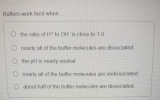 Buffers work best when O the ratio of H+ to OH is close to 1.0 O nearly all of the buffer molecules are dissociated. the pH is nearly neutral O nearly all of the buffer molecules are undissociated. O about half of the buffer molecules are dissociated.
1. Identify the acid (A), base (B), conjugate acid (CA) and the conjugate base (CB) in...
 1. Identify the acid (A), base (B), conjugate acid (CA) and the conjugate base (CB) in the following equation (5) NH3(aq) + H2O + NH(aq) + OH(aq) B CB CA 2. Determine the pH of a solution at 25°C in which the hydronium ion [H3O+] is 3.5 X 10 - log 3.5x10⁻⁴ - pH = 3.45 M. C 3. Calculate the [H3O+] in a solution at 25°C in which the pH is 4.76. (5)
If you wanted a ratio of conjugate base over fatty acid ([A-]/[HA]) of 100 in aqueous...
If you wanted a ratio of conjugate base over fatty acid ([A-]/[HA]) of 100 in aqueous solution, what should you adjust the pH of the solution to?
 is a solution that resists changes in pH when a small amount of acid or base is added to best buffer solutions are prepared from weak acids and their conjugate base added as a sodium of potassium salt. Most biological systems must maintain a very narrow range of pH; therefore, buffers allow the biological solution to function correctly. Blood is a good example of a biological system that must maintain a pH in a very narrow range from 7.3 to...
 (d) Conjugate acid: OH"; conjugate base: H3* (e) None of these 5. Identify the conjugate acid/base pairs in the following equation (10) HASO4 + H2O <H2AsO4 + OH (A). HASO. (acid)HAsO4 (base): H2O (acid)/ OH (base) (B). HASO4 (acid)/HASO. (base): H2O (acid)/ OH (base) (C). H2AsO4 (acid)/ OH (base) ; H2O (acid)/HASO4 (base) (D). H AsO4 and H20 (acids): OH and HASO4(bases) (E). None of these 6. Which is an INCORRECT statement?(10) a) The conjugate base of H2O is OH....
 Physiological buffers can be prepared by combining the base HPO4 with its conjugate acid H2P0,- (pk, -7.21) as per the equilibrium shown below. H3PO,- (aq) 2 HPO 2- (aq) + H+ (aq) Calculate the molar ratio of (HPO 2-Y(H2PO4) needed to prepare a buffer with pH = 7.40 Calculate the grams of Na2HPO4 (141.96 g/mol) required to prepare a buffer of pH = 7.40 if 12.584 g of NaH,PO(119.98 g/mol) are available.
 Experiment 11-Pre-lab Questions listed give the conjugate base, and indicate if a solution of the conjugate acid-base pair would act as a buffer. Acid a. HCI b. HF e. HNO, d. CH,CO,H e. HBr Conjugate base CI- Buffered Solution? No 2. A buffered solution will resist changes in pH when small amounts of acid or base are added. However if a large amount of acid or base is added, the buffer will cease to work and a large pH change...
 Buffers work best when O the ratio of H+ to OH is close to 1.0 O nearly all of the buffer molecules are dissociated. the pH is nearly neutral O nearly all of the buffer molecules are undissociated. O about half of the buffer molecules are dissociated.
 1. Identify the acid (A), base (B), conjugate acid (CA) and the conjugate base (CB) in the following equation (5) NH3(aq) + H2O + NH(aq) + OH(aq) B CB CA 2. Determine the pH of a solution at 25°C in which the hydronium ion [H3O+] is 3.5 X 10 - log 3.5x10⁻⁴ - pH = 3.45 M. C 3. Calculate the [H3O+] in a solution at 25°C in which the pH is 4.76. (5)
Most questions answered within 3 hours.
-
Where is the error in this code sequence?
String s1 = "Hello";
String s2 = "ello";...
asked 10 months ago -
Financial data for Joel de Paris, Inc., for last year
follow:
Joel de Paris, Inc.
Balance...
asked 10 months ago -
Consider this reaction:
Al2(SO4)3 (aq)+ BaCl3
(aq) Al2Cl6 (aq)- +
3BaSO4(s) . What is the...
asked 10 months ago -
Suppose that Savneet is considering increasing her
recent random sample from 20 car rentals to 40...
asked 10 months ago -
Trucks arrive at an unloading terminal at an average rate of 120
per hour.
Trucks arrive...
asked 10 months ago -
Why are methanol and ethanol completely soluble in water while
octanol is not very little soluble....
asked 10 months ago -
A facilities manager at a university reads in a research report
that the mean amount of...
asked 10 months ago -
When the CuSO4 is rehydrated by adding water to the anhydrous
compound, is this an endothermic...
asked 10 months ago -
A ray of sunlight is passing from diamond into crown glass; the
angle of incidence is...
asked 10 months ago -
A block of mass 0.249 kg is placed on top of a light, vertical
spring of...
asked 10 months ago -
how do the kidneys compensate in the presences of acidosis
a) trigger hyperventilate
b) reserve acid...
asked 10 months ago -
Question 501 pts
The rental rate of capital to the firm increases. Which of the
following...
asked 10 months ago