QUESTIONS: Is the mechanical energy remaining the same (conserved) with time? Is the decrease in the...
QUESTIONS:
- Is the mechanical energy remaining the same (conserved) with time?
- Is the decrease in the potential energy get completely converted into the kinetic energy?
- What is the cause of any mechanical energy loss in this experiment?
- Since energy is never really lost, what types of energy was this “loss” transferred into?
Homework Answers

Add Answer to:
QUESTIONS:
Is the mechanical energy remaining the same
(conserved) with time?
Is the decrease in the...
Kinetic energy was not conserved in any of the 6 cases studied today. Since we know total energy ...
Kinetic energy was not conserved in any of the 6 cases studied today. Since we know total energy is conserved, explain what may have happened to the kinetic energy that was "lost".
Mechanical energy is conserved in the presence of which of thefollowing types of forces?Conservation...
 Mechanical energy is conserved in the presence of which of the
following types of forces?PSS 21.1 Conservation of energy in charge interactions Learning Goal: To practice Problem-Solving Strategy 21.1 Conservation of energy in charge interactions. An alpha particle (a), which is the same as a helium-4 nucleus, is momentarily at rest in a region of space occupied by an electric field. The particle then begins to move. Find the speed of the alpha particle after it has moved through a potential difference of-3.45x10⁻³V.The...
Mechanical energy is conserved in the presence of which of the
following types of forces?PSS 21.1 Conservation of energy in charge interactions Learning Goal: To practice Problem-Solving Strategy 21.1 Conservation of energy in charge interactions. An alpha particle (a), which is the same as a helium-4 nucleus, is momentarily at rest in a region of space occupied by an electric field. The particle then begins to move. Find the speed of the alpha particle after it has moved through a potential difference of-3.45x10⁻³V.The...
The energy of motion is called: Kinetic energy. potential energy, inertial energy. Power. In an inelastic...
 The energy of motion is called: Kinetic energy. potential energy, inertial energy. Power. In an inelastic collision: momentum is conserved. kinetic energy is conserved, both (a) and (b). If the velocity of a moving object is doubled and its mass is cut in half, the kinetic energy of the object is; remains the same, doubled quadrupled, cut in half. When the net work done on an object is speed of the object is me on an object is zero; the...
What does conservation of mechanical energy mean? a.Heat is created but we cannot measure it. b.Kinetic...
What does conservation of mechanical energy mean? a.Heat is created but we cannot measure it. b.Kinetic energy cannot be converted to potential energy. c.None of the other answers. d.The potential energy remains the same. e.The kinetic energy remains the same.
Remarks Because the impact is inelastic, it would be incorrect to equate the initial kinetic energy...
Remarks Because the impact is inelastic, it would be incorrect to equate the initial kinetic energy of the incoming bullet to the final gravitational potential energy associated with the bullet-block combination. The energy isn't conserved! Question---- The ways that mechanical energy is lost from the system in this experiment include: (Select all that apply.) 1) energy loss from the change in height of the block. 2) energy loss because the kinetic energy of the bullet becomes the kinetic energy of...
A 0.45 kg object rests on a frictionless horizontal surface, where it is attached to a...
 A 0.45 kg object rests on a frictionless horizontal surface, where it is attached to a massless spring whose k-value equals 24.0 N/m. Let x be the displacement, where x = o is the equilibrium position and x > 0 when the spring is stretched. The object is pushed, and the spring compressed, until хі =-4.00 cm. It then is released from rest and undergoes simple harmonic motion. (a) What is the object's maximum speed (in m/s) after it is...
Elastic collisions: one at rest one moving, two colliding, both initially moving the same direction. Inelastic...
Elastic collisions: one at rest one moving, two colliding, both initially moving the same direction. Inelastic collisions: one at rest one moving, two colliding, both initially moving the same direction. Perfectly elastic collisions: one at rest one moving, two colliding, both initially moving the same direction. Questions1. Was momentum conserved for all types of collisions you examined in this experiment? If not, explain the cause of losing orgaining momentum.2. Was total velocity conserved for all types of collisions you examined...
Pls, use Mathlab to answer all questions. Thank you. 2. The energy of the mass-spring system...
 Pls, use Mathlab to answer all questions.
Thank you.
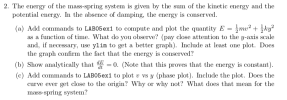
2. The energy of the mass-spring system is given by the sum of the kinetic energy and the potential energy. In the absence of damping, the energy is conserved mu2ky2 (a) Add commands to LAB05ex1 to compute and plot the quantity E as a function of time. What do you observe? (pay close attention to the y-axis scale and, if necessary, use ylim to get a better graph). Include at least...
Pls, use Mathlab to answer all questions.
Thank you.
2. The energy of the mass-spring system is given by the sum of the kinetic energy and the potential energy. In the absence of damping, the energy is conserved mu2ky2 (a) Add commands to LAB05ex1 to compute and plot the quantity E as a function of time. What do you observe? (pay close attention to the y-axis scale and, if necessary, use ylim to get a better graph). Include at least...
A 0.45 kg object rests on a frictionless horizontal surface, where it is attached to a...
 A 0.45 kg object rests on a frictionless horizontal surface, where it is attached to a massless spring whose k-value equals 24.0 N/m. Let x be the displacement, where x = 0 is the equilibrium position and x > 0 when the spring is stretched. The object is pushed, and the spring compressed, until x, =-4.00 cm. It then is released from rest and undergoes simple harmonic motion. (a) What is the object's maximum speed (in m/s) after it is...
Conservation of energy In the examples you have examined in this lab, as the coaster travels...
 Conservation of energy In the examples you have examined in this lab, as the coaster travels down the track its gravitational potential energy decreases, and its kinetic energy increases. At any point along the path of the coaster, the potential energy plus the kinetic energy add up to the same value. In the absence of friction and air resistance, we find that the total energy (kinetic plus potential) stays the same. For this reason, physicists call the total energy a...
 Mechanical energy is conserved in the presence of which of the
following types of forces?PSS 21.1 Conservation of energy in charge interactions Learning Goal: To practice Problem-Solving Strategy 21.1 Conservation of energy in charge interactions. An alpha particle (a), which is the same as a helium-4 nucleus, is momentarily at rest in a region of space occupied by an electric field. The particle then begins to move. Find the speed of the alpha particle after it has moved through a potential difference of-3.45x10⁻³V.The...
Mechanical energy is conserved in the presence of which of the
following types of forces?PSS 21.1 Conservation of energy in charge interactions Learning Goal: To practice Problem-Solving Strategy 21.1 Conservation of energy in charge interactions. An alpha particle (a), which is the same as a helium-4 nucleus, is momentarily at rest in a region of space occupied by an electric field. The particle then begins to move. Find the speed of the alpha particle after it has moved through a potential difference of-3.45x10⁻³V.The...
 The energy of motion is called: Kinetic energy. potential energy, inertial energy. Power. In an inelastic collision: momentum is conserved. kinetic energy is conserved, both (a) and (b). If the velocity of a moving object is doubled and its mass is cut in half, the kinetic energy of the object is; remains the same, doubled quadrupled, cut in half. When the net work done on an object is speed of the object is me on an object is zero; the...
 A 0.45 kg object rests on a frictionless horizontal surface, where it is attached to a massless spring whose k-value equals 24.0 N/m. Let x be the displacement, where x = o is the equilibrium position and x > 0 when the spring is stretched. The object is pushed, and the spring compressed, until хі =-4.00 cm. It then is released from rest and undergoes simple harmonic motion. (a) What is the object's maximum speed (in m/s) after it is...
 Pls, use Mathlab to answer all questions.
Thank you.
2. The energy of the mass-spring system is given by the sum of the kinetic energy and the potential energy. In the absence of damping, the energy is conserved mu2ky2 (a) Add commands to LAB05ex1 to compute and plot the quantity E as a function of time. What do you observe? (pay close attention to the y-axis scale and, if necessary, use ylim to get a better graph). Include at least...
Pls, use Mathlab to answer all questions.
Thank you.
2. The energy of the mass-spring system is given by the sum of the kinetic energy and the potential energy. In the absence of damping, the energy is conserved mu2ky2 (a) Add commands to LAB05ex1 to compute and plot the quantity E as a function of time. What do you observe? (pay close attention to the y-axis scale and, if necessary, use ylim to get a better graph). Include at least...
 A 0.45 kg object rests on a frictionless horizontal surface, where it is attached to a massless spring whose k-value equals 24.0 N/m. Let x be the displacement, where x = 0 is the equilibrium position and x > 0 when the spring is stretched. The object is pushed, and the spring compressed, until x, =-4.00 cm. It then is released from rest and undergoes simple harmonic motion. (a) What is the object's maximum speed (in m/s) after it is...
 Conservation of energy In the examples you have examined in this lab, as the coaster travels down the track its gravitational potential energy decreases, and its kinetic energy increases. At any point along the path of the coaster, the potential energy plus the kinetic energy add up to the same value. In the absence of friction and air resistance, we find that the total energy (kinetic plus potential) stays the same. For this reason, physicists call the total energy a...
Most questions answered within 3 hours.
-
Where is the error in this code sequence?
String s1 = "Hello";
String s2 = "ello";...
asked 10 months ago -
Financial data for Joel de Paris, Inc., for last year
follow:
Joel de Paris, Inc.
Balance...
asked 10 months ago -
Consider this reaction:
Al2(SO4)3 (aq)+ BaCl3
(aq) Al2Cl6 (aq)- +
3BaSO4(s) . What is the...
asked 10 months ago -
Suppose that Savneet is considering increasing her
recent random sample from 20 car rentals to 40...
asked 10 months ago -
Trucks arrive at an unloading terminal at an average rate of 120
per hour.
Trucks arrive...
asked 10 months ago -
Why are methanol and ethanol completely soluble in water while
octanol is not very little soluble....
asked 10 months ago -
A facilities manager at a university reads in a research report
that the mean amount of...
asked 10 months ago -
When the CuSO4 is rehydrated by adding water to the anhydrous
compound, is this an endothermic...
asked 10 months ago -
A ray of sunlight is passing from diamond into crown glass; the
angle of incidence is...
asked 10 months ago -
A block of mass 0.249 kg is placed on top of a light, vertical
spring of...
asked 10 months ago -
how do the kidneys compensate in the presences of acidosis
a) trigger hyperventilate
b) reserve acid...
asked 10 months ago -
Question 501 pts
The rental rate of capital to the firm increases. Which of the
following...
asked 10 months ago