Draw a different protonation states of histidine at pH 0, 4, 8, 12
Draw a different protonation states of histidine at pH 0, 4, 8, 12
Homework Answers
 lower the pKa of proton,more
it is acidic.So easier to deprotonate...2° amine are less basic
than 3° amine..Hence 2° deprotonate first... Please rate thumbs
UP
lower the pKa of proton,more
it is acidic.So easier to deprotonate...2° amine are less basic
than 3° amine..Hence 2° deprotonate first... Please rate thumbs
UP
if you like it.
3. Draw the predominant forms of lysine (in terms of the protonation states of the amino and carb...
 3. Draw the predominant forms of lysine (in terms of the protonation states of the amino and carboxylic acid groups) at pH 1,6,8, and 12. Ignore stereochemistry
3. Draw the predominant forms of lysine (in terms of the protonation states of the amino and carboxylic acid groups) at pH 1,6,8, and 12. Ignore stereochemistry
3. Draw the predominant forms of lysine (in terms of the protonation states of the amino and carboxylic acid groups) at pH 1,6,8, and 12. Ignore stereochemistry
Please help. Thank you!! Draw the protonation states for the following amino acids at pH 2,...
Please help. Thank you!! Draw the protonation states for the following amino acids at pH 2, 7, and 12. Glycine Lysine Glutamic acid
(5) A myoglobin similar to the ex ample we did in class had the protonation of a histidine residue coupled to the oxidation of a heme. The histidine had a pKA of 6.0 when the heme is oxidized and...
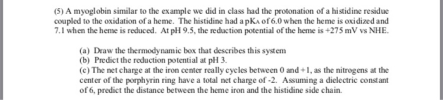 (5) A myoglobin similar to the ex ample we did in class had the protonation of a histidine residue coupled to the oxidation of a heme. The histidine had a pKA of 6.0 when the heme is oxidized and 7.1 when the heme is reduced. At pH 9.5, the reduction potential of the heme s +275 mV vs NHE (a) Draw the thermodynamic box that describes this system (b) Predict the reduction potential at pH 3. (c) The net charge...
II. SHORT ANSWER QUESTIONS 1. Draw the structures of the different protonation states of Lys (with...
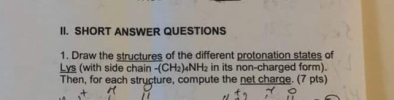 II. SHORT ANSWER QUESTIONS 1. Draw the structures of the different protonation states of Lys (with side chain -(CH2)4NH2 in its non-charged form). Then, for each struçture, compute the net charge. (7 pts)
Draw the change in the protonation state of acetic acid as a function of pH, knowing...
Draw the change in the protonation state of acetic acid as a function of pH, knowing the pKa value of 4.6.
Draw and label the titration curve of 1M histidine starting at pH 1.0 with 1.0M NaOH
Draw and label the titration curve of 1M histidine starting at pH 1.0 with 1.0M NaOH
Match the pH environment to the major ionization state of Histidine. (Not one- to-one.) pH =...
 Match the pH environment to the major ionization state of Histidine. (Not one- to-one.) pH = 1 pH = 2 pH = 4 pH = 7 pH = 12 pka = 6.0 OH pKa = 1.82 HEN 02 pKa = 9.17 HEN ΑΝ Η oo HN
The base protonation constant Kb of lidocane (C14H21NONH) is 1.5x10^-8. Calculate the pH of a 3.33...
The base protonation constant Kb of lidocane (C14H21NONH) is 1.5x10^-8. Calculate the pH of a 3.33 M solution of lidocane at 25 degrees Celcius. Round to 1 decimal place.
Match the pH environment to the major ionization state of Histidine. (Not one-to-one.) pH = 1...
 Match the pH environment to the major ionization state of Histidine. (Not one-to-one.) pH = 1 pH = 2 pH = 4 pH = 7 pH = 12 pKa = 6.0 OH -OH pKa = 1.82 H3N HN HON pKa = 9.17 OH POH HANH HN ΗΝ Η HON H HN
Please answer ALL questions or I'll thumbs down! 2) Imagine an enzyme that has a histidine...
 Please answer ALL questions or I'll thumbs
down!
2) Imagine an enzyme that has a histidine in the substrate binding pocket that regulates substrate binding based on its protonation state to control enzyme function. Substrates can only bind in the unprotonated state; in other words, substrate binding is blocked when the histidine is protonated and when the substrate is bound, the histidine cannot be protonated. This enzyme exhibits classical Michaelis-Menten behavior. a) Assume that the pka of the histidine in...
Please answer ALL questions or I'll thumbs
down!
2) Imagine an enzyme that has a histidine in the substrate binding pocket that regulates substrate binding based on its protonation state to control enzyme function. Substrates can only bind in the unprotonated state; in other words, substrate binding is blocked when the histidine is protonated and when the substrate is bound, the histidine cannot be protonated. This enzyme exhibits classical Michaelis-Menten behavior. a) Assume that the pka of the histidine in...
 3. Draw the predominant forms of lysine (in terms of the protonation states of the amino and carboxylic acid groups) at pH 1,6,8, and 12. Ignore stereochemistry
3. Draw the predominant forms of lysine (in terms of the protonation states of the amino and carboxylic acid groups) at pH 1,6,8, and 12. Ignore stereochemistry
3. Draw the predominant forms of lysine (in terms of the protonation states of the amino and carboxylic acid groups) at pH 1,6,8, and 12. Ignore stereochemistry
 (5) A myoglobin similar to the ex ample we did in class had the protonation of a histidine residue coupled to the oxidation of a heme. The histidine had a pKA of 6.0 when the heme is oxidized and 7.1 when the heme is reduced. At pH 9.5, the reduction potential of the heme s +275 mV vs NHE (a) Draw the thermodynamic box that describes this system (b) Predict the reduction potential at pH 3. (c) The net charge...
 II. SHORT ANSWER QUESTIONS 1. Draw the structures of the different protonation states of Lys (with side chain -(CH2)4NH2 in its non-charged form). Then, for each struçture, compute the net charge. (7 pts)
 Match the pH environment to the major ionization state of Histidine. (Not one- to-one.) pH = 1 pH = 2 pH = 4 pH = 7 pH = 12 pka = 6.0 OH pKa = 1.82 HEN 02 pKa = 9.17 HEN ΑΝ Η oo HN
 Match the pH environment to the major ionization state of Histidine. (Not one-to-one.) pH = 1 pH = 2 pH = 4 pH = 7 pH = 12 pKa = 6.0 OH -OH pKa = 1.82 H3N HN HON pKa = 9.17 OH POH HANH HN ΗΝ Η HON H HN
 Please answer ALL questions or I'll thumbs
down!
2) Imagine an enzyme that has a histidine in the substrate binding pocket that regulates substrate binding based on its protonation state to control enzyme function. Substrates can only bind in the unprotonated state; in other words, substrate binding is blocked when the histidine is protonated and when the substrate is bound, the histidine cannot be protonated. This enzyme exhibits classical Michaelis-Menten behavior. a) Assume that the pka of the histidine in...
Please answer ALL questions or I'll thumbs
down!
2) Imagine an enzyme that has a histidine in the substrate binding pocket that regulates substrate binding based on its protonation state to control enzyme function. Substrates can only bind in the unprotonated state; in other words, substrate binding is blocked when the histidine is protonated and when the substrate is bound, the histidine cannot be protonated. This enzyme exhibits classical Michaelis-Menten behavior. a) Assume that the pka of the histidine in...
Most questions answered within 3 hours.
-
Where is the error in this code sequence?
String s1 = "Hello";
String s2 = "ello";...
asked 11 months ago -
Financial data for Joel de Paris, Inc., for last year
follow:
Joel de Paris, Inc.
Balance...
asked 11 months ago -
Consider this reaction:
Al2(SO4)3 (aq)+ BaCl3
(aq) Al2Cl6 (aq)- +
3BaSO4(s) . What is the...
asked 11 months ago -
Suppose that Savneet is considering increasing her
recent random sample from 20 car rentals to 40...
asked 11 months ago -
Trucks arrive at an unloading terminal at an average rate of 120
per hour.
Trucks arrive...
asked 11 months ago -
Why are methanol and ethanol completely soluble in water while
octanol is not very little soluble....
asked 11 months ago -
A facilities manager at a university reads in a research report
that the mean amount of...
asked 11 months ago -
When the CuSO4 is rehydrated by adding water to the anhydrous
compound, is this an endothermic...
asked 11 months ago -
A ray of sunlight is passing from diamond into crown glass; the
angle of incidence is...
asked 11 months ago -
A block of mass 0.249 kg is placed on top of a light, vertical
spring of...
asked 11 months ago -
how do the kidneys compensate in the presences of acidosis
a) trigger hyperventilate
b) reserve acid...
asked 11 months ago -
Question 501 pts
The rental rate of capital to the firm increases. Which of the
following...
asked 11 months ago