Why do most organisms use aerobic cellular respiration (36ATP/glucose) rather than fermentation (2ATP/glucose)to supply their energy...
Why do most organisms use aerobic cellular respiration (36ATP/glucose) rather than fermentation (2ATP/glucose)to supply their energy needs? (hint: refer to the overall chemical equations for these metabolic pathways)
Homework Answers
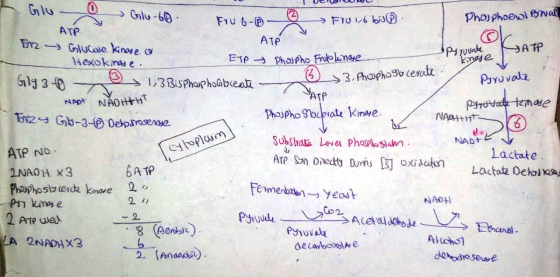
In aerobic respiration one mol of glucose will produce 36 ATP molecule which will be used for energy requirement by the cells where as in anaerobic respiration only 2 ATP molecules will be synthesis. The detailed pathway is attached.
In anaerobic reaction pyruvate converted to lactic acid (6th reaction) are consumed NADH synthesis from glyceraldehyde 3 phosphate to 1,3 bisphospho glycerate in 3rd reaction.
In aerobic reaction the pyruvate entered to TCA cycle and oxidative carboxylation to produce 36 ATP.
Add Answer to:
Why do most organisms use aerobic cellular respiration
(36ATP/glucose) rather than fermentation (2ATP/glucose)to supply
their energy...
Chemoorganotrophic heterotrophs oxidize carbohydrates as their primary source of energy. Glucose is the most common energy...
Chemoorganotrophic heterotrophs oxidize carbohydrates as their primary source of energy. Glucose is the most common energy source for such organisms and energy may be extracted from glucose via respiration or fermentation. a. Explain the difference between aerobic respiration, anaerobic respiration, and fermentation. b. Identify and briefly define the metabolic pathways involved in aerobic respiration. For each metabolic pathway your response should address the forms of carbon that enter and exit, the amount of ATP produced, and the number and types...
1. What is the overall goal of cellular respiration? What are the reactants of cellular respiration?...
 1. What is the overall goal of cellular respiration? What are the reactants of cellular respiration? What are the products of cellular respiration? 2. Why is cellular respiration also called aerobic respiration? 3. Is glucose oxidized or reduced? Is oxygen oxidized or reduced? 4. Why is it important that there are many small intermediate steps in cellular respiration rather than one or two short bursts of metabolic energy? 5. What critical role does NAD+ and FAD play in cellular respiration?...
two organisms are grown with the same food source. one uses aerobic respiration for energy production,...
two organisms are grown with the same food source. one uses aerobic respiration for energy production, and the other uses fermentation for energy production. if both produce the same amount of atp over a 24-hour period, which one had the faster metabolic rate (i.e. used more glucose)? explain your answer.
Microbiology question! 6. Microbes may have the ability to use aerobic cellular respiration, alcohol fermentation, and/or...
 Microbiology question!
6. Microbes may have the ability to use aerobic cellular respiration, alcohol fermentation, and/or anaerobic respiration. Provide an example of a microbe that might be able to do this Explain how this occurs and describe when one pathway may be used over another. Which is most efficient? (5 pts)
Microbiology question!
6. Microbes may have the ability to use aerobic cellular respiration, alcohol fermentation, and/or anaerobic respiration. Provide an example of a microbe that might be able to do this Explain how this occurs and describe when one pathway may be used over another. Which is most efficient? (5 pts)
QUESTION 43 Starting with a single glucose molecule, explain how aerobic respiration generates ATP. You do...
 QUESTION 43 Starting with a single glucose molecule, explain how aerobic respiration generates ATP. You do NOT need to describe each chemical reaction along the way, but you must indicate the catabolic pathways that are used by aerobic respiration and at which points ATP is produced and how much ATP is produced. How does this differ from anaerobic respiration and fermentation? TTTT Paragraph v Arial 3 (120) X2 %DOQ Of Me Τ' Τ,
Question #1: Aerobic organisms use oxygen; where & when do humans "consume" oxygen in the steps...
 Question #1: Aerobic organisms use oxygen; where & when do humans "consume" oxygen in the steps of aerobic cellular respiration? Question #2: What are the advantages & disadvantages of glycolysis followed by anaerobic fermentation? Question #3: What is the economic importance of fermentation by yeast Question #4: What gas is responsible for the holes in baked bread? Question #5: What are the two types of fermentation and which is possible in human skeletal muscle under certain conditions? Question #6: Why...
Oxygen is a product in: aerobic cellular respiration fermentation photosynthesis Which of the following molecules are...
Oxygen is a product in: aerobic cellular respiration fermentation photosynthesis Which of the following molecules are classified as air pollutants and as emissions coming out of your car’s tailpipe? CO2 and H2O vapor NOx and CO2 NOx and water vapor Perfect gasoline combustion rxns would release: HC, O2, N2 HC, H2O, CO2 N2, H2O, CO2 The DNA parental strand 5’-ACCG-3’ can make a mRNA strand: 5’UGGU-3’ 3’TAAC-5’ 3’UGGC-5’ Cars of the future are being designed using what kind of alternative...
Biology Help. 1) Do animals carry out aerobic cellular respiration? Explain your answer. 2) Why are...
Biology Help. 1) Do animals carry out aerobic cellular respiration? Explain your answer. 2) Why are boiled beans metabolically inactive? Why are non-germinated beans metabolically inactive? 3) If you observe the production of CO2 as a waste gas, can you determine if the organism is carrying out aerobic respiration or anaerobic fermentation? Explain your answer. 4) What interaction occurs between Water & Carbon Dioxide? How can you observe this interaction? Thanks.
Q1: What are catabolism and anabolism (4 marks)? Q2: Under aerobic respiration, a molecule glucose is...
Q1: What are catabolism and anabolism (4 marks)? Q2: Under aerobic respiration, a molecule glucose is oxidized to generate 36 ATPs in eukaryote cell while 38 ATPs in prokaryote cell. Explain how this difference occurred (6 marks). Q3: Why aerobic respiration could produce more energy (ATP molecules) than anaerobic respiration and fermentation? By using glucose as the substrate, illustrate how ATP molecules are being produced in each case (15 marks). Q4: "Most microbes use carbohydrate (glucose) as the energy sources...
Cellular respiration results in the release of energy from glucose. What is this released energy most often used for?
Question 4 Cellular respiration results in the release of energy from glucose. What is this released energy most often used for? The energy is used to break down fatty acids and triglycerides The energy is used to concentrate water molecules within the cell The energy is used for ATP hydrolysis. The energy is used to form a bond between ADP and Pi The energy is used to produce carbon dioxide and oxygenQuestion 5 During the process of cellular respiration, the majority of the chemical energy that is...
 1. What is the overall goal of cellular respiration? What are the reactants of cellular respiration? What are the products of cellular respiration? 2. Why is cellular respiration also called aerobic respiration? 3. Is glucose oxidized or reduced? Is oxygen oxidized or reduced? 4. Why is it important that there are many small intermediate steps in cellular respiration rather than one or two short bursts of metabolic energy? 5. What critical role does NAD+ and FAD play in cellular respiration?...
 Microbiology question!
6. Microbes may have the ability to use aerobic cellular respiration, alcohol fermentation, and/or anaerobic respiration. Provide an example of a microbe that might be able to do this Explain how this occurs and describe when one pathway may be used over another. Which is most efficient? (5 pts)
Microbiology question!
6. Microbes may have the ability to use aerobic cellular respiration, alcohol fermentation, and/or anaerobic respiration. Provide an example of a microbe that might be able to do this Explain how this occurs and describe when one pathway may be used over another. Which is most efficient? (5 pts)
 QUESTION 43 Starting with a single glucose molecule, explain how aerobic respiration generates ATP. You do NOT need to describe each chemical reaction along the way, but you must indicate the catabolic pathways that are used by aerobic respiration and at which points ATP is produced and how much ATP is produced. How does this differ from anaerobic respiration and fermentation? TTTT Paragraph v Arial 3 (120) X2 %DOQ Of Me Τ' Τ,
 Question #1: Aerobic organisms use oxygen; where & when do humans "consume" oxygen in the steps of aerobic cellular respiration? Question #2: What are the advantages & disadvantages of glycolysis followed by anaerobic fermentation? Question #3: What is the economic importance of fermentation by yeast Question #4: What gas is responsible for the holes in baked bread? Question #5: What are the two types of fermentation and which is possible in human skeletal muscle under certain conditions? Question #6: Why...
Most questions answered within 3 hours.
-
Where is the error in this code sequence?
String s1 = "Hello";
String s2 = "ello";...
asked 10 months ago -
Financial data for Joel de Paris, Inc., for last year
follow:
Joel de Paris, Inc.
Balance...
asked 10 months ago -
Consider this reaction:
Al2(SO4)3 (aq)+ BaCl3
(aq) Al2Cl6 (aq)- +
3BaSO4(s) . What is the...
asked 10 months ago -
Suppose that Savneet is considering increasing her
recent random sample from 20 car rentals to 40...
asked 10 months ago -
Trucks arrive at an unloading terminal at an average rate of 120
per hour.
Trucks arrive...
asked 10 months ago -
Why are methanol and ethanol completely soluble in water while
octanol is not very little soluble....
asked 10 months ago -
A facilities manager at a university reads in a research report
that the mean amount of...
asked 10 months ago -
When the CuSO4 is rehydrated by adding water to the anhydrous
compound, is this an endothermic...
asked 10 months ago -
A ray of sunlight is passing from diamond into crown glass; the
angle of incidence is...
asked 10 months ago -
A block of mass 0.249 kg is placed on top of a light, vertical
spring of...
asked 10 months ago -
how do the kidneys compensate in the presences of acidosis
a) trigger hyperventilate
b) reserve acid...
asked 10 months ago -
Question 501 pts
The rental rate of capital to the firm increases. Which of the
following...
asked 10 months ago