Provide pseudocode post-order traversal for general trees using stack.
Provide pseudocode post-order traversal for general trees using stack.
Homework Answers
Using two stack:
1. Push root into Stack_One.
- while(Stack_One is not empty)
- Pop the node from Stack_One and push it into Stack_Two.
- Push the left and right child nodes of popped node into Stack_One.
- End Loop
- Pop out all the nodes from Stack_Two and print it.
Using one stack:
1.1 Create an empty stack
2.1 Do following while root is not NULL
a) Push root's right child and then root to stack.
b) Set root as root's left child.
2.2 Pop an item from stack and set it as root.
a) If the popped item has a right child and the right child
is at top of stack, then remove the right child from stack,
push the root back and set root as root's right child.
b) Else print root's data and set root as NULL.
2.3 Repeat steps 2.1 and 2.2 while stack is not empty.
Add Answer to:
Provide pseudocode post-order traversal for general trees using
stack.
Provide pseudocode for breadth-first (level order) traversal for general trees. All I need is the breadth-first...
 Provide pseudocode for breadth-first (level order) traversal for
general trees. All I need is the breadth-first one, I know the
post-order one. So far I knew stack, list, Queues.
Provide pseudocode for either preorder traversal or post-order traversal for general trees without recursion (hint: use a stack). Also provide pseudocode for breadth-first level order) traversal for general trees (hint: use a data structure that you studied before).
Provide pseudocode for breadth-first (level order) traversal for
general trees. All I need is the breadth-first one, I know the
post-order one. So far I knew stack, list, Queues.
Provide pseudocode for either preorder traversal or post-order traversal for general trees without recursion (hint: use a stack). Also provide pseudocode for breadth-first level order) traversal for general trees (hint: use a data structure that you studied before).
Write pseudocode for one of the classic traversal algorithms (preorder, inorder, and postorder) for binary trees....
Write pseudocode for one of the classic traversal algorithms (preorder, inorder, and postorder) for binary trees. Assuming that your algorithm is recursive, find the number of recursive calls made
(Pre-order and post-order traversal). Implement the textbook's algorithm (not the Java implementation) for pre-order and post-order...
 (Pre-order and post-order traversal). Implement the textbook's
algorithm (not the Java implementation) for
pre-order and post-order traversal. To "process" or "visit" a node
means to print the data at that node.
Pre-order traversal output: 10 6 4 8 18 15 21
Post-order traversal output: 4 8 6 15 21 18 10
Additionally, create and traverse the following trees:
Algorithm preorder(p) perform the "visit" action for position p this happens before any recursion for each child c in children(p) do recursively...
(Pre-order and post-order traversal). Implement the textbook's
algorithm (not the Java implementation) for
pre-order and post-order traversal. To "process" or "visit" a node
means to print the data at that node.
Pre-order traversal output: 10 6 4 8 18 15 21
Post-order traversal output: 4 8 6 15 21 18 10
Additionally, create and traverse the following trees:
Algorithm preorder(p) perform the "visit" action for position p this happens before any recursion for each child c in children(p) do recursively...
C++ Binary Search trees Depth first traversal is the same as _____ order traversal. When we add...
C++ Binary Search trees Depth first traversal is the same as _____ order traversal. When we add a new node to an existing binary search tree, it will always become a ______. When we delete a node with 2 children from a binary search tree, we replace the node with ______.
The in-order traversal of a binary tree processes the nodes in the order ABCD. The post-order...
 The in-order traversal of a binary tree processes the nodes in the order ABCD. The post-order traversal of the same binary tree processes the nodes in the order ACDB. Draw the tree below.
Question 39 Binary Trees: Traversal Describe the binary tree shown using depth-first, in order traversal (image...
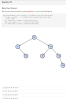 Question 39 Binary Trees: Traversal Describe the binary tree shown using depth-first, in order traversal (image t) void print TreeNode * start = nullptr){ // by default, we'll print from the head if (start == nullptr) // if nullptr, then we should start from the head start = head; if ( start->left != nullptr) printTree( start->left ) cout<< start-value << ", "; // print the current node if ( start->right != nullptr) printTree( start->right) } 12 15 10 14 18...
Question II - Graph Traversal and Minimum Spanning Trees [40 Points] Consider the following graph: B...
 Question II - Graph Traversal and Minimum Spanning Trees [40 Points] Consider the following graph: B 10 1 4 1 H 9 4 a) Traverse the graph starting from vertex A, and using the Breadth-First Search algorithm. Show the traversal result and the data structure you are using. [10 Points] b) Traverse the graph starting from vertex A, and using the Depth-First Search (Post-order) algorithm. Show the traversal result and the data structure you are using. [10 Points] c) Apply...
JAVA Given the sequence of in-order traversal for a general binary tree, stored in an array...
JAVA Given the sequence of in-order traversal for a general binary tree, stored in an array inOrder[] = {9, 5, 1, 7, 2, 12, 8, 4, 3, 11 }. And given the sequence of post-order traversal for the same tree, stored in an array postOrder[] = {9, 1, 2, 12, 7, 5, 3, 11, 4, 8}. Please implement the following method: static BinaryTree buildTree(Object inOrder[], Object postOrder[]) -The method buildTree() returns a BinaryTree object in memory that is constructed on...
Provide python implementation of a spiral order tree traversal
Provide python implementation of a spiral order tree traversal
C++ Using the Stack operations, write a pseudocode routine, dupA, that takes aStack for string, checks...
C++ Using the Stack operations, write a pseudocode routine, dupA, that takes aStack for string, checks to see if the top starts with ‘A’ or ‘a’. If so, duplicate the top of the stack (i.e. push a copy of that value onto the stack) else if length > 10, pop it off the stack
 Provide pseudocode for breadth-first (level order) traversal for
general trees. All I need is the breadth-first one, I know the
post-order one. So far I knew stack, list, Queues.
Provide pseudocode for either preorder traversal or post-order traversal for general trees without recursion (hint: use a stack). Also provide pseudocode for breadth-first level order) traversal for general trees (hint: use a data structure that you studied before).
Provide pseudocode for breadth-first (level order) traversal for
general trees. All I need is the breadth-first one, I know the
post-order one. So far I knew stack, list, Queues.
Provide pseudocode for either preorder traversal or post-order traversal for general trees without recursion (hint: use a stack). Also provide pseudocode for breadth-first level order) traversal for general trees (hint: use a data structure that you studied before).
 (Pre-order and post-order traversal). Implement the textbook's
algorithm (not the Java implementation) for
pre-order and post-order traversal. To "process" or "visit" a node
means to print the data at that node.
Pre-order traversal output: 10 6 4 8 18 15 21
Post-order traversal output: 4 8 6 15 21 18 10
Additionally, create and traverse the following trees:
Algorithm preorder(p) perform the "visit" action for position p this happens before any recursion for each child c in children(p) do recursively...
(Pre-order and post-order traversal). Implement the textbook's
algorithm (not the Java implementation) for
pre-order and post-order traversal. To "process" or "visit" a node
means to print the data at that node.
Pre-order traversal output: 10 6 4 8 18 15 21
Post-order traversal output: 4 8 6 15 21 18 10
Additionally, create and traverse the following trees:
Algorithm preorder(p) perform the "visit" action for position p this happens before any recursion for each child c in children(p) do recursively...
 The in-order traversal of a binary tree processes the nodes in the order ABCD. The post-order traversal of the same binary tree processes the nodes in the order ACDB. Draw the tree below.
 Question 39 Binary Trees: Traversal Describe the binary tree shown using depth-first, in order traversal (image t) void print TreeNode * start = nullptr){ // by default, we'll print from the head if (start == nullptr) // if nullptr, then we should start from the head start = head; if ( start->left != nullptr) printTree( start->left ) cout<< start-value << ", "; // print the current node if ( start->right != nullptr) printTree( start->right) } 12 15 10 14 18...
 Question II - Graph Traversal and Minimum Spanning Trees [40 Points] Consider the following graph: B 10 1 4 1 H 9 4 a) Traverse the graph starting from vertex A, and using the Breadth-First Search algorithm. Show the traversal result and the data structure you are using. [10 Points] b) Traverse the graph starting from vertex A, and using the Depth-First Search (Post-order) algorithm. Show the traversal result and the data structure you are using. [10 Points] c) Apply...
Most questions answered within 3 hours.
-
Where is the error in this code sequence?
String s1 = "Hello";
String s2 = "ello";...
asked 11 months ago -
Financial data for Joel de Paris, Inc., for last year
follow:
Joel de Paris, Inc.
Balance...
asked 11 months ago -
Consider this reaction:
Al2(SO4)3 (aq)+ BaCl3
(aq) Al2Cl6 (aq)- +
3BaSO4(s) . What is the...
asked 11 months ago -
Suppose that Savneet is considering increasing her
recent random sample from 20 car rentals to 40...
asked 11 months ago -
Trucks arrive at an unloading terminal at an average rate of 120
per hour.
Trucks arrive...
asked 11 months ago -
Why are methanol and ethanol completely soluble in water while
octanol is not very little soluble....
asked 11 months ago -
A facilities manager at a university reads in a research report
that the mean amount of...
asked 11 months ago -
When the CuSO4 is rehydrated by adding water to the anhydrous
compound, is this an endothermic...
asked 11 months ago -
A ray of sunlight is passing from diamond into crown glass; the
angle of incidence is...
asked 11 months ago -
A block of mass 0.249 kg is placed on top of a light, vertical
spring of...
asked 11 months ago -
how do the kidneys compensate in the presences of acidosis
a) trigger hyperventilate
b) reserve acid...
asked 11 months ago -
Question 501 pts
The rental rate of capital to the firm increases. Which of the
following...
asked 11 months ago