Suppose that you and a friend are discussing the effects of pollution on society. Your friend...
Suppose that you and a friend are discussing the effects of pollution on society. Your friend argues that the best level of emissions for society as a whole is zero. Your friend argues that zero emissions would cause zero environmental damage to society and would, therefore, be optimal.
a) Explain using the tools of economic analysis from class, show that the optimal level of emissions is generally not zero. Show how the optimal level of emissions is determined for any given industry on a graph. Carefully explain how the optimal level of emissions is determined. Why is this level optimal?
b) On your graph, clearly label the total amount of damages to society from this level of emissions. On your graph, clearly label the total amount of abatement cost to society from this level of emissions.
c) Under what rare circumstance would your friend’s argument be correct, that the optimal level of emissions is zero? What must be true in this case? Explain. Show this scenario on a graph. What is the total damages to society at this zero level of pollution?
Homework Answers
Answer:
a) Optimal level of pollution is not zero. The optimal level of pollution can be found out with the help of economic decision rule of equating the marginal benefit to the marginal cost.
When a negative externality is present, there is a cost imposed on a third party not involved in the production or consumption of the good. Examples of the negative externalities include various forms of pollution, such as air pollution from factories or power plants, water pollution, noise pollution.
Economist has argued that it is not efficient to reduce pollution to zero. The cost of this reduction would probably exceed the benefits. Waterways and the atmosphere have a natural capacity to assimilate at least some pollution with no associated ill-effects on the environment or humans. To not benefit from this natural assimilative capacity would be wasteful. Moreover, one person's pollution may be another person's consumption.
for question a and b Please see the figure.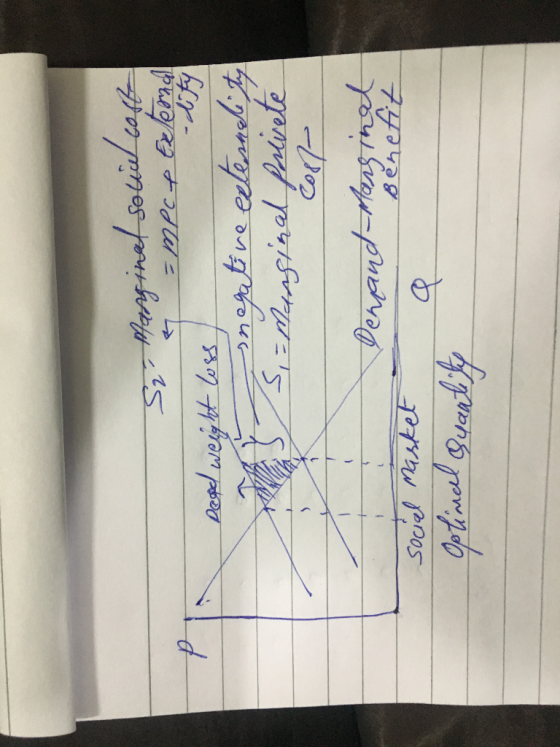
c)
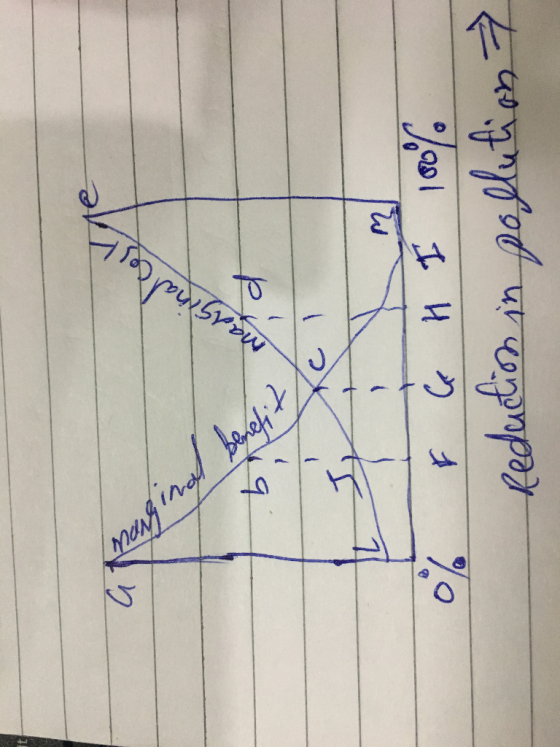
Economist has argued that it is not efficient to reduce pollution to zero. The cost of this reduction would probably exceed the benefits. Waterways and the atmosphere have a natural capacity to assimilate at least some pollution with no associated ill-effects on the environment or humans. To not benefit from this natural assimilative capacity would be wasteful. Moreover, one person's pollution may be another person's consumption.
Add Answer to:
Suppose that you and a friend are discussing the effects of
pollution on society. Your friend...
Consider a pulp mill that emits air and water pollution emissions (E) that impose negative external...
Consider a pulp mill that emits air and water pollution emissions (E) that impose negative external costs (damages) onto society. The aggregate marginal abatement cost (MAC) and marginal damage (MD) curves have been estimated follows: MAC = 800 − 20E MD = 20E a. On a diagram, plot the MAC and MD curves. Be sure to label the curves, calculate the vertical intercept and horizontal intercepts of the MAC line, and the intersection point of the two lines. Show all...
Suppose that a friend of yours states: " The optimal pollution level is clearly zero. Any...
Suppose that a friend of yours states: " The optimal pollution level is clearly zero. Any level of pollution is obviously undesirable". How would you respond to your friend?.
4. Production of a good in an industry leads to pollution/emissions as a by-product of the...
 4. Production of a good in an industry leads to pollution/emissions as a by-product of the production process. Let E be the level of emissions. The marginal damages function is MD(E)5 + E. There are two firms in the industry. Firm 1 can reduce emissions according to the Marginal Abatement Cost function MAC1(E1) 20 - 2E1. Firm 2 has Marginal Abatement Cost function MAG(E-30-3E2. (a) Find the Marginal Abatement Costs for the industry. (b) Determine the socially optimal level of...
Company A, the polluter, is located upstream of Company B, the victim, on a certain river. A productive activity pollutes the water, thereby negatively affecting the value of water to B. In the beginni...
Company A, the polluter, is located upstream of Company B, the victim, on a certain river. A productive activity pollutes the water, thereby negatively affecting the value of water to B. In the beginning, before regulation, emissions are E = 96. A’s marginal abatement cost is MAC = 50−A/2, where A is the amount of emissions abatement. B’s marginal abatement damages are MPD = A/3. a. If polluter A has the right to the river, what is the total damage...
ANSWER QUESTION 4 ONLY You work for the state environmental office and have been told that...
ANSWER QUESTION 4 ONLY You work for the state environmental office and have been told that you are now in charge of determining the optimal amount of pollution allowed from powerplants in the area. You recognize that emissions from this powerplant causes damage to the environment, but that it is also costly to reduce the number of emissions due to reduced production of the plant. After doing some research you find that the Marginal Damage Cost (MDC) and Marginal Abatement...
Question 3 (11 points) liability Q Consider a firm, which is polluting the water near Good...
 Question 3 (11 points) liability Q Consider a firm, which is polluting the water near Good Grief, Idaho. The marginal damage cost of this pollution is given by; MDC - - 6 + 0.75 e where e is the level of emissions. The marginal abatement costs are; MAC - 200 - 2 e. (a) Determine the optimal level of emissions. (b) Draw a diagram showing the MAC, MDC and the optimal level of emissions. On this diagram show the total...
The Great Fracking Natural Gas company has just established a new well in the ranching community...
The Great Fracking Natural Gas company has just established a new well in the ranching community of Grassville, USA. It turns out that some of the chemical emissions used in the fracking process are contaminating the groundwater. The total damage to ranchers due to livestock losses from drinking the water is 50p2, where p is the level of pollution in this case. The total damage to families who must travel to town and purchase clean water each month is 300p2....
The use of energy is one of the major causes of pollution and greenhouse gases that...
The use of energy is one of the major causes of pollution and greenhouse gases that lead to climate change. It is desirable to reduce the emissions from energy use. Suppose there are two firms whose marginal abatements costs are as follows: MAC1=q1 and MAC2=q2 where q1is the amount of emissions reduction by firm 1 and q2is the amount of emissions reduction by firm 2. In the context of this question, what is “marginal abatement cost”? Draw the two marginal abatement...
You are a policy advisor responsible for air pollution in a region where there are only...
You are a policy advisor responsible for air pollution in a region where there are only two chemical plants run by firm A and firm B. Firm A’s pollution abatement costs are 2x3, where x is a unit of pollution. Firm B is newer and has pollution abatement costs of 2x2. Assume that neither firm is initially abating pollution. The per-unit benefit to a unit of pollution abatement is a constant $600. ii. Suppose your boss, an elected politician, decides...
The marginal damage averted from pollution cleanup is MD = 200 – 5Q. The total cost associated with pollution cleanup is TC = 10Q + 0.5Q^2. a. What is the optimal level of pollution reduction? Show yo...
The marginal damage averted from pollution cleanup is MD = 200 – 5Q. The total cost associated with pollution cleanup is TC = 10Q + 0.5Q^2. a. What is the optimal level of pollution reduction? Show your work and explain b. What amount of tax per unit would generate the optimal amount of pollution reduction from part (a)? Show your work and explain
 4. Production of a good in an industry leads to pollution/emissions as a by-product of the production process. Let E be the level of emissions. The marginal damages function is MD(E)5 + E. There are two firms in the industry. Firm 1 can reduce emissions according to the Marginal Abatement Cost function MAC1(E1) 20 - 2E1. Firm 2 has Marginal Abatement Cost function MAG(E-30-3E2. (a) Find the Marginal Abatement Costs for the industry. (b) Determine the socially optimal level of...
 Question 3 (11 points) liability Q Consider a firm, which is polluting the water near Good Grief, Idaho. The marginal damage cost of this pollution is given by; MDC - - 6 + 0.75 e where e is the level of emissions. The marginal abatement costs are; MAC - 200 - 2 e. (a) Determine the optimal level of emissions. (b) Draw a diagram showing the MAC, MDC and the optimal level of emissions. On this diagram show the total...
Most questions answered within 3 hours.
-
Where is the error in this code sequence?
String s1 = "Hello";
String s2 = "ello";...
asked 11 months ago -
Financial data for Joel de Paris, Inc., for last year
follow:
Joel de Paris, Inc.
Balance...
asked 11 months ago -
Consider this reaction:
Al2(SO4)3 (aq)+ BaCl3
(aq) Al2Cl6 (aq)- +
3BaSO4(s) . What is the...
asked 11 months ago -
Suppose that Savneet is considering increasing her
recent random sample from 20 car rentals to 40...
asked 11 months ago -
Trucks arrive at an unloading terminal at an average rate of 120
per hour.
Trucks arrive...
asked 11 months ago -
Why are methanol and ethanol completely soluble in water while
octanol is not very little soluble....
asked 11 months ago -
A facilities manager at a university reads in a research report
that the mean amount of...
asked 11 months ago -
When the CuSO4 is rehydrated by adding water to the anhydrous
compound, is this an endothermic...
asked 11 months ago -
A ray of sunlight is passing from diamond into crown glass; the
angle of incidence is...
asked 11 months ago -
A block of mass 0.249 kg is placed on top of a light, vertical
spring of...
asked 11 months ago -
how do the kidneys compensate in the presences of acidosis
a) trigger hyperventilate
b) reserve acid...
asked 11 months ago -
Question 501 pts
The rental rate of capital to the firm increases. Which of the
following...
asked 11 months ago