Explain with aid of a graph why a concave utility function indicates risk adverse preferences.
Explain with aid of a graph why a concave utility function indicates risk adverse preferences.
Homework Answers
Ans
As csn be seen in fig 1 a concave indifference curve means that a consumer prefers more returns as risk rises. That's why indifference curve is upward sloping
Had indifference curve been convex it would mean a person
prefers higher risk. A straight line indifference curve will mean
risk neutrality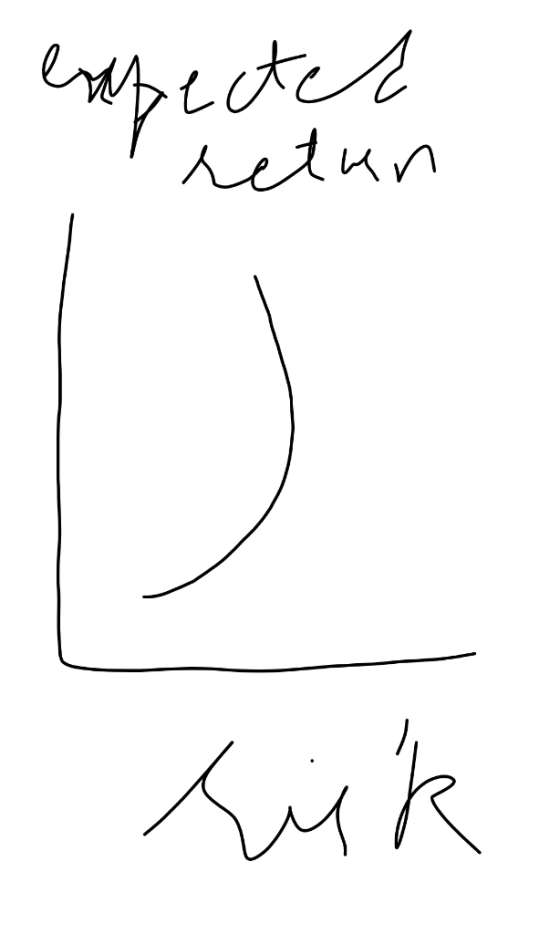
Add Answer to:
Explain with aid of a graph why a concave utility function
indicates risk adverse preferences.
4. Tom has preferences that can be described by the utility function ?=?(?,?)=??+??, ?>0, ?>0, ?≥0,...
4. Tom has preferences that can be described by the utility function ?=?(?,?)=??+??, ?>0, ?>0, ?≥0, ?≥0, (?+?)≠0 Tom Junior’s preferences can be described by a transformation of Tom’s utility function ?(?), where ?(?)=(?−36)3. Tom III’s (i.e. Tom’s grandson’s) preferences can be described by a transformation of Tom’s utility function ?(?), where ?(?)=(?−18)4. 4a. Is ?(?) a positive monotonic transformation? Show your work. What does that imply for Tom and Tom Jr’s preferences? Explain why. 4b. Is ?(?) a positive...
2) Describe Larry, Judy and Carol's risk preferences. Their utility as a function of income is...
 2) Describe Larry, Judy and Carol's risk preferences. Their utility as a function of income is given as follows Larry: UL(I) = 101 Judy: UJ(I) = 312 Carol: UC (1)=201.
Risk aversion is defined by the downward curvature/concave utility function as:
Risk aversion is defined by the downward curvature/concave utility function as:A. Minimum selling price of a risky opportunity is less than its expected value.B. Maximum transaction price of a risky opportunity is more than its expected valueC. Minimum selling price of a risky opportunity is more than its expected valueD. Minimum buying price of a risky opportunity is less than its expected value
Irma has concave utility function U(w) = ln(w). Calculate the arrow-Pratt measure of risk aversion and...
Irma has concave utility function U(w) = ln(w). Calculate the arrow-Pratt measure of risk aversion and find the relation between risk aversion and wealth.
Cobb-Douglas Preferences: Cobb-Douglas preferences on the consump- tion set R2+ can be represented by a utility...
Cobb-Douglas Preferences: Cobb-Douglas preferences on the consump- tion set R2+ can be represented by a utility function of the form U (q1,q2) = Aq1αq2β, where A > 0, α ∈ (0,1), and β ∈ (0,1) are fixed parameters. 1. If we assume that preferences are ordinal, explain why these precise preferences are also represented by the utility function U(q ,q )=qγq1−γ, 1212 whereγ= α .Isγ∈(0,1)? (α+β) 2. If we assume that preferences are ordinal and restrict attention to the consumption...
Please explain why this is false. 4. A person with the utility function U(x,y)= 10 +y2...
 Please explain why this is false.
4. A person with the utility function U(x,y)= 10 +y2 + x has convex preferences.
Please explain why this is false.
4. A person with the utility function U(x,y)= 10 +y2 + x has convex preferences.
1. For a utility function u(x) the measure of Absolute Risk Aversion is defined as Alca)...
 1. For a utility function u(x) the measure of Absolute Risk Aversion is defined as Alca) = uchun Consider the utility function u(x)=1-e-axi where a is some positive parameter. Show that this utility function is for risk-averse consumer (concave utility/negative second derivative). Show that this utility function exhibits Constant Absolute Risk Aversion. Find the value of this constant.
Write an equation of a utility function that is appropriate to modelling preferences over the following...
Write an equation of a utility function that is appropriate to modelling preferences over the following goods and then graph a representative indifference curves indicating the direction of increasing preference. a. left shoes and right shoes. Equation: Graph: b. Food and housing. Equation: Graph: Blue and Black pens (preference blue pens) Equation: Graph:
2. (a) Explain the terms risk averse, risk loving and risk neutral with the aid of...
 2. (a) Explain the terms risk averse, risk loving and risk neutral with the aid of diagrams. Jane's utility (U) depends upon her income( Y) according to the following table U(Y) 50 7 100 9.5 150 200一一 14 250 300 350 12 16.5 17 19 She has received a prize with an uncertain value. In particular, with probability 0.25 she wins $300 and with probability 0.75 she wins $100. (b) What is the expected payoff from this prize? What is...
Larry's utility function is U = 4X + 12Y. Which property of consumer preferences does Larry's...
Larry's utility function is U = 4X + 12Y. Which property of consumer preferences does Larry's utility function violate? Explain your answer.
 2) Describe Larry, Judy and Carol's risk preferences. Their utility as a function of income is given as follows Larry: UL(I) = 101 Judy: UJ(I) = 312 Carol: UC (1)=201.
 Please explain why this is false.
4. A person with the utility function U(x,y)= 10 +y2 + x has convex preferences.
Please explain why this is false.
4. A person with the utility function U(x,y)= 10 +y2 + x has convex preferences.
 1. For a utility function u(x) the measure of Absolute Risk Aversion is defined as Alca) = uchun Consider the utility function u(x)=1-e-axi where a is some positive parameter. Show that this utility function is for risk-averse consumer (concave utility/negative second derivative). Show that this utility function exhibits Constant Absolute Risk Aversion. Find the value of this constant.
 2. (a) Explain the terms risk averse, risk loving and risk neutral with the aid of diagrams. Jane's utility (U) depends upon her income( Y) according to the following table U(Y) 50 7 100 9.5 150 200一一 14 250 300 350 12 16.5 17 19 She has received a prize with an uncertain value. In particular, with probability 0.25 she wins $300 and with probability 0.75 she wins $100. (b) What is the expected payoff from this prize? What is...
Most questions answered within 3 hours.
-
Where is the error in this code sequence?
String s1 = "Hello";
String s2 = "ello";...
asked 10 months ago -
Financial data for Joel de Paris, Inc., for last year
follow:
Joel de Paris, Inc.
Balance...
asked 10 months ago -
Consider this reaction:
Al2(SO4)3 (aq)+ BaCl3
(aq) Al2Cl6 (aq)- +
3BaSO4(s) . What is the...
asked 10 months ago -
Suppose that Savneet is considering increasing her
recent random sample from 20 car rentals to 40...
asked 10 months ago -
Trucks arrive at an unloading terminal at an average rate of 120
per hour.
Trucks arrive...
asked 10 months ago -
Why are methanol and ethanol completely soluble in water while
octanol is not very little soluble....
asked 10 months ago -
A facilities manager at a university reads in a research report
that the mean amount of...
asked 10 months ago -
When the CuSO4 is rehydrated by adding water to the anhydrous
compound, is this an endothermic...
asked 10 months ago -
A ray of sunlight is passing from diamond into crown glass; the
angle of incidence is...
asked 10 months ago -
A block of mass 0.249 kg is placed on top of a light, vertical
spring of...
asked 10 months ago -
how do the kidneys compensate in the presences of acidosis
a) trigger hyperventilate
b) reserve acid...
asked 10 months ago -
Question 501 pts
The rental rate of capital to the firm increases. Which of the
following...
asked 10 months ago