PLEASE HELP 1. Which reacts more rapidly with bromine, an alkane, an alkene or an an...
PLEASE HELP
1. Which reacts more rapidly with bromine, an alkane, an alkene or an an aromatic compound?
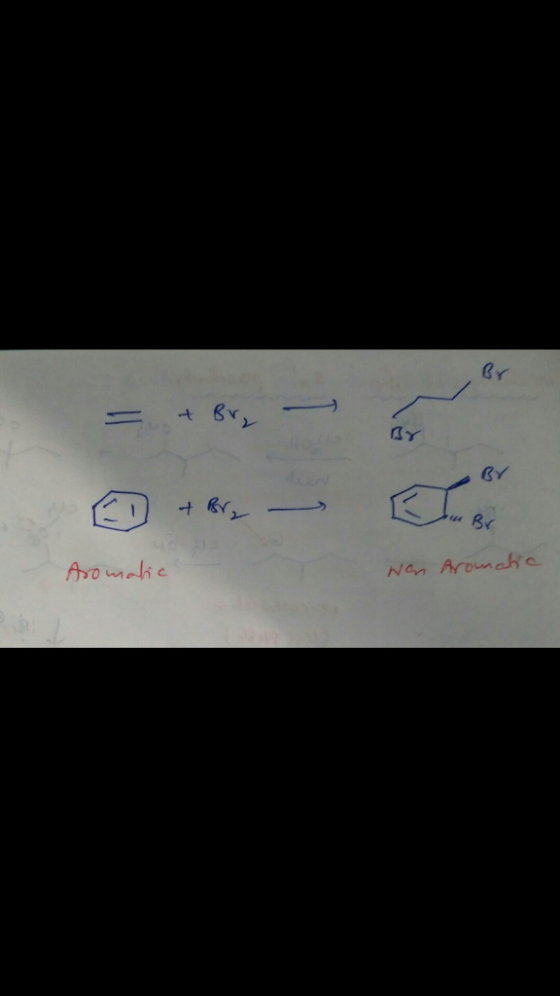
2. Based on your answer to the above question, what is the group that causes the increased reactivity towards bromine addition?
3. Why are aromatic groups unreactive towards bromine addition?
Homework Answers
1)
Bromine addition is an electrophilic addition reaction. So the compound must have nucleophillic character to react with bromine.
Alkenes are more nucleophilic than alakanes.
Alkene reacts more rapidly with bromine.
2) presene of Electron donating group increases the reactivity towards bromine addition.
3) If Aromatic groups undergoes bromine addition it loses its aromatic character. So aromatic groups interactive towards bromination.
Add Answer to:
PLEASE HELP
1. Which reacts more rapidly with bromine, an alkane, an alkene
or an an...
convert from alcohol to alkane by reduction process vis SN2 mechanism. (SHOW MECHANISM) 1-ethylcyclohexan-1-ol reacts with...
convert from alcohol to alkane by reduction process vis SN2 mechanism. (SHOW MECHANISM) 1-ethylcyclohexan-1-ol reacts with 1.TsOH, Pyridine/2.LiAlH4, H3O^+ I don't know how to describe the second one its a Phenol as the main ring with a carbon group attached to the side. It has a methyl, ethyl and alcohol attached to this carbon which is connected to the main ring. This phenol compound with the attached alcohol, ethyl and methyl groups reacts with TsCL, Pyridine/ LiAlH4, acetone. Obtain the...
Organic Chemistry Addition of Bromine to an Alkene-HELP ASAP PLEASE table of reagents and properties Reagent &n
Organic Chemistry Addition of Bromine to an Alkene-HELP ASAP PLEASE table of reagents and properties Reagent MW (g/mol) mp(Celsius) d( g/ml) trans-cinamic acid 148.2 132-135 acetic acid 60 1.05 pyridinium tribromide 319.8 - 2,3-dibromo-3-phenylpropanoic acid 308.0 Pair A: 93-95, Pair B: 202-204 Organic Chemistry- addition of bromine to an Alkene For a lab the preparation of 2,3-dibromo-3 phenylpropanoic acid was done. 1.2 g of trans-cinnamic acid was dissolved in 4 ml of glacial acetic acid. 2.5 g of pyrimide tribromide...
Please help me to find the answer Challenge Problem 08.94 9-Borabicyclo[3.3.1]nonane (9-BBN) is a reagent commonly...
 Please help me to find the answer
Challenge Problem 08.94 9-Borabicyclo[3.3.1]nonane (9-BBN) is a reagent commonly used in the hydroboration of alkynes, but it can also be employed in reactions with alkenes. The following table provides the relative rates of hydroboration (using 9-BBN) for a variety of alkenes (J. Am. Chem. Soc. 1989, 111, 1414-1418) : Relative Reactivity Alkenes CH—CHОBU, 1 CH2 CHBu, 2 CH2-CHCH2OMe, 3 CH CHOAC, 4 CH2 CHCH2OAC, 5 сH—CHCH,CN, 6 CH2 CHCH2C, 7 cis-2-Butene, 8 tans-CH,CH,CHСHC,...
Please help me to find the answer
Challenge Problem 08.94 9-Borabicyclo[3.3.1]nonane (9-BBN) is a reagent commonly used in the hydroboration of alkynes, but it can also be employed in reactions with alkenes. The following table provides the relative rates of hydroboration (using 9-BBN) for a variety of alkenes (J. Am. Chem. Soc. 1989, 111, 1414-1418) : Relative Reactivity Alkenes CH—CHОBU, 1 CH2 CHBu, 2 CH2-CHCH2OMe, 3 CH CHOAC, 4 CH2 CHCH2OAC, 5 сH—CHCH,CN, 6 CH2 CHCH2C, 7 cis-2-Butene, 8 tans-CH,CH,CHСHC,...
Determine the class of the compound, which contains only carbon and hydrogen, and exhibits the infrared...
 Determine the class of the compound, which contains only carbon and hydrogen, and exhibits the infrared spectrum below. Possible compound classes are alkane, alkene, alkyne, aromatic, alcohol, amine, aldehyde ketone, carboxylic acid, acid chloride, ester, amide The compound is an) (Use your cursor to read the IR frequency scale.) Flash Installation and Troubleshooting Infrared spectra provided courtesy of Thermo Electron Corp 110% Transmittance Wavenumber. 0% 4000 3500 3000 2500 2000 Wavenumber(cm) 1500 1000 Submit Answer Retry Entire Group 1 more...
please help in all sections asap!! Which type of electron is the highest in energy? An electron in an an...
 please help in all sections asap!!
Which type of electron is the highest in energy? An electron in an anti-bonding molecular orbital. An electron in a bonding molecular orbital. An electron in an atomic orbital. O A non-bonding electron. Choose a systematic name for the following compound. 1,4 dimethyl ethyl benzene 1,4 diethyl methyl benzene 1,4-diisopropylbenzene 1,4 dipropylbenzene Answer the following questions. -OR Would you expect the above compound to be aromatic? Yes No Choose the correct explanations for the...
please help in all sections asap!!
Which type of electron is the highest in energy? An electron in an anti-bonding molecular orbital. An electron in a bonding molecular orbital. An electron in an atomic orbital. O A non-bonding electron. Choose a systematic name for the following compound. 1,4 dimethyl ethyl benzene 1,4 diethyl methyl benzene 1,4-diisopropylbenzene 1,4 dipropylbenzene Answer the following questions. -OR Would you expect the above compound to be aromatic? Yes No Choose the correct explanations for the...
please answer this question Listed below are the outcomes of reacting a compound with the reagents...
 please answer this question
Listed below are the outcomes of reacting a compound with the reagents used in this experiment. Based on these observations what functional groups does the compound have? Only select the correct answer(s). selecting other answers will result in a mark penalty. • No observable reaction with Brz. • No precipitate after reaction with NaOH, acidification and addition of Ag+ (aq). • Permanganate reacts - loses purple colour. • Silver mirror produced with Tollen's reagent. • Soluble...
please answer this question
Listed below are the outcomes of reacting a compound with the reagents used in this experiment. Based on these observations what functional groups does the compound have? Only select the correct answer(s). selecting other answers will result in a mark penalty. • No observable reaction with Brz. • No precipitate after reaction with NaOH, acidification and addition of Ag+ (aq). • Permanganate reacts - loses purple colour. • Silver mirror produced with Tollen's reagent. • Soluble...
Help me pleaseeeee! Identify the mechanism by which each of the reactions above proceeds from among...
 Help me pleaseeeee! Identify the mechanism by which each of the
reactions above proceeds from among the mechanisms listed. Use the
letters a - j for your answers.
Chapter 16: Mastery [Review Topics] [References] 1. Identifying Unknown Aromatic Com... 1 pts M 2. Electrophilic Aromatic Substitution: ... 1 pts M 3. Electrophilic Aromatic Substitution: ... 1 pts M 4. Electrophilic Aromatic Substitution: ... 1 pts M CH3 _CH3 CH3 FeCl3 = 2. I T + Cl2 - + HCI 5....
Help me pleaseeeee! Identify the mechanism by which each of the
reactions above proceeds from among the mechanisms listed. Use the
letters a - j for your answers.
Chapter 16: Mastery [Review Topics] [References] 1. Identifying Unknown Aromatic Com... 1 pts M 2. Electrophilic Aromatic Substitution: ... 1 pts M 3. Electrophilic Aromatic Substitution: ... 1 pts M 4. Electrophilic Aromatic Substitution: ... 1 pts M CH3 _CH3 CH3 FeCl3 = 2. I T + Cl2 - + HCI 5....
Please answer all 3 questions Which of the following species has en stor that has a...
 Please answer all 3 questions
Which of the following species has en stor that has a partially filled valence shell of electroni? molecular bromine, Bez fluoride anion, ammonia, NH3 aluminum trichloride, AlCl3 QUESTION 43 What reagents are needed to accomplish this reaction? H2/Pt NaBH, MOH Hp/Lindlar's catalyst LI, ENH2, -78 °C followed by aq. NHACI QUESTION 44 The addition of bromine to the alkene shown will give: Br2 one meso compound one pair of enantiomers two meso compounds four stereoisomers
Please answer all 3 questions
Which of the following species has en stor that has a partially filled valence shell of electroni? molecular bromine, Bez fluoride anion, ammonia, NH3 aluminum trichloride, AlCl3 QUESTION 43 What reagents are needed to accomplish this reaction? H2/Pt NaBH, MOH Hp/Lindlar's catalyst LI, ENH2, -78 °C followed by aq. NHACI QUESTION 44 The addition of bromine to the alkene shown will give: Br2 one meso compound one pair of enantiomers two meso compounds four stereoisomers
Please help with all the parts Part 2: Reactivity ore on this section, no more than...
 Please help with all the parts
Part 2: Reactivity ore on this section, no more than 5 errors are permitted. reaction is a (4+2] cycloaddition reaction used to form cyclohexene. Shade in the orbitals appropriately for the ground state of butadiene and HOMO and LUMO and draw in all electrons ethene. Label the Ground State Ground State Shade in the orbitals involved in the reaction and indicate constractive or destructive overlap for thermal conditions. Hint: The LUMO comes from ethene...
Please help with all the parts
Part 2: Reactivity ore on this section, no more than 5 errors are permitted. reaction is a (4+2] cycloaddition reaction used to form cyclohexene. Shade in the orbitals appropriately for the ground state of butadiene and HOMO and LUMO and draw in all electrons ethene. Label the Ground State Ground State Shade in the orbitals involved in the reaction and indicate constractive or destructive overlap for thermal conditions. Hint: The LUMO comes from ethene...
Can you help me identify reagent (i), Compound 8 and Compound 12 in the reaction scheme?...
 Can you help me identify reagent (i), Compound 8 and
Compound 12 in the reaction scheme?
You have laboratory data on all the compounds in the
synthesis, however the amount of data available to you varies. Some
have the entirety of the spectral data, others have as little as
the elemental analysis. Use the laboratory data to help you
discover which reaction has been performed.
The lab data for Compound 8 and 12 is as
follows:
You can use any...
Can you help me identify reagent (i), Compound 8 and
Compound 12 in the reaction scheme?
You have laboratory data on all the compounds in the
synthesis, however the amount of data available to you varies. Some
have the entirety of the spectral data, others have as little as
the elemental analysis. Use the laboratory data to help you
discover which reaction has been performed.
The lab data for Compound 8 and 12 is as
follows:
You can use any...
 Please help me to find the answer
Challenge Problem 08.94 9-Borabicyclo[3.3.1]nonane (9-BBN) is a reagent commonly used in the hydroboration of alkynes, but it can also be employed in reactions with alkenes. The following table provides the relative rates of hydroboration (using 9-BBN) for a variety of alkenes (J. Am. Chem. Soc. 1989, 111, 1414-1418) : Relative Reactivity Alkenes CH—CHОBU, 1 CH2 CHBu, 2 CH2-CHCH2OMe, 3 CH CHOAC, 4 CH2 CHCH2OAC, 5 сH—CHCH,CN, 6 CH2 CHCH2C, 7 cis-2-Butene, 8 tans-CH,CH,CHСHC,...
Please help me to find the answer
Challenge Problem 08.94 9-Borabicyclo[3.3.1]nonane (9-BBN) is a reagent commonly used in the hydroboration of alkynes, but it can also be employed in reactions with alkenes. The following table provides the relative rates of hydroboration (using 9-BBN) for a variety of alkenes (J. Am. Chem. Soc. 1989, 111, 1414-1418) : Relative Reactivity Alkenes CH—CHОBU, 1 CH2 CHBu, 2 CH2-CHCH2OMe, 3 CH CHOAC, 4 CH2 CHCH2OAC, 5 сH—CHCH,CN, 6 CH2 CHCH2C, 7 cis-2-Butene, 8 tans-CH,CH,CHСHC,...
 Determine the class of the compound, which contains only carbon and hydrogen, and exhibits the infrared spectrum below. Possible compound classes are alkane, alkene, alkyne, aromatic, alcohol, amine, aldehyde ketone, carboxylic acid, acid chloride, ester, amide The compound is an) (Use your cursor to read the IR frequency scale.) Flash Installation and Troubleshooting Infrared spectra provided courtesy of Thermo Electron Corp 110% Transmittance Wavenumber. 0% 4000 3500 3000 2500 2000 Wavenumber(cm) 1500 1000 Submit Answer Retry Entire Group 1 more...
 please help in all sections asap!!
Which type of electron is the highest in energy? An electron in an anti-bonding molecular orbital. An electron in a bonding molecular orbital. An electron in an atomic orbital. O A non-bonding electron. Choose a systematic name for the following compound. 1,4 dimethyl ethyl benzene 1,4 diethyl methyl benzene 1,4-diisopropylbenzene 1,4 dipropylbenzene Answer the following questions. -OR Would you expect the above compound to be aromatic? Yes No Choose the correct explanations for the...
please help in all sections asap!!
Which type of electron is the highest in energy? An electron in an anti-bonding molecular orbital. An electron in a bonding molecular orbital. An electron in an atomic orbital. O A non-bonding electron. Choose a systematic name for the following compound. 1,4 dimethyl ethyl benzene 1,4 diethyl methyl benzene 1,4-diisopropylbenzene 1,4 dipropylbenzene Answer the following questions. -OR Would you expect the above compound to be aromatic? Yes No Choose the correct explanations for the...
 please answer this question
Listed below are the outcomes of reacting a compound with the reagents used in this experiment. Based on these observations what functional groups does the compound have? Only select the correct answer(s). selecting other answers will result in a mark penalty. • No observable reaction with Brz. • No precipitate after reaction with NaOH, acidification and addition of Ag+ (aq). • Permanganate reacts - loses purple colour. • Silver mirror produced with Tollen's reagent. • Soluble...
please answer this question
Listed below are the outcomes of reacting a compound with the reagents used in this experiment. Based on these observations what functional groups does the compound have? Only select the correct answer(s). selecting other answers will result in a mark penalty. • No observable reaction with Brz. • No precipitate after reaction with NaOH, acidification and addition of Ag+ (aq). • Permanganate reacts - loses purple colour. • Silver mirror produced with Tollen's reagent. • Soluble...
 Help me pleaseeeee! Identify the mechanism by which each of the
reactions above proceeds from among the mechanisms listed. Use the
letters a - j for your answers.
Chapter 16: Mastery [Review Topics] [References] 1. Identifying Unknown Aromatic Com... 1 pts M 2. Electrophilic Aromatic Substitution: ... 1 pts M 3. Electrophilic Aromatic Substitution: ... 1 pts M 4. Electrophilic Aromatic Substitution: ... 1 pts M CH3 _CH3 CH3 FeCl3 = 2. I T + Cl2 - + HCI 5....
Help me pleaseeeee! Identify the mechanism by which each of the
reactions above proceeds from among the mechanisms listed. Use the
letters a - j for your answers.
Chapter 16: Mastery [Review Topics] [References] 1. Identifying Unknown Aromatic Com... 1 pts M 2. Electrophilic Aromatic Substitution: ... 1 pts M 3. Electrophilic Aromatic Substitution: ... 1 pts M 4. Electrophilic Aromatic Substitution: ... 1 pts M CH3 _CH3 CH3 FeCl3 = 2. I T + Cl2 - + HCI 5....
 Please answer all 3 questions
Which of the following species has en stor that has a partially filled valence shell of electroni? molecular bromine, Bez fluoride anion, ammonia, NH3 aluminum trichloride, AlCl3 QUESTION 43 What reagents are needed to accomplish this reaction? H2/Pt NaBH, MOH Hp/Lindlar's catalyst LI, ENH2, -78 °C followed by aq. NHACI QUESTION 44 The addition of bromine to the alkene shown will give: Br2 one meso compound one pair of enantiomers two meso compounds four stereoisomers
Please answer all 3 questions
Which of the following species has en stor that has a partially filled valence shell of electroni? molecular bromine, Bez fluoride anion, ammonia, NH3 aluminum trichloride, AlCl3 QUESTION 43 What reagents are needed to accomplish this reaction? H2/Pt NaBH, MOH Hp/Lindlar's catalyst LI, ENH2, -78 °C followed by aq. NHACI QUESTION 44 The addition of bromine to the alkene shown will give: Br2 one meso compound one pair of enantiomers two meso compounds four stereoisomers
 Please help with all the parts
Part 2: Reactivity ore on this section, no more than 5 errors are permitted. reaction is a (4+2] cycloaddition reaction used to form cyclohexene. Shade in the orbitals appropriately for the ground state of butadiene and HOMO and LUMO and draw in all electrons ethene. Label the Ground State Ground State Shade in the orbitals involved in the reaction and indicate constractive or destructive overlap for thermal conditions. Hint: The LUMO comes from ethene...
Please help with all the parts
Part 2: Reactivity ore on this section, no more than 5 errors are permitted. reaction is a (4+2] cycloaddition reaction used to form cyclohexene. Shade in the orbitals appropriately for the ground state of butadiene and HOMO and LUMO and draw in all electrons ethene. Label the Ground State Ground State Shade in the orbitals involved in the reaction and indicate constractive or destructive overlap for thermal conditions. Hint: The LUMO comes from ethene...
 Can you help me identify reagent (i), Compound 8 and
Compound 12 in the reaction scheme?
You have laboratory data on all the compounds in the
synthesis, however the amount of data available to you varies. Some
have the entirety of the spectral data, others have as little as
the elemental analysis. Use the laboratory data to help you
discover which reaction has been performed.
The lab data for Compound 8 and 12 is as
follows:
You can use any...
Can you help me identify reagent (i), Compound 8 and
Compound 12 in the reaction scheme?
You have laboratory data on all the compounds in the
synthesis, however the amount of data available to you varies. Some
have the entirety of the spectral data, others have as little as
the elemental analysis. Use the laboratory data to help you
discover which reaction has been performed.
The lab data for Compound 8 and 12 is as
follows:
You can use any...
Most questions answered within 3 hours.
-
Where is the error in this code sequence?
String s1 = "Hello";
String s2 = "ello";...
asked 10 months ago -
Financial data for Joel de Paris, Inc., for last year
follow:
Joel de Paris, Inc.
Balance...
asked 10 months ago -
Consider this reaction:
Al2(SO4)3 (aq)+ BaCl3
(aq) Al2Cl6 (aq)- +
3BaSO4(s) . What is the...
asked 10 months ago -
Suppose that Savneet is considering increasing her
recent random sample from 20 car rentals to 40...
asked 10 months ago -
Trucks arrive at an unloading terminal at an average rate of 120
per hour.
Trucks arrive...
asked 10 months ago -
Why are methanol and ethanol completely soluble in water while
octanol is not very little soluble....
asked 10 months ago -
A facilities manager at a university reads in a research report
that the mean amount of...
asked 10 months ago -
When the CuSO4 is rehydrated by adding water to the anhydrous
compound, is this an endothermic...
asked 10 months ago -
A ray of sunlight is passing from diamond into crown glass; the
angle of incidence is...
asked 10 months ago -
A block of mass 0.249 kg is placed on top of a light, vertical
spring of...
asked 10 months ago -
how do the kidneys compensate in the presences of acidosis
a) trigger hyperventilate
b) reserve acid...
asked 10 months ago -
Question 501 pts
The rental rate of capital to the firm increases. Which of the
following...
asked 10 months ago