Using the bond supply and demand framework, show the changes in the interest rate due to...
Using the bond supply and demand framework, show the changes in the interest rate due to a decrease in expected inflation.
Homework Answers
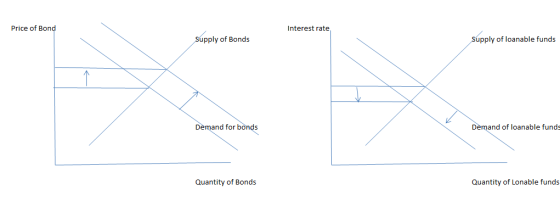
Interest rate and price of a bond are inversely related. So when the expected inflation decreases, the interest rate decreases which reduces the demand for loan able funds. For the decreased interest rate, people find bonds as an alternative for interest and hence the demand for bonds increases which increases the price of bonds
Add Answer to:
Using the bond supply and demand framework, show the changes in
the interest rate due to...
5. Inflation and the nominal interest rate The following graph shows the supply and demand curves...
 5. Inflation and the nominal interest rate The following graph shows the supply and demand curves in the market for loanable funds when actual inflation and expected inflation are zero. Suppose the expected inflation rate increases to 4%. Adjust the following graph to show the effect of this increase in the expected inflation rate. INTEREST RATE 500 100 200 300 400 QUANTITY OF LOANABLE FUNDS An expected inflation rate of 4% results in a nominal interest rate of and a...
1. How does expected inflation rate affects interest rate? Use the demand and supply in the...
1. How does expected inflation rate affects interest rate? Use the demand and supply in the bond market to explain your answer. 2. Differentiate the Expectation theory and Market Segmentation theory in explaining the yield curve?
6) Using money supply-money demand and the interest rate parity relationship, show how the central bank...
 6) Using money supply-money demand and the interest rate parity relationship, show how the central bank can maintain fixed exchange rates in the face of changes in output. 7) Using the DD-AA model under fixed exchange rates, show the effects of monetary policy. What are the main results? 8) Using the DD-AA model under fixed exchange rates, show the effects of fiscal policy. What are the main results? 9) Using the DD-AA model under fixed exchange rates, show the effects...
7. Show the changes in the graph below and predict the changes in output, interest rate,...
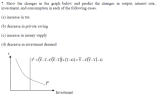 7. Show the changes in the graph below and predict the changes in output, interest rate, investment, and consumption in each of the following cases. (a) increase in tax b) decrease in private saving (c) increase in money supply (d) decrease in investment demand 1 Is = (Y-T-C(Y-T))-(T-G)-Y-C(Y-T)-G Investment
Problem 2 The Behavior of Interest rates (10 points) Suppose the public expects a higher return...
 Problem 2 The Behavior of Interest rates (10 points) Suppose the public expects a higher return from holding bonds. Consider the impact of this increase in expected return on the interest rate using the bond demand and supply framework, as well as the liquidity preference framework. First, draw bond demand and supply diagram. Assume, for the sake of your graphs, that we begin in equilibrium. Show the initial equilibrium starting point and the new equilibrium that occurs due to the...
Please show detail and work 12. Consider a typical supply and demand framework in which Demand...
 Please show detail and
work
12. Consider a typical supply and demand framework in which Demand and Supply have their usual slopes $Price (P) Quantity (Q) Suppose the market is initially in equilibrium at Pe, Qe on the graph above. If there were a decrease in demand, what would be the situation in the market if the price did not change? a. Surplus. b. Shortage. c. A tendency for the price to increase from its original level d. The market...
Please show detail and
work
12. Consider a typical supply and demand framework in which Demand and Supply have their usual slopes $Price (P) Quantity (Q) Suppose the market is initially in equilibrium at Pe, Qe on the graph above. If there were a decrease in demand, what would be the situation in the market if the price did not change? a. Surplus. b. Shortage. c. A tendency for the price to increase from its original level d. The market...
MTv1 4. Discuss how contractionary monetary policy impacts the equilibrium interest rate using the bond market to motivate the change in the interest rate. Explain using the Bond market graph and...
 MTv1 4. Discuss how contractionary monetary policy impacts the equilibrium interest rate using the bond market to motivate the change in the interest rate. Explain using the Bond market graph and the Bond pricing formula. Clearly label the graph Soond Dbond 5. In our Chapter 4 Money Market, the demand for money is given by M-SY (03-i), where $Ys 100 and the supply of money is $20. Find the equilibrium interest rate Show calculation
MTv1 4. Discuss how contractionary monetary...
MTv1 4. Discuss how contractionary monetary policy impacts the equilibrium interest rate using the bond market to motivate the change in the interest rate. Explain using the Bond market graph and the Bond pricing formula. Clearly label the graph Soond Dbond 5. In our Chapter 4 Money Market, the demand for money is given by M-SY (03-i), where $Ys 100 and the supply of money is $20. Find the equilibrium interest rate Show calculation
MTv1 4. Discuss how contractionary monetary...
22) Which of the following would not increase the supply curve of loanable funds? A) A...
 22) Which of the following would not increase the supply curve of loanable funds? A) A Federal Reserve purchase does of U.S. Government securities from commercial banks. B) A higher interest rate. C) An increase in the nation's real income D) All of the above shift the supply. 23) In Keynes's liquidity preference framework, A) the demand for bonds must equal the supply of money B) the demand for money must equal the supply of bonds. C) an excess demand...
Using money supply-money demand and the interest rate parity relationship, show how the central bank can...
Using money supply-money demand and the interest rate parity relationship, show how the central bank can deal with a balance of payments crisis and capital flight.
show both changes in graph and answer 2. Assume the economy is initially in equilibrium, and...
 show both changes in graph and answer
2. Assume the economy is initially in equilibrium, and then firms expect future total factor productivity, z', to decrease. Using the New Keynesian Model framework, what are the implications on the following: a) Output supply increase / decrease / indeterminate / no change)? b) Output demand (increase / decrease / indeterminate/ no change)? c) Labor supply increase / decrease / indeterminate / no change)? d) Labor demand (increase / decrease / indeterminate/ no...
show both changes in graph and answer
2. Assume the economy is initially in equilibrium, and then firms expect future total factor productivity, z', to decrease. Using the New Keynesian Model framework, what are the implications on the following: a) Output supply increase / decrease / indeterminate / no change)? b) Output demand (increase / decrease / indeterminate/ no change)? c) Labor supply increase / decrease / indeterminate / no change)? d) Labor demand (increase / decrease / indeterminate/ no...
 5. Inflation and the nominal interest rate The following graph shows the supply and demand curves in the market for loanable funds when actual inflation and expected inflation are zero. Suppose the expected inflation rate increases to 4%. Adjust the following graph to show the effect of this increase in the expected inflation rate. INTEREST RATE 500 100 200 300 400 QUANTITY OF LOANABLE FUNDS An expected inflation rate of 4% results in a nominal interest rate of and a...
 6) Using money supply-money demand and the interest rate parity relationship, show how the central bank can maintain fixed exchange rates in the face of changes in output. 7) Using the DD-AA model under fixed exchange rates, show the effects of monetary policy. What are the main results? 8) Using the DD-AA model under fixed exchange rates, show the effects of fiscal policy. What are the main results? 9) Using the DD-AA model under fixed exchange rates, show the effects...
 7. Show the changes in the graph below and predict the changes in output, interest rate, investment, and consumption in each of the following cases. (a) increase in tax b) decrease in private saving (c) increase in money supply (d) decrease in investment demand 1 Is = (Y-T-C(Y-T))-(T-G)-Y-C(Y-T)-G Investment
 Problem 2 The Behavior of Interest rates (10 points) Suppose the public expects a higher return from holding bonds. Consider the impact of this increase in expected return on the interest rate using the bond demand and supply framework, as well as the liquidity preference framework. First, draw bond demand and supply diagram. Assume, for the sake of your graphs, that we begin in equilibrium. Show the initial equilibrium starting point and the new equilibrium that occurs due to the...
 Please show detail and
work
12. Consider a typical supply and demand framework in which Demand and Supply have their usual slopes $Price (P) Quantity (Q) Suppose the market is initially in equilibrium at Pe, Qe on the graph above. If there were a decrease in demand, what would be the situation in the market if the price did not change? a. Surplus. b. Shortage. c. A tendency for the price to increase from its original level d. The market...
Please show detail and
work
12. Consider a typical supply and demand framework in which Demand and Supply have their usual slopes $Price (P) Quantity (Q) Suppose the market is initially in equilibrium at Pe, Qe on the graph above. If there were a decrease in demand, what would be the situation in the market if the price did not change? a. Surplus. b. Shortage. c. A tendency for the price to increase from its original level d. The market...
 MTv1 4. Discuss how contractionary monetary policy impacts the equilibrium interest rate using the bond market to motivate the change in the interest rate. Explain using the Bond market graph and the Bond pricing formula. Clearly label the graph Soond Dbond 5. In our Chapter 4 Money Market, the demand for money is given by M-SY (03-i), where $Ys 100 and the supply of money is $20. Find the equilibrium interest rate Show calculation
MTv1 4. Discuss how contractionary monetary...
MTv1 4. Discuss how contractionary monetary policy impacts the equilibrium interest rate using the bond market to motivate the change in the interest rate. Explain using the Bond market graph and the Bond pricing formula. Clearly label the graph Soond Dbond 5. In our Chapter 4 Money Market, the demand for money is given by M-SY (03-i), where $Ys 100 and the supply of money is $20. Find the equilibrium interest rate Show calculation
MTv1 4. Discuss how contractionary monetary...
 22) Which of the following would not increase the supply curve of loanable funds? A) A Federal Reserve purchase does of U.S. Government securities from commercial banks. B) A higher interest rate. C) An increase in the nation's real income D) All of the above shift the supply. 23) In Keynes's liquidity preference framework, A) the demand for bonds must equal the supply of money B) the demand for money must equal the supply of bonds. C) an excess demand...
 show both changes in graph and answer
2. Assume the economy is initially in equilibrium, and then firms expect future total factor productivity, z', to decrease. Using the New Keynesian Model framework, what are the implications on the following: a) Output supply increase / decrease / indeterminate / no change)? b) Output demand (increase / decrease / indeterminate/ no change)? c) Labor supply increase / decrease / indeterminate / no change)? d) Labor demand (increase / decrease / indeterminate/ no...
show both changes in graph and answer
2. Assume the economy is initially in equilibrium, and then firms expect future total factor productivity, z', to decrease. Using the New Keynesian Model framework, what are the implications on the following: a) Output supply increase / decrease / indeterminate / no change)? b) Output demand (increase / decrease / indeterminate/ no change)? c) Labor supply increase / decrease / indeterminate / no change)? d) Labor demand (increase / decrease / indeterminate/ no...
Most questions answered within 3 hours.
-
Where is the error in this code sequence?
String s1 = "Hello";
String s2 = "ello";...
asked 10 months ago -
Financial data for Joel de Paris, Inc., for last year
follow:
Joel de Paris, Inc.
Balance...
asked 10 months ago -
Consider this reaction:
Al2(SO4)3 (aq)+ BaCl3
(aq) Al2Cl6 (aq)- +
3BaSO4(s) . What is the...
asked 10 months ago -
Suppose that Savneet is considering increasing her
recent random sample from 20 car rentals to 40...
asked 10 months ago -
Trucks arrive at an unloading terminal at an average rate of 120
per hour.
Trucks arrive...
asked 10 months ago -
Why are methanol and ethanol completely soluble in water while
octanol is not very little soluble....
asked 10 months ago -
A facilities manager at a university reads in a research report
that the mean amount of...
asked 10 months ago -
When the CuSO4 is rehydrated by adding water to the anhydrous
compound, is this an endothermic...
asked 10 months ago -
A ray of sunlight is passing from diamond into crown glass; the
angle of incidence is...
asked 10 months ago -
A block of mass 0.249 kg is placed on top of a light, vertical
spring of...
asked 10 months ago -
how do the kidneys compensate in the presences of acidosis
a) trigger hyperventilate
b) reserve acid...
asked 10 months ago -
Question 501 pts
The rental rate of capital to the firm increases. Which of the
following...
asked 10 months ago