Give a diagram showing muscle force, weight force and reaction force in the first position of...
Give a diagram showing muscle force, weight force and reaction force in the first position of a plié BALLET
Homework Answers

Add Answer to:
Give a diagram showing muscle force, weight force and reaction
force in the first position of...
You are able to hold your arm in an outstretched position because of the deltoid muscle....
 You are able to hold your arm in an outstretched position
because of the deltoid muscle. The force diagram for this is shown
below. Assume that the weight of the humerus is 8 lb (with a center
of gravity as shown), and that the deltoid muscle makes an angle of
α = 18 degrees to the humerus.
What is the magnitude of the tension in the deltoid muscle? What
is the magnitude of the force F at the joint?
Deltoid...
You are able to hold your arm in an outstretched position
because of the deltoid muscle. The force diagram for this is shown
below. Assume that the weight of the humerus is 8 lb (with a center
of gravity as shown), and that the deltoid muscle makes an angle of
α = 18 degrees to the humerus.
What is the magnitude of the tension in the deltoid muscle? What
is the magnitude of the force F at the joint?
Deltoid...
Muscle force Axis w The mass and length of the forearm in the diagram below are...
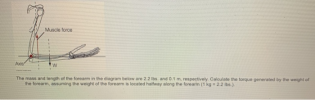 Muscle force Axis w The mass and length of the forearm in the diagram below are 2.2 lbs. and 0.1 m, respectively. Calculate the torque generated by the weight of the forearm, assuming the weight of the forearm is located halfway along the forearm (1 kg = 2.2 lbs.).
An athlete is measuring the force by their flexor muscle by pulling a rope horizontally at...
 An athlete is measuring the force by their flexor muscle by pulling a rope horizontally at a constant force. While pulling the rope the muscle applies a force on the forearm an angle of 71° as shown in the diagram. While keeping your forearm completely vertical, the tension in the rope is at 185N. The athlete's muscle is attached to the forearm 5 cm from the elbow joint and that the weight of your forearm is 22 N with a...
Consider the case of the bicepts muscle acting on a forearm holding a 43 N weight....
 Consider the case of the bicepts muscle acting on a forearm
holding a 43 N weight. The forearm is 30° below the horizontal and
the bicepts muscle inserts at an angle of 45° with the forearm. The
muscle insertion is at 5 cm from the elbow joint. The forearm has a
weight of 21 N and has its center of gravity 15 cm from the elbow.
The 43 N weight is held in the hand 30 cm from the joint...
Consider the case of the bicepts muscle acting on a forearm
holding a 43 N weight. The forearm is 30° below the horizontal and
the bicepts muscle inserts at an angle of 45° with the forearm. The
muscle insertion is at 5 cm from the elbow joint. The forearm has a
weight of 21 N and has its center of gravity 15 cm from the elbow.
The 43 N weight is held in the hand 30 cm from the joint...
Consider the case of the bicepts muscle acting on a forearm holding a 35 N weight....
 Consider the case of the bicepts muscle acting on a forearm holding a 35 N weight. The forearm is 30 below the horizontal and the bicepts muscle inserts at an angle of 45 with the forearm. The muscle insertion is at 5 cm from the elbow joint. The forearm has a weight of 18 N and has its center of gravity 15 cm from the elbow. The 35 N weight is held in the hand 30 cm from the joint...
Each of the four parts of this problem depicts a motion diagram showing the position and...
 Each of the four parts of this problem depicts a motion diagram
showing the position and velocity of a charged particle at equal
time intervals as it moves through a region of uniform electric
field. For each part, draw a vector representing the direction of
the electric field.
Draw a vector representing the direction of the electric
field. The orientation of the vector will be graded. The location
and length of the vector will not be graded.
Electric Field Vector...
Each of the four parts of this problem depicts a motion diagram
showing the position and velocity of a charged particle at equal
time intervals as it moves through a region of uniform electric
field. For each part, draw a vector representing the direction of
the electric field.
Draw a vector representing the direction of the electric
field. The orientation of the vector will be graded. The location
and length of the vector will not be graded.
Electric Field Vector...
Deltoid muscle Fig. 1a Problem #2.1 You are able to hold your arm in an outstretched...
 Deltoid muscle Fig. 1a Problem #2.1 You are able to hold your arm in an outstretched position because of the deltoid muscle. The force diagram for this is shown in Fig. 1b. Use the equilibrium conditions to determine the tension T in the deltoid muscle needed to achieve this equilibrium, and the vertical and horizontal components of the force exerted by the scapula (shoulder blade)on the humerus. Assume the weight of the humerus is 36.0 N and the deltoid muscle...
Draw a biomechanical force diagram for the flexor carpi radialis muscle. Label the fulcrum, bones used...
Draw a biomechanical force diagram for the flexor carpi radialis muscle. Label the fulcrum, bones used as levers, force application point, and the resistance. What kind of lever system does this represent?
7. Find the quadriceps muscle force (F3) needed to hold the leg in the horizontal position...
 7. Find the quadriceps muscle force (F3) needed to hold the leg in the horizontal position during an isometric leg extension exercise, given that F2 = 180 N,F1-75 N and θ angle of pull of the quads with respect to the horizontal). 25° (ie, the F, 10am 20
An object whose weight is is balanced in the force of as seen on the diagram....
 An object whose weight is is balanced in the force of
as seen on the diagram. Note
that the pulley is frictionless. What is the magnitude of ?
;
37 Rope
An object whose weight is is balanced in the force of
as seen on the diagram. Note
that the pulley is frictionless. What is the magnitude of ?
;
37 Rope
 You are able to hold your arm in an outstretched position
because of the deltoid muscle. The force diagram for this is shown
below. Assume that the weight of the humerus is 8 lb (with a center
of gravity as shown), and that the deltoid muscle makes an angle of
α = 18 degrees to the humerus.
What is the magnitude of the tension in the deltoid muscle? What
is the magnitude of the force F at the joint?
Deltoid...
You are able to hold your arm in an outstretched position
because of the deltoid muscle. The force diagram for this is shown
below. Assume that the weight of the humerus is 8 lb (with a center
of gravity as shown), and that the deltoid muscle makes an angle of
α = 18 degrees to the humerus.
What is the magnitude of the tension in the deltoid muscle? What
is the magnitude of the force F at the joint?
Deltoid...
 Muscle force Axis w The mass and length of the forearm in the diagram below are 2.2 lbs. and 0.1 m, respectively. Calculate the torque generated by the weight of the forearm, assuming the weight of the forearm is located halfway along the forearm (1 kg = 2.2 lbs.).
 An athlete is measuring the force by their flexor muscle by pulling a rope horizontally at a constant force. While pulling the rope the muscle applies a force on the forearm an angle of 71° as shown in the diagram. While keeping your forearm completely vertical, the tension in the rope is at 185N. The athlete's muscle is attached to the forearm 5 cm from the elbow joint and that the weight of your forearm is 22 N with a...
 Consider the case of the bicepts muscle acting on a forearm
holding a 43 N weight. The forearm is 30° below the horizontal and
the bicepts muscle inserts at an angle of 45° with the forearm. The
muscle insertion is at 5 cm from the elbow joint. The forearm has a
weight of 21 N and has its center of gravity 15 cm from the elbow.
The 43 N weight is held in the hand 30 cm from the joint...
Consider the case of the bicepts muscle acting on a forearm
holding a 43 N weight. The forearm is 30° below the horizontal and
the bicepts muscle inserts at an angle of 45° with the forearm. The
muscle insertion is at 5 cm from the elbow joint. The forearm has a
weight of 21 N and has its center of gravity 15 cm from the elbow.
The 43 N weight is held in the hand 30 cm from the joint...
 Consider the case of the bicepts muscle acting on a forearm holding a 35 N weight. The forearm is 30 below the horizontal and the bicepts muscle inserts at an angle of 45 with the forearm. The muscle insertion is at 5 cm from the elbow joint. The forearm has a weight of 18 N and has its center of gravity 15 cm from the elbow. The 35 N weight is held in the hand 30 cm from the joint...
 Each of the four parts of this problem depicts a motion diagram
showing the position and velocity of a charged particle at equal
time intervals as it moves through a region of uniform electric
field. For each part, draw a vector representing the direction of
the electric field.
Draw a vector representing the direction of the electric
field. The orientation of the vector will be graded. The location
and length of the vector will not be graded.
Electric Field Vector...
Each of the four parts of this problem depicts a motion diagram
showing the position and velocity of a charged particle at equal
time intervals as it moves through a region of uniform electric
field. For each part, draw a vector representing the direction of
the electric field.
Draw a vector representing the direction of the electric
field. The orientation of the vector will be graded. The location
and length of the vector will not be graded.
Electric Field Vector...
 Deltoid muscle Fig. 1a Problem #2.1 You are able to hold your arm in an outstretched position because of the deltoid muscle. The force diagram for this is shown in Fig. 1b. Use the equilibrium conditions to determine the tension T in the deltoid muscle needed to achieve this equilibrium, and the vertical and horizontal components of the force exerted by the scapula (shoulder blade)on the humerus. Assume the weight of the humerus is 36.0 N and the deltoid muscle...
 7. Find the quadriceps muscle force (F3) needed to hold the leg in the horizontal position during an isometric leg extension exercise, given that F2 = 180 N,F1-75 N and θ angle of pull of the quads with respect to the horizontal). 25° (ie, the F, 10am 20
 An object whose weight is is balanced in the force of
as seen on the diagram. Note
that the pulley is frictionless. What is the magnitude of ?
;
37 Rope
An object whose weight is is balanced in the force of
as seen on the diagram. Note
that the pulley is frictionless. What is the magnitude of ?
;
37 Rope
Most questions answered within 3 hours.
-
Where is the error in this code sequence?
String s1 = "Hello";
String s2 = "ello";...
asked 10 months ago -
Financial data for Joel de Paris, Inc., for last year
follow:
Joel de Paris, Inc.
Balance...
asked 10 months ago -
Consider this reaction:
Al2(SO4)3 (aq)+ BaCl3
(aq) Al2Cl6 (aq)- +
3BaSO4(s) . What is the...
asked 10 months ago -
Suppose that Savneet is considering increasing her
recent random sample from 20 car rentals to 40...
asked 10 months ago -
Trucks arrive at an unloading terminal at an average rate of 120
per hour.
Trucks arrive...
asked 10 months ago -
Why are methanol and ethanol completely soluble in water while
octanol is not very little soluble....
asked 10 months ago -
A facilities manager at a university reads in a research report
that the mean amount of...
asked 10 months ago -
When the CuSO4 is rehydrated by adding water to the anhydrous
compound, is this an endothermic...
asked 10 months ago -
A ray of sunlight is passing from diamond into crown glass; the
angle of incidence is...
asked 10 months ago -
A block of mass 0.249 kg is placed on top of a light, vertical
spring of...
asked 10 months ago -
how do the kidneys compensate in the presences of acidosis
a) trigger hyperventilate
b) reserve acid...
asked 10 months ago -
Question 501 pts
The rental rate of capital to the firm increases. Which of the
following...
asked 10 months ago