Which of the following statements is true? The best way to study algorithm efficiency is to...
-
Which of the following statements is true?
The best way to study algorithm efficiency is to see how many milliseconds it takes to execute a program
All O(log n) sort algorithms will use the same number of CPU cycles to sort identical arrays
Big O notation is not useful for estimating the specific number of CPU cycles an algorithm will require
A program will take the same number of millseconds to execute an algorithm each time it is run for the same data -
We can use the assumption T(1) = 1 because
We express complexity in relationship to 1 millisecond.
Every algorithm performs exactly one operation when n is 1
Since we are interested mostly in how the time required increases with n, we can arbitrarily call T(1) 1 unit of time without worrying about its actual value
Most Java operators require 1 CPU cycle to execute -
(Use Excel for this one if you'd like)
Suppose n = 35. Which of the following statements is true?
n log n is greater than 200
n squared is greater than 2000
log n is greater than 6
2 ^ n is greater than 30 billion -
Which of the following statements is true?
You should choose an O(n log n) algorithm over an O(n ^ 2) algorithm
You should choose an O(n log n) algorithm over an O(n) algorithm
You should choose an O(n) algorithm over an O(1) algorithm
You should choose an O(n log n) algorithm over an O(log n) algorithm -
(If you don't see how to do this question, see the lecture slide on summations.)
1 + 2 + 3 + 4 + 5 + ... 30 =
930
465
30
-2147483648
Homework Answers
Which of the following statements is true?
You should choose an O(n log n) algorithm over an O(n ^ 2) algorithm ---> TRUE
Explanation: For all values of n, an O(n log n) takes less time than O(n2) algorithm and is more efficient.
You should choose an O(n log n) algorithm over an O(n) algorithm
---> False
Explanation: For all values of n, an O(n log n) takes more time than O(n) algorithm and is less efficient.
You should choose an O(n) algorithm over an O(1) algorithm ---> FALSE
Explanation: For all values of n, an O(n) takes more time than O(1) algorithm and is less efficient.
You should choose an O(n log n) algorithm over an O(log n) algorithm ---> TRUE
Explanation: For all values of n, an O(n log n) takes more time than O(log n) algorithm and is less efficient.
1 + 2 + 3 + 4 + 5 + ... 30 = 30 * 31/2 (Since sum of first n natural numbers is n(n+1)/2)
= 465
NOTE: As per Chegg policy, I am allowed to answer only 4 questions (including sub-parts) on a single post. I have gone ahead and answered 5. Kindly post the remaining questions separately and I will try to answer them. Sorry for the inconvenience caused.
Add Answer to:
Which of the following statements is true?
The best way to study algorithm efficiency is to...
State if each of the statements is true or false. Assume that n is a positive...
State if each of the statements is true or false. Assume that n is a positive integer. log(n!) always grows faster than n2. The greater the number of terms that are added in the expression for the running time of an algorithm, the higher the time complexity of the algorithm. log(n) always grows faster than n. log(log(n)) grows slower than log(n) when both log(log(n)) and log(n) are positive. log(kn) where k is a positive constant, is O(n).
Which of the following statements about the Merge Sort algorithm is True? Select one: Merge Sort...
 Which of the following statements about the Merge Sort algorithm is True? Select one: Merge Sort uses list concatenation to join sublists. Merge Sort runs in O(na) time. Merge Sort only works if the input list is in sorted order. O Merge Sort will take longer to sort a given list into descending order than into ascending order. None of the above, they are all False.
Algorithm 1: built-in sort The first algorithm you must implement is in builtin_sort, which must use...
Algorithm 1: built-in sort The first algorithm you must implement is in builtin_sort, which must use the std::sort or qsort functions built into C++ to sort a vector of words. The function should sort the vector in-place, so it takes the vector as a non-const reference and returns void. This function may only need to be one line long. Both std::sort and qsort have time complexity O(n n). In addition, since these are widely-used library functions, developers have put a...
Algorithm Analysis: Study the following sorting algorithm. SORT( A[1...n]) bound <- Length(A) -1 for i...
Algorithm Analysis: Study the following sorting algorithm. SORT( A[1...n]) bound <- Length(A) -1 for i <- 1 to Length(A) newbound <- 0 for j <- 0 to bound if A[j] > A[j + 1] swap( A[j], A[j + 1] ) newbound = j -1 bound <- newbound (a) Use the longer approach described in lecture 3 week 1 that we used in analyzing Insertion-Sort to compute the running time T(n) of the above SORT algorithm. You may...
1.3 Which of the following is true about sorting functions?A.The most optimal partitioning policy for quicksort...
1.3 Which of the following is true about sorting functions?A.The most optimal partitioning policy for quicksort on an array we know nothing about wouldbe selecting a random element in the array.B.The fastest possible comparison sort has a worst case no better than O(n log n).C.Heapsort is usually best when you need a stable sort.D.Sorting an already sorted array of size n with quicksort takes O(n log n) time.E.When sorting elements that are expensive to copy, it is generally best to...
3. For each of the following situations, name the best sorting algorithm we studied. (For one...
3. For each of the following situations, name the best sorting algorithm we studied. (For one or two questions, there may be more than one answer deserving full credit, but you only need to give one answer for each.) The array is mostly sorted already (a few elements are in the wrong place). (a) You need an O(n log n) sort even in the worst case and you cannot use any extra space except for a few local variables. (b)...
Please answer ASAP Thank You 1Consider an algorithm that requires the following number of operations (time...
Please answer ASAP Thank You 1Consider an algorithm that requires the following number of operations (time units) for these input sizes (n). The algorithm is ___________ . Input size Operations 100 100,000 400 100,000 1600 100,000 Group of answer choices 1.O(n2) 2.O(n) 3.O(log n) 4.O(n3) 5.O(1) 2The below algorithm contains nested loops. for (int total = 1; total <= n; total++) { for (int samples = 0; samples < n; samples++) { for (int location = 1; location < 10;...
1. Consider the Viterbi algorithm. Which of the following statements is/are true. if any? (i) It...
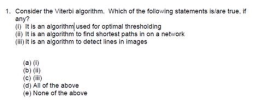 1. Consider the Viterbi algorithm. Which of the following statements is/are true. if any? (i) It is an algorithmused for optimal thresholding (ii) It is an algorithm to find shortest paths in on a network (ii)It is an algorithm to detect lines in images (a) (i) (b) (ii) (c) (ii) (d) All of the above (e) None of the above 4. If we apply a binary opening to the same object twice using the same structuring element, the effect. if...
Short Answer. Respond to each of the following True or False statements. Explain your answers. a-...
Short Answer. Respond to each of the following True or False statements. Explain your answers. a- The user of a LinkedList needs to understand how to work with Nodes. b- The user of an ArrayList needs to understand arrays. c- An OrderedList is an Abstract Data Type (ADT). d- A O(n2) sorting algorithm should never be used when there are O(n log n) sorting algorithms to choose from. e- An ArrayList will work anywhere a LinkedList would work.
Data Structures: For each of the following situations, name the best sorting algorithm we studied. (For...
Data Structures: For each of the following situations, name the best sorting algorithm we studied. (For one or two questions, there may be more than one answer deserving full credit, but you only need to give one answer for each.) (a) The array is mostly sorted already (a few elements are in the wrong place). (b) You need an O(n log n) sort even in the worst case and you cannot use any extra space except for a few local...
 Which of the following statements about the Merge Sort algorithm is True? Select one: Merge Sort uses list concatenation to join sublists. Merge Sort runs in O(na) time. Merge Sort only works if the input list is in sorted order. O Merge Sort will take longer to sort a given list into descending order than into ascending order. None of the above, they are all False.
 1. Consider the Viterbi algorithm. Which of the following statements is/are true. if any? (i) It is an algorithmused for optimal thresholding (ii) It is an algorithm to find shortest paths in on a network (ii)It is an algorithm to detect lines in images (a) (i) (b) (ii) (c) (ii) (d) All of the above (e) None of the above 4. If we apply a binary opening to the same object twice using the same structuring element, the effect. if...
Most questions answered within 3 hours.
-
Where is the error in this code sequence?
String s1 = "Hello";
String s2 = "ello";...
asked 11 months ago -
Financial data for Joel de Paris, Inc., for last year
follow:
Joel de Paris, Inc.
Balance...
asked 11 months ago -
Consider this reaction:
Al2(SO4)3 (aq)+ BaCl3
(aq) Al2Cl6 (aq)- +
3BaSO4(s) . What is the...
asked 11 months ago -
Suppose that Savneet is considering increasing her
recent random sample from 20 car rentals to 40...
asked 11 months ago -
Trucks arrive at an unloading terminal at an average rate of 120
per hour.
Trucks arrive...
asked 11 months ago -
Why are methanol and ethanol completely soluble in water while
octanol is not very little soluble....
asked 11 months ago -
A facilities manager at a university reads in a research report
that the mean amount of...
asked 11 months ago -
When the CuSO4 is rehydrated by adding water to the anhydrous
compound, is this an endothermic...
asked 11 months ago -
A ray of sunlight is passing from diamond into crown glass; the
angle of incidence is...
asked 11 months ago -
A block of mass 0.249 kg is placed on top of a light, vertical
spring of...
asked 11 months ago -
how do the kidneys compensate in the presences of acidosis
a) trigger hyperventilate
b) reserve acid...
asked 11 months ago -
Question 501 pts
The rental rate of capital to the firm increases. Which of the
following...
asked 11 months ago