In an analysis of variance (ANOVA), subtracting the grand mean from each person’s score provides a...
In an analysis of variance (ANOVA), subtracting the grand mean from each person’s score provides a representation of:
Select one:
1.total variability because the study groups are not taken in to consideration.
2.between-groups variability because the study groups are taken in to consideration.
3.within-groups variability because the study groups are not taken in to consideration.
4.total variability because the study groups are taken in to consideration.
Homework Answers
From the given information,
As the grand mean is subtracted from each value, there is no consideration regarding groups.
Hence,
The required correct answer is,
1.total variability because the study groups are not taken in to consideration.
Thank you.
Add Answer to:
In an analysis of variance (ANOVA), subtracting the grand mean
from each person’s score provides a...
1. In analysis of variance, MS between-groups provides a measure of the total variability for the...
1. In analysis of variance, MS between-groups provides a measure of the total variability for the set of N scores, standard deviation, the overall mean for the set of N scores, differences among treatment means 2. An independent-measures research study compares three treatment conditions using a sample of n = 5 in each treatment. For this study, the three totals are, T1 = 5, T2 = 10, and T3 = 15. What value would be obtained for the grand mean,...
In ANOVA, variability between groups reflects _________, whereas variability within groups reflects __________ . total variance;...
In ANOVA, variability between groups reflects _________, whereas variability within groups reflects __________ . total variance; error variance error variance ; total variance random error; a true effect (if one exists) both a true effect (if one exists) and random error; only random error just a true effect (if one exists); random error Rejecting the null hypothesis with the overall or omnibus One-way Analysis of Variance indicates that the: mean of one sample differs significantly from the mean of at...
Analysis of variance compares the means of a response variable for several groups. ANOVA compares the...
 Analysis of variance compares the means of a response variable for several groups. ANOVA compares the variation within each group to the variation of the mean of each group. The ratio of these two is the F statistic from an F distribution with (number of groups - 1) as the numerator degrees of freedom and (number of observations - number of groups) as the denominator degrees of freedom. You intend to conduct an ANOVA with 4 groups in which each...
Analysis of variance compares the means of a response variable for several groups. ANOVA compares the...
 Analysis of variance compares the means of a response variable for several groups. ANOVA compares the variation within each group to the variation of the mean of each group. The ratio of these two is the F statistic from an F distribution with (number of groups - 1) as the numerator degrees of freedom and (number of observations - number of groups) as the denominator degrees of freedom. You intend to conduct an ANOVA with 4 groups in which each...
Analysis of variance compares the means of a response variable for several groups. ANOVA compares the...
 Analysis of variance compares the means of a response variable for several groups. ANOVA compares the variation within each group to the variation of the mean of each group. The ratio of these two is the F statistic from an F distribution with (number of groups - 1) as the numerator degrees of freedom and (number of observations - number of groups) as the denominator degrees of freedom. You intend to conduct an ANOVA with 4 groups in which each...
Question 8 ANOVA Score Sum of Squares df Mean Square F Sig. Between Groups 1746.100 3...
Question 8 ANOVA Score Sum of Squares df Mean Square F Sig. Between Groups 1746.100 3 582.033 47.686 .000 Within Groups 439.400 36 12.206 Total 2185.500 39 Which value below represents the effect size (eta squared) for this analysis? η2 =.83 η2 =.79 η2 =.59 η2 =.69
Please make V1=3 not 4 d) An experiment is to have its results examined by analysis...
 Please make V1=3 not 4
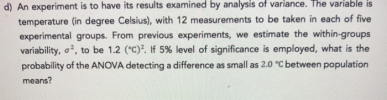
d) An experiment is to have its results examined by analysis of variance. The variable is temperature (in degree Celsius), with 12 measurements to be taken in each of five experimental groups. From previous experiments, we estimate the within-groups variability, ơ2, to be 1.2 (°C)2. If 5% level of significance is employed, what is the probability of the ANOVA detecting a difference as small as 2.0 °c between population means?
Please make V1=3 not 4
d) An experiment is to have its results examined by analysis of variance. The variable is temperature (in degree Celsius), with 12 measurements to be taken in each of five experimental groups. From previous experiments, we estimate the within-groups variability, ơ2, to be 1.2 (°C)2. If 5% level of significance is employed, what is the probability of the ANOVA detecting a difference as small as 2.0 °c between population means?
ANOVA Score Sum of Squares df Mean Square F Sig. Between Groups 652.875 3 217.625 14.404...
ANOVA Score Sum of Squares df Mean Square F Sig. Between Groups 652.875 3 217.625 14.404 .000 Within Groups 543.900 36 15.108 Total 1196.775 39
QUESTION 3 In an analysis of variance, differences caused by treatment effects contribute to which of...
 QUESTION 3 In an analysis of variance, differences caused by treatment effects contribute to which of the following variances? a. Between-treatments variance but not within-treatments variance o b. Both between-treatments variance and within-treatments variance e c Within-treatments variance but not between treatments variance o d. Neither between-treatments variance nor within treatments variance QUESTION 4 In analysis of variance, what is measured by the MS values? o a. The total variability for the set of N scores e b Population variance...
1. An analysis of variance with one dependent and one independent variable is referred to as:...
 1.
An analysis of variance with one dependent and one independent
variable is referred to as:
A)
one-way ANOVA
B)
two-way ANOVA
C)
many-way ANOVA
D)
correlation
3. What is the
null hypothesis when using ANOVA?
A)
B)
C)
D)
4. What is
the research hypothesis when using ANOVA procedures?
A) all of the
group means are equal
B) all of the
group means are significantly different from all other group
means
C) at least one
of the group means is significantly different from...
1.
An analysis of variance with one dependent and one independent
variable is referred to as:
A)
one-way ANOVA
B)
two-way ANOVA
C)
many-way ANOVA
D)
correlation
3. What is the
null hypothesis when using ANOVA?
A)
B)
C)
D)
4. What is
the research hypothesis when using ANOVA procedures?
A) all of the
group means are equal
B) all of the
group means are significantly different from all other group
means
C) at least one
of the group means is significantly different from...
 Analysis of variance compares the means of a response variable for several groups. ANOVA compares the variation within each group to the variation of the mean of each group. The ratio of these two is the F statistic from an F distribution with (number of groups - 1) as the numerator degrees of freedom and (number of observations - number of groups) as the denominator degrees of freedom. You intend to conduct an ANOVA with 4 groups in which each...
 Analysis of variance compares the means of a response variable for several groups. ANOVA compares the variation within each group to the variation of the mean of each group. The ratio of these two is the F statistic from an F distribution with (number of groups - 1) as the numerator degrees of freedom and (number of observations - number of groups) as the denominator degrees of freedom. You intend to conduct an ANOVA with 4 groups in which each...
 Analysis of variance compares the means of a response variable for several groups. ANOVA compares the variation within each group to the variation of the mean of each group. The ratio of these two is the F statistic from an F distribution with (number of groups - 1) as the numerator degrees of freedom and (number of observations - number of groups) as the denominator degrees of freedom. You intend to conduct an ANOVA with 4 groups in which each...
 Please make V1=3 not 4
d) An experiment is to have its results examined by analysis of variance. The variable is temperature (in degree Celsius), with 12 measurements to be taken in each of five experimental groups. From previous experiments, we estimate the within-groups variability, ơ2, to be 1.2 (°C)2. If 5% level of significance is employed, what is the probability of the ANOVA detecting a difference as small as 2.0 °c between population means?
Please make V1=3 not 4
d) An experiment is to have its results examined by analysis of variance. The variable is temperature (in degree Celsius), with 12 measurements to be taken in each of five experimental groups. From previous experiments, we estimate the within-groups variability, ơ2, to be 1.2 (°C)2. If 5% level of significance is employed, what is the probability of the ANOVA detecting a difference as small as 2.0 °c between population means?
 QUESTION 3 In an analysis of variance, differences caused by treatment effects contribute to which of the following variances? a. Between-treatments variance but not within-treatments variance o b. Both between-treatments variance and within-treatments variance e c Within-treatments variance but not between treatments variance o d. Neither between-treatments variance nor within treatments variance QUESTION 4 In analysis of variance, what is measured by the MS values? o a. The total variability for the set of N scores e b Population variance...
 1.
An analysis of variance with one dependent and one independent
variable is referred to as:
A)
one-way ANOVA
B)
two-way ANOVA
C)
many-way ANOVA
D)
correlation
3. What is the
null hypothesis when using ANOVA?
A)
B)
C)
D)
4. What is
the research hypothesis when using ANOVA procedures?
A) all of the
group means are equal
B) all of the
group means are significantly different from all other group
means
C) at least one
of the group means is significantly different from...
1.
An analysis of variance with one dependent and one independent
variable is referred to as:
A)
one-way ANOVA
B)
two-way ANOVA
C)
many-way ANOVA
D)
correlation
3. What is the
null hypothesis when using ANOVA?
A)
B)
C)
D)
4. What is
the research hypothesis when using ANOVA procedures?
A) all of the
group means are equal
B) all of the
group means are significantly different from all other group
means
C) at least one
of the group means is significantly different from...
Most questions answered within 3 hours.
-
Where is the error in this code sequence?
String s1 = "Hello";
String s2 = "ello";...
asked 10 months ago -
Financial data for Joel de Paris, Inc., for last year
follow:
Joel de Paris, Inc.
Balance...
asked 10 months ago -
Consider this reaction:
Al2(SO4)3 (aq)+ BaCl3
(aq) Al2Cl6 (aq)- +
3BaSO4(s) . What is the...
asked 10 months ago -
Suppose that Savneet is considering increasing her
recent random sample from 20 car rentals to 40...
asked 10 months ago -
Trucks arrive at an unloading terminal at an average rate of 120
per hour.
Trucks arrive...
asked 10 months ago -
Why are methanol and ethanol completely soluble in water while
octanol is not very little soluble....
asked 10 months ago -
A facilities manager at a university reads in a research report
that the mean amount of...
asked 10 months ago -
When the CuSO4 is rehydrated by adding water to the anhydrous
compound, is this an endothermic...
asked 10 months ago -
A ray of sunlight is passing from diamond into crown glass; the
angle of incidence is...
asked 10 months ago -
A block of mass 0.249 kg is placed on top of a light, vertical
spring of...
asked 10 months ago -
how do the kidneys compensate in the presences of acidosis
a) trigger hyperventilate
b) reserve acid...
asked 10 months ago -
Question 501 pts
The rental rate of capital to the firm increases. Which of the
following...
asked 10 months ago