An electron is moving with a velocity V parallel to an infinitely long wire with uniform...
An electron is moving with a velocity V parallel to an infinitely long wire with uniform charge density (λ) and current I. what is V so that electron continues in a straight line? ( Please be really detailed about the methods and formulas used as I am so lost)
Homework Answers
magnetic field due to current carrying wire
B = (uo/ 4pi) 2 I / a
electric field due to charge linear conductor
E = (1/ 4 pi eo)  / a
/ a
for no deflection
E = B v
v = E/B
v = (1/4 pi eo)
/ ( (uo / 4pi) * 2I)
=======
Comment before rate in case any doubt, will reply for sure.. goodluck
Add Answer to:
An electron is moving with a velocity V parallel to an
infinitely long wire with uniform...
a)Consider the case of a point test charge q moving with velocity u parallel to an...
a)Consider the case of a point test charge q moving with velocity u parallel to an infinitely long straight current. Let λ be the proper charge density of the positive ions and v be the drift velocity of the electrons in the wire. Calculate the charge density of the wire relative to the rest-frame of the test charge q. b) Prove that the force ˜f the test charge feels in its rest-frame corresponds exactly to the force f on it...
a)Consider the case of a point test charge q moving with velocity u parallel to an...
a)Consider the case of a point test charge q moving with velocity u parallel to an infinitely long straight current (as in Section 7.7 of Rindler). Let λ be the proper charge density of the positive ions and v be the drift velocity of the electrons in the wire. Calculate the charge density of the wire relative to the rest-frame of the test charge q. b) Prove that the force ˜f the test charge feels in its rest-frame corresponds exactly...
Consider the case of a point test charge q moving with velocity u parallel to an...
Consider the case of a point test charge q moving with velocity u parallel to an infinitely long straight current (as in Section 7.7 of Rindler). Let λ be the proper charge density of the positive ions and v be the drift velocity of the electrons in the wire. Calculate the charge density of the wire relative to the rest-frame of the test charge q.
Can someone carefully explain question A and B in detail, please? 5.2 A uniform linear charge density λ is placed on an infinitely long wire. The wire is parallel to an infinite grounded plane, and a...
 Can someone carefully explain question A and B in detail,
please?
5.2 A uniform linear charge density λ is placed on an infinitely long wire. The wire is parallel to an infinite grounded plane, and a distance b above that plane. To make things specific, the points on the wire are described as (x, 0, b), and the conducting plane is z 0. A. Find the potential V(O, y, z) for z > 0. B. Find the induced charge density...
Can someone carefully explain question A and B in detail,
please?
5.2 A uniform linear charge density λ is placed on an infinitely long wire. The wire is parallel to an infinite grounded plane, and a distance b above that plane. To make things specific, the points on the wire are described as (x, 0, b), and the conducting plane is z 0. A. Find the potential V(O, y, z) for z > 0. B. Find the induced charge density...
An infinitely long straight wire has a uniform linear charge density of λ. Derive the equation...
An infinitely long straight wire has a uniform linear charge density of λ. Derive the equation for the electric field a distance R away from the wire using Gauss's Law for Electrostatics.
Find the electric field a distance s from an infinitely long straight wire that carries a...
 Find the electric field a distance s from an infinitely long straight wire that carries a uniform line charge λ. You must use two methods, one is standard methods (do the integration from -oo to oo along the wire), another is Gauss law, then you will know why Gauss law is so convenient by comparison.
9.5) Coaxial cable An infinitely long wire carries a uniform linear charge density of −λ. The...
9.5) Coaxial cable An infinitely long wire carries a uniform linear charge density of −λ. The wire is surrounded by a cylindrical sheath of radius a coaxial with the wire. The sheath carries a uniform surface charge density of η = +λ/(2πa). (a) Consider a cylindrical Gaussian surface of radius R and length `coaxial with the cables. How much charge is enclosed in the Gaussian surface for R < a and R > a? (b) What does symmetry dictate about...
A rectangular loop of dimensions / and w moves with a constant velocity v away from an infinitely long straight wire carrying a current I in the plane of the loop, as shown in Figure 10.9.6
 Problem 2 (Current through Loop) A rectangular loop of dimensions / and w moves with a constant velocity v away from an infinitely long straight wire carrying a current I in the plane of the loop, as shown in Figure 10.9.6. Let the total resistance of the loop be R. What is the current in the loop at the instant the near side is a distance r from the wire? Figure 10.9.6 A rectangular loop moving away from a current-carrying wire
Two separate parallel long (infinitely long) wires in air and parallel to the ground are separated by a distance D 1.0m...
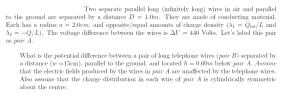 Two separate parallel long (infinitely long) wires in air and parallel to the ground are separated by a distance D 1.0m. They are made of conducting material. Each has a radius a 2.00m, and opposite/equal amounts of charge density (λ Qtot/L and λ2 = O/L) The voltage difference between the wires is ΔΙ. 440 Volts. Let's label this pair as pair A. What is the potential difference between a pair of long telephone wires (pair B) separated by a distance...
An electron is moving in the vicinity of a long, straight wire that lies along the...
An electron is moving in the vicinity of a long, straight wire that lies along the x-axis. The wire has a constant current of8.10 A in the -x-direction. At an instant when the electron is at point (0, 0.200 m, 0) and the electron's velocity is v⃗ = (5.00 × 10⁴ m/s)i^ −(3.00 × 10⁴ m/s)j^. What is the force that the wire exerts on the electron? Calculate the magnitude of this force.
 Can someone carefully explain question A and B in detail,
please?
5.2 A uniform linear charge density λ is placed on an infinitely long wire. The wire is parallel to an infinite grounded plane, and a distance b above that plane. To make things specific, the points on the wire are described as (x, 0, b), and the conducting plane is z 0. A. Find the potential V(O, y, z) for z > 0. B. Find the induced charge density...
Can someone carefully explain question A and B in detail,
please?
5.2 A uniform linear charge density λ is placed on an infinitely long wire. The wire is parallel to an infinite grounded plane, and a distance b above that plane. To make things specific, the points on the wire are described as (x, 0, b), and the conducting plane is z 0. A. Find the potential V(O, y, z) for z > 0. B. Find the induced charge density...
 Find the electric field a distance s from an infinitely long straight wire that carries a uniform line charge λ. You must use two methods, one is standard methods (do the integration from -oo to oo along the wire), another is Gauss law, then you will know why Gauss law is so convenient by comparison.
 Two separate parallel long (infinitely long) wires in air and parallel to the ground are separated by a distance D 1.0m. They are made of conducting material. Each has a radius a 2.00m, and opposite/equal amounts of charge density (λ Qtot/L and λ2 = O/L) The voltage difference between the wires is ΔΙ. 440 Volts. Let's label this pair as pair A. What is the potential difference between a pair of long telephone wires (pair B) separated by a distance...
Most questions answered within 3 hours.
-
Where is the error in this code sequence?
String s1 = "Hello";
String s2 = "ello";...
asked 10 months ago -
Financial data for Joel de Paris, Inc., for last year
follow:
Joel de Paris, Inc.
Balance...
asked 10 months ago -
Consider this reaction:
Al2(SO4)3 (aq)+ BaCl3
(aq) Al2Cl6 (aq)- +
3BaSO4(s) . What is the...
asked 10 months ago -
Suppose that Savneet is considering increasing her
recent random sample from 20 car rentals to 40...
asked 10 months ago -
Trucks arrive at an unloading terminal at an average rate of 120
per hour.
Trucks arrive...
asked 10 months ago -
Why are methanol and ethanol completely soluble in water while
octanol is not very little soluble....
asked 10 months ago -
A facilities manager at a university reads in a research report
that the mean amount of...
asked 10 months ago -
When the CuSO4 is rehydrated by adding water to the anhydrous
compound, is this an endothermic...
asked 10 months ago -
A ray of sunlight is passing from diamond into crown glass; the
angle of incidence is...
asked 10 months ago -
A block of mass 0.249 kg is placed on top of a light, vertical
spring of...
asked 10 months ago -
how do the kidneys compensate in the presences of acidosis
a) trigger hyperventilate
b) reserve acid...
asked 10 months ago -
Question 501 pts
The rental rate of capital to the firm increases. Which of the
following...
asked 10 months ago