Which of the following is a term for the maximization of shareholder value? a. Shareholder primacy...
Which of the following is a term for the maximization of shareholder value?
| a. |
Shareholder primacy |
|
| b. |
Corporate allocation |
|
| c. |
Shareholder importance |
|
| d. |
Value of shares maximization |
Homework Answers
Answer: option a; Shareholder primacy
Explanation:
Shareholder primacy is the concept which gives more importance to the shareholders as they are the owners of the company and it focuses on maximization of shareholder value before considering the interests of other stakeholders. Hence the answer is option a. Corporate allocation is used to manipulate existing ledger transactions to create new transactions and value of shares maximization increases the value of stock and maximizes the value of the firm. Shareholder importance refers to the importance of shareholders in the business and does not mean maximization of shareholder value. Hence these options are wrong.
Add Answer to:
Which of the following is a term for the maximization of
shareholder value?
a.
Shareholder primacy...
Q.1) Discuss the altemative goals of the firm and explain why finance recommends shareholder value maximization?...
 Q.1) Discuss the altemative goals of the firm and explain why finance recommends shareholder value maximization? [25 marks] Q.2) Discuss the reasoning of agency theory recommendations for an independent board structure to enhance Corporate Govemance. Examine the extent to which Agency Theory's recommendations have led to enhance firm performance? (25 Marks]
select the best term for each definition below. Term definition A. shareholder Check my work Select...
 select the best term for each definition below. Term
definition A. shareholder
Check my work Select the best term for each definition below Definitions a. Shareholders can lose no more than the amount they invest in the company. b. Corporate eanings are taxed twice-at the corporate level and individual shareholder level. c Like an S corporation, but there are no limitations on the number of owners as in an S corporation. d. Traces the line of authority within the corporation....
select the best term for each definition below. Term
definition A. shareholder
Check my work Select the best term for each definition below Definitions a. Shareholders can lose no more than the amount they invest in the company. b. Corporate eanings are taxed twice-at the corporate level and individual shareholder level. c Like an S corporation, but there are no limitations on the number of owners as in an S corporation. d. Traces the line of authority within the corporation....
QUESTION 16 The primary goal of the corporation should be A. Maximization of profits B. Maximization...
 QUESTION 16 The primary goal of the corporation should be A. Maximization of profits B. Maximization of shareholder wealth C. Maximization of sales D. Minimization of risk QUESTION 10 A disadvantage of organizing a business as a corporation is that A. The owners have unlimited legal liability for corporate losses B. Other forms of business organization provide greater funding flexibility than do corporations C. Owners of a corporations are potentially subject to double taxation D. All of the above are...
What are ways to maximize shareholder value through long-term and short-term financial planning and the implementation...
What are ways to maximize shareholder value through long-term and short-term financial planning and the implementation of various strategies?
Which of the following statements correctly describes an advantage of having the principal shareholder of a...
Which of the following statements correctly describes an advantage of having the principal shareholder of a business receive a salary rather than dividend income? a) Only by taking a salary can the principal shareholder minimize the overall tax cost of extracting money from the corporation. b) Taking a salary allows the principal shareholder to contribute to a Registered Retirement Savings Plan (RRSP). c) Taking a salary reduces the shareholder’s cumulative net investment loss (CNIL) balance, which will help ensure that...
Which of the following statements about a 2-for-1 stock split is not true? A shareholder with...
 Which of the following statements about a 2-for-1 stock split is not true? A shareholder with 200 shares before the split owns 400 shares after the split. Legal capital per share is reduced to half of what it was before the split. Total share capital increases. The market value of the shares will probably decrease.
The primary role of _________________________ is to protect investors, create longterm shareholder value, ensure investor confidence...
The primary role of _________________________ is to protect investors, create longterm shareholder value, ensure investor confidence and support strong and efficient capital markets. A. Corporate governance B. Certified Fraud Examiners and CPAs C. The SEC, PCAOB and COSO ERM Framework D. Wall Street analysts
25. Corporate distributions to a shareholder include A Taxable Dividends B. Liquidation distributions C. Nontaxable return...
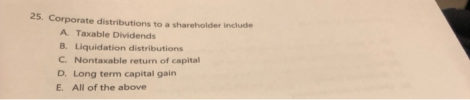 25. Corporate distributions to a shareholder include A Taxable Dividends B. Liquidation distributions C. Nontaxable return of capital D. Long term capital gain E. All of the above
In evaluating what is "reasonable compensation "for a C corporation shareholder-employee, which one of the following...
In evaluating what is "reasonable compensation "for a C corporation shareholder-employee, which one of the following factors may be relevant? a. The shareholder-employee's length of service and past contributions to the company, b. The shareholder-employee's income from other sources, c. The shareholder-employee's age and need to accumulate a substantial retirement nest egg as soon as possible, d. The shareholder-employee's expenses to pay for children's college
Which of the following statements is true about an S corporation’s capital gains and losses? A....
Which of the following statements is true about an S corporation’s capital gains and losses? A. They are stated separately and passes through to the shareholders. B. They are taxed to the corporation using the maximum corporate rate. C. They may be taxed at the corporate level or passed through to the shareholders if the majority of the shareholders elect to do so by the due date of the tax return. D. They must be allocated on a pro rata...
 Q.1) Discuss the altemative goals of the firm and explain why finance recommends shareholder value maximization? [25 marks] Q.2) Discuss the reasoning of agency theory recommendations for an independent board structure to enhance Corporate Govemance. Examine the extent to which Agency Theory's recommendations have led to enhance firm performance? (25 Marks]
 select the best term for each definition below. Term
definition A. shareholder
Check my work Select the best term for each definition below Definitions a. Shareholders can lose no more than the amount they invest in the company. b. Corporate eanings are taxed twice-at the corporate level and individual shareholder level. c Like an S corporation, but there are no limitations on the number of owners as in an S corporation. d. Traces the line of authority within the corporation....
select the best term for each definition below. Term
definition A. shareholder
Check my work Select the best term for each definition below Definitions a. Shareholders can lose no more than the amount they invest in the company. b. Corporate eanings are taxed twice-at the corporate level and individual shareholder level. c Like an S corporation, but there are no limitations on the number of owners as in an S corporation. d. Traces the line of authority within the corporation....
 QUESTION 16 The primary goal of the corporation should be A. Maximization of profits B. Maximization of shareholder wealth C. Maximization of sales D. Minimization of risk QUESTION 10 A disadvantage of organizing a business as a corporation is that A. The owners have unlimited legal liability for corporate losses B. Other forms of business organization provide greater funding flexibility than do corporations C. Owners of a corporations are potentially subject to double taxation D. All of the above are...
 Which of the following statements about a 2-for-1 stock split is not true? A shareholder with 200 shares before the split owns 400 shares after the split. Legal capital per share is reduced to half of what it was before the split. Total share capital increases. The market value of the shares will probably decrease.
 25. Corporate distributions to a shareholder include A Taxable Dividends B. Liquidation distributions C. Nontaxable return of capital D. Long term capital gain E. All of the above
Most questions answered within 3 hours.
-
Where is the error in this code sequence?
String s1 = "Hello";
String s2 = "ello";...
asked 11 months ago -
Financial data for Joel de Paris, Inc., for last year
follow:
Joel de Paris, Inc.
Balance...
asked 11 months ago -
Consider this reaction:
Al2(SO4)3 (aq)+ BaCl3
(aq) Al2Cl6 (aq)- +
3BaSO4(s) . What is the...
asked 11 months ago -
Suppose that Savneet is considering increasing her
recent random sample from 20 car rentals to 40...
asked 11 months ago -
Trucks arrive at an unloading terminal at an average rate of 120
per hour.
Trucks arrive...
asked 11 months ago -
Why are methanol and ethanol completely soluble in water while
octanol is not very little soluble....
asked 11 months ago -
A facilities manager at a university reads in a research report
that the mean amount of...
asked 11 months ago -
When the CuSO4 is rehydrated by adding water to the anhydrous
compound, is this an endothermic...
asked 11 months ago -
A ray of sunlight is passing from diamond into crown glass; the
angle of incidence is...
asked 11 months ago -
A block of mass 0.249 kg is placed on top of a light, vertical
spring of...
asked 11 months ago -
how do the kidneys compensate in the presences of acidosis
a) trigger hyperventilate
b) reserve acid...
asked 11 months ago -
Question 501 pts
The rental rate of capital to the firm increases. Which of the
following...
asked 11 months ago