Program 2: P0\/\/|\|3D. In the early 80s, hackers used to write in an obfuscated, but mostly...
Program 2: P0\/\/|\|3D. In the early 80s,
hackers used to write in an obfuscated, but mostly readable way
called “leet” – short for “elite”. In essence, it was a simple
character replacement algorithm, where a single “regular” character
was replaced by one or more “leet” characters; numbers remained the
same. Here’s one of the most readable versions:
|
a |
4 |
g |
9 |
m |
/\\/\\ |
s |
$ |
y |
‘/ |
|
b |
B |
h |
|-| |
n |
|\\| |
t |
7 |
z |
Z |
|
c |
( |
i |
1 |
o |
0 |
u |
U |
||
|
d |
D |
j |
j |
p |
P |
v |
\\/ |
||
|
e |
3 |
k |
|< |
q |
Q |
w |
\\/\\/ |
||
|
f |
Ph |
l |
L |
r |
R |
x |
>< |
Note! You will need to know how to 1) get the length of a string (the number of characters) and 2) access individual characters of the string. See the appendix for more information. You must call your function translateToL337. Note #2: your first task should be to try to print out a single ‘\’ character…
Your task is to design (pseudocode) and implement (source code). For the source code, name your class “A5_2” and put it into a file called “A5_2” (either .java, .cs or .cpp)
Sample run 1:
Enter a string: you have been powned
'/0U |-|4\\/3 B33|\\| P0\\/\\/|\\|3D
Sample run 1:
Enter a string: you have programming skrilz
'/0U |-|4\\/3 PR09R4/\\/\\/\\/\\1|\\|9 $|<R1LZ
In C++ using classes with switch cases.
Homework Answers
//Please do comment if any problem arises and give rating too
//Code
#include <iostream>
#include<string>
using namespace std;
string translateToL337(char ch) {
switch(ch) {
case 'a': return "4";
case 'b': return "B";
case 'c': return "(";
case 'd': return "D";
case 'e': return "3";
case 'f': return "Ph";
case 'g': return "9";
case 'h': return "|-|";
case 'i': return "1";
case 'j': return "j";
case 'k': return "|<";
case 'l': return "L";
case 'm': return "/\\/\\";
case 'n': return "|\\|";
case 'o': return "O";
case 'p': return "P";
case 'q': return "Q";
case 'r': return "R";
case 's': return "$";
case 't': return "7";
case 'u': return "U";
case 'v': return "\\/";
case 'w': return "\\/\\/";
case 'x': return "><";
case 'y': return "'/";
case 'z': return "Z";
default: return " ";
}
}
int main() {
string input, encodedString = "";
int i, strLength;
cout<<"Enter a string: ";
getline(cin, input);
strLength = input.length();
for(i = 0; i < strLength; i ++) {
char ch = input.at(i);
encodedString += translateToL337(ch);
}
cout<<encodedString;
return 0;
}
//Output
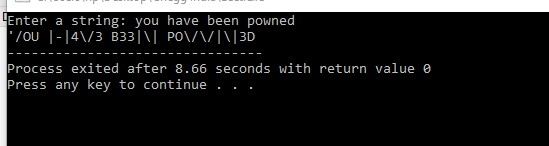
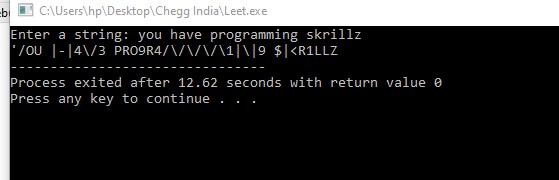
Add Answer to:
Program 2: P0\/\/|\|3D. In the early 80s,
hackers used to write in an obfuscated, but mostly...
C++ SOURCE CODE P0\/\/|\|3D. In the early 80s, hackers used to write in an obfuscated, but...
C++ SOURCE CODE P0\/\/|\|3D. In the early 80s, hackers used to write in an obfuscated, but mostly readable way called “leet” – short for “elite”. In essence, it was a simple character replacement algorithm, where a single “regular” character was replaced by one or more “leet” characters; numbers remained the same. Here’s one of the most readable versions: a 4 g 9 m /\\/\\ s $ y ‘/ b B h |-| n |\\| t 7 z Z c (...
IN JAVA. P0\/\/|\|3D. In the early 80s, hackers used to write in an obfuscated, but mostly...
IN JAVA. P0\/\/|\|3D. In the early 80s, hackers used to write in an obfuscated, but mostly readable way called “leet” – short for “elite”. In essence, it was a simple character replacement algorithm, where a single “regular” character was replaced by one or more “leet” characters; numbers remained the same. Here’s one of the most readable versions: a 4 g 9 m /\\/\\ s $ y ‘/ b B h |-| n |\\| t 7 z Z c ( i...
Need in pseudocode Program 2: POWIN3D. In the early 80s, hackers used to write in an...
 Need in pseudocode
Program 2: POWIN3D. In the early 80s, hackers used to write in an obfuscated, but mostly readable way called "leet" - short for "elite". In essence, it was a simple character replacement algorithm, whereya single "regular" character was replaced by one or more "leet" characters; numbers remained the same. Here's one of the most readable versions: g9m AS$y 00u | |р | P v II 9 IQ W LrRXI>< VI Note! You will need to know how...
Need in pseudocode
Program 2: POWIN3D. In the early 80s, hackers used to write in an obfuscated, but mostly readable way called "leet" - short for "elite". In essence, it was a simple character replacement algorithm, whereya single "regular" character was replaced by one or more "leet" characters; numbers remained the same. Here's one of the most readable versions: g9m AS$y 00u | |р | P v II 9 IQ W LrRXI>< VI Note! You will need to know how...
Q16-Decoder (0.5 points) Write a code block to decode strings from secret encodings back to reada...
 Q16-Decoder (0.5 points) Write a code block to decode strings from secret encodings back to readable messages. To do so: Initialize a variable called decoded as an empty string . Use a for loop to loop across all characters of a presumed string variable called encoded Inside the loop, convert the character to another character o Get the unicode code point for the character (using ord o Subtract the value of key to that code point (which should be an...
1. Write a C++ program called Password that handles encrypting a password. 2. The program must...
 1. Write a C++ program called Password that handles encrypting a
password.
2. The program must perform encryption as follows:
a. main method
i. Ask the user for a password.
ii. Sends the password to a boolean function called
isValidPassword to check validity.
1. Returns true if password is at least 8 characters long
2. Returns false if it is not at least 8 characters long
iii. If isValidPassword functions returns false
1. Print the following error message “The password...
1. Write a C++ program called Password that handles encrypting a
password.
2. The program must perform encryption as follows:
a. main method
i. Ask the user for a password.
ii. Sends the password to a boolean function called
isValidPassword to check validity.
1. Returns true if password is at least 8 characters long
2. Returns false if it is not at least 8 characters long
iii. If isValidPassword functions returns false
1. Print the following error message “The password...
Objectives: Use strings and string library functions. Write a program that asks the user to enter...
Objectives: Use strings and string library functions. Write a program that asks the user to enter a string and output the string in all uppercase letters. The program should then display the number of white space characters in the string. You program should run continuously until the user enters an empty string. The program must use the following two functions: A function called count_spaces that counts the number of white spaces inside a string. int count_space(char str[]); which tell you...
Please write code using Python. Rubric Assignment Solution Total: 100 pts Program successfully retrieves and validates...
 Please write code using Python.
Rubric
Assignment Solution Total: 100 pts
Program successfully retrieves and validates user input 15
pts
Morse Code Function Created 10 pts
Function Uses Parameters to get input message 15 pts
Function successfully converts passed message to Morse Code
and returns the Morse Code equivalent of message 45 pts
Program calls Morse Code function and outputs the result of
the function (i.e. the actual Morse Code) 15 pts
Main Function Requirement
Part 2 MUST have a...
Please write code using Python.
Rubric
Assignment Solution Total: 100 pts
Program successfully retrieves and validates user input 15
pts
Morse Code Function Created 10 pts
Function Uses Parameters to get input message 15 pts
Function successfully converts passed message to Morse Code
and returns the Morse Code equivalent of message 45 pts
Program calls Morse Code function and outputs the result of
the function (i.e. the actual Morse Code) 15 pts
Main Function Requirement
Part 2 MUST have a...
This is for C++ Write a program that reads in a sequence of characters entered by...
This is for C++ Write a program that reads in a sequence of characters entered by the user and terminated by a period ('.'). Your program should allow the user to enter multiple lines of input by pressing the enter key at the end of each line. The program should print out a frequency table, sorted in decreasing order by number of occurences, listing each letter that ocurred along with the number of times it occured. All non-alphabetic characters must...
Please, please help! (Programming Assignment: fork gymnastics) Write a C/C++ program (call it string-invert) that takes...
 Please, please help!
(Programming Assignment: fork gymnastics) Write a C/C++ program (call it string-invert) that takes a string argument from the command line and outputs the string in reversed order You have two constraints: Constraint 1: Each process can output at most one character. If you want to output more than a single character, you must fork off one or more processes in order to do that, and each of the forked processes in turn outputs a single character t...
Please, please help!
(Programming Assignment: fork gymnastics) Write a C/C++ program (call it string-invert) that takes a string argument from the command line and outputs the string in reversed order You have two constraints: Constraint 1: Each process can output at most one character. If you want to output more than a single character, you must fork off one or more processes in order to do that, and each of the forked processes in turn outputs a single character t...
TASK Your task is to build a palindrome from an input string. A palindrome is a...
TASK Your task is to build a palindrome from an input string. A palindrome is a word that reads the same backward or forward. Your code will take the first 5 characters of the user input, and create a 9- character palindrome from it. Words shorter than 5 characters will result in a runtime error when you run your code. This is acceptable for this exercise – we will cover input validation in a later class. Some examples of input...
 Need in pseudocode
Program 2: POWIN3D. In the early 80s, hackers used to write in an obfuscated, but mostly readable way called "leet" - short for "elite". In essence, it was a simple character replacement algorithm, whereya single "regular" character was replaced by one or more "leet" characters; numbers remained the same. Here's one of the most readable versions: g9m AS$y 00u | |р | P v II 9 IQ W LrRXI>< VI Note! You will need to know how...
Need in pseudocode
Program 2: POWIN3D. In the early 80s, hackers used to write in an obfuscated, but mostly readable way called "leet" - short for "elite". In essence, it was a simple character replacement algorithm, whereya single "regular" character was replaced by one or more "leet" characters; numbers remained the same. Here's one of the most readable versions: g9m AS$y 00u | |р | P v II 9 IQ W LrRXI>< VI Note! You will need to know how...
 Q16-Decoder (0.5 points) Write a code block to decode strings from secret encodings back to readable messages. To do so: Initialize a variable called decoded as an empty string . Use a for loop to loop across all characters of a presumed string variable called encoded Inside the loop, convert the character to another character o Get the unicode code point for the character (using ord o Subtract the value of key to that code point (which should be an...
 1. Write a C++ program called Password that handles encrypting a
password.
2. The program must perform encryption as follows:
a. main method
i. Ask the user for a password.
ii. Sends the password to a boolean function called
isValidPassword to check validity.
1. Returns true if password is at least 8 characters long
2. Returns false if it is not at least 8 characters long
iii. If isValidPassword functions returns false
1. Print the following error message “The password...
1. Write a C++ program called Password that handles encrypting a
password.
2. The program must perform encryption as follows:
a. main method
i. Ask the user for a password.
ii. Sends the password to a boolean function called
isValidPassword to check validity.
1. Returns true if password is at least 8 characters long
2. Returns false if it is not at least 8 characters long
iii. If isValidPassword functions returns false
1. Print the following error message “The password...
 Please write code using Python.
Rubric
Assignment Solution Total: 100 pts
Program successfully retrieves and validates user input 15
pts
Morse Code Function Created 10 pts
Function Uses Parameters to get input message 15 pts
Function successfully converts passed message to Morse Code
and returns the Morse Code equivalent of message 45 pts
Program calls Morse Code function and outputs the result of
the function (i.e. the actual Morse Code) 15 pts
Main Function Requirement
Part 2 MUST have a...
Please write code using Python.
Rubric
Assignment Solution Total: 100 pts
Program successfully retrieves and validates user input 15
pts
Morse Code Function Created 10 pts
Function Uses Parameters to get input message 15 pts
Function successfully converts passed message to Morse Code
and returns the Morse Code equivalent of message 45 pts
Program calls Morse Code function and outputs the result of
the function (i.e. the actual Morse Code) 15 pts
Main Function Requirement
Part 2 MUST have a...
 Please, please help!
(Programming Assignment: fork gymnastics) Write a C/C++ program (call it string-invert) that takes a string argument from the command line and outputs the string in reversed order You have two constraints: Constraint 1: Each process can output at most one character. If you want to output more than a single character, you must fork off one or more processes in order to do that, and each of the forked processes in turn outputs a single character t...
Please, please help!
(Programming Assignment: fork gymnastics) Write a C/C++ program (call it string-invert) that takes a string argument from the command line and outputs the string in reversed order You have two constraints: Constraint 1: Each process can output at most one character. If you want to output more than a single character, you must fork off one or more processes in order to do that, and each of the forked processes in turn outputs a single character t...
Most questions answered within 3 hours.
-
Where is the error in this code sequence?
String s1 = "Hello";
String s2 = "ello";...
asked 10 months ago -
Financial data for Joel de Paris, Inc., for last year
follow:
Joel de Paris, Inc.
Balance...
asked 10 months ago -
Consider this reaction:
Al2(SO4)3 (aq)+ BaCl3
(aq) Al2Cl6 (aq)- +
3BaSO4(s) . What is the...
asked 10 months ago -
Suppose that Savneet is considering increasing her
recent random sample from 20 car rentals to 40...
asked 10 months ago -
Trucks arrive at an unloading terminal at an average rate of 120
per hour.
Trucks arrive...
asked 10 months ago -
Why are methanol and ethanol completely soluble in water while
octanol is not very little soluble....
asked 10 months ago -
A facilities manager at a university reads in a research report
that the mean amount of...
asked 10 months ago -
When the CuSO4 is rehydrated by adding water to the anhydrous
compound, is this an endothermic...
asked 10 months ago -
A ray of sunlight is passing from diamond into crown glass; the
angle of incidence is...
asked 10 months ago -
A block of mass 0.249 kg is placed on top of a light, vertical
spring of...
asked 10 months ago -
how do the kidneys compensate in the presences of acidosis
a) trigger hyperventilate
b) reserve acid...
asked 10 months ago -
Question 501 pts
The rental rate of capital to the firm increases. Which of the
following...
asked 10 months ago