Thermal Storage Solar heating of a house is much more efficient if there is a way...
Thermal Storage Solar heating of a house is much more efficient if there is a way to store the thermal energy collected during the day to warm the house at night. Suppose one solar-heated home utilizes a concrete slab of area 14 m2 and 22 cm thick.
Part A: If the density of concrete is 2400 kg/m3, what is the mass of the slab?
Part B: The slab is exposed to sunlight and absorbs energy at a rate of 1.1 ×10⁷J/h for 10 h. If it begins the day at 21 ∘C and has a specific heat of 750 J/(kg⋅K), what is its temperature at sunset?
Part C: Model the concrete slab as being surrounded on both sides (contact area 28 m2) with a 1.5-m-thick layer of air in contact with a surface that is 5.0 ∘C cooler than the concrete. At sunset, what is the rate at which the concrete loses thermal energy by conduction through the air layer?
Part D: Model the concrete slab as having a surface area of 24 m2 and surrounded by an environment 5.0 ∘C cooler than the concrete. If its emissivity is 0.92, what is the rate at which the concrete loses thermal energy by radiation at sunset?
Homework Answers


Add Answer to:
Thermal Storage Solar heating of a house is
much more efficient if there is a way...
Thermal Storage Solar heating of a house is much more efficient if there is a way...
Thermal Storage Solar heating of a house is much more efficient if there is a way to store the thermal energy collected during the day to warm the house at night. Suppose one solar-heated home utilizes a concrete slab of area 11 m2 and 26 cm thick. If the density of concrete is 2400 kg/m3, what is the mass of the slab? The slab is exposed to sunlight and absorbs energy at a rate of 1.2 ×10⁷J/h for 10 h....
P2 (50 pts.) Assume the roof of a room in a typical house is 12 cm...
 P2 (50 pts.) Assume the roof of a room in a typical house is 12 cm thick concrete slab with a thermal conductivity k = 1.50 W/m•°C. The roof of the room is 4 m wide and 4 m long. Assume convection heat transfer coefficients on the inner and outer surfaces of the roof are hi=6 and ho=10 W/m2°C, respectively. At noon, when the sun is "hotter" the solar irradiation is estimated to be color = 750 W/m- and the...
Heat Loss and Heating Costs of a House Part A A house has well-insulated walls 17.1...
 Heat Loss and Heating Costs of a House Part A A house has well-insulated walls 17.1 cm thick (assume conductivity of air) and area 411 m2, a roof of wood б.бб cm thick and area 279 m2, and uncovered windows 0.626 cm thick and total area 33.4 m2. Assuming that the heat loss is only by conduction, calculate the rate at which heat must be supplied to this house to maintain its temperature at 21.4°C if the outside temperature is...
Ch 17 HW Problem 17.104 Constants Animals in cold climates often depend on two layers of...
 Ch 17 HW Problem 17.104 Constants Animals in cold climates often depend on two layers of insulation a layer of body fat jof thermal conductivity 0 200 W/(m K)I surrounded by a layer of air trapped inside fur or down We can model a black bear (Ursus americanus) as a sphere 1.40 m in diameter having a layer of fat 4 10 cm thick (Actually the thickness varies with the season, but we are interested in hibernation, when the fat...
Animals in cold climates often depend on two layers of insulation: a layer of body fat...
Animals in cold climates often depend on two layers of insulation: a layer of body fat (of thermal conductivity 0.200 W/(m⋅K) ) surrounded by a layer of air trapped inside fur or down. We can model a black bear as a sphere 1.50 m in diameter having a layer of fat 4.00×10⁻² m thick, as shown in the figure.(Figure 1) In studies of bear hibernation, it was found that the outer surface layer of the fur is at TC =...
A concrete wall of a house is 45 cm thick and has a surface area 20m...
 A concrete wall of a house is 45 cm thick and has a surface area 20m x 5 m. The inside temperature of the wall is 47 °C and the outside air temperature is 14 °C. Thermal conductivity of the concrete wall is 0.8 W/mK. Calculate the heat transfer rate through the wall by conduction and its thermal resistance.
Calculate the rate of energy loss due to thermal radiation from an unclothed person if the average skin temperature is...
 Calculate the rate of energy loss due to thermal radiation from an unclothed person if the average skin temperature is 37 °C and the room temperature is 20 °C. You may sume a total surface area of 1.5 m and a skin emissivity value of 0.9. How much energy (from food) must be consumed per day to compensate for this loss? If the person is surrounded by a layer of insulation of thickness 1.0 cm with a thermal conductivity of...
To reduce building heating costs, modern building codes in many parts of the country require the...
 To reduce building heating costs, modern building codes in many parts of the country require the use of double-pane windows (sometimes, called "double-glazed" or "thermopane" windows). Ivpically, a double-pane window consists of two panes of glass separated by a space that contains trapped stagnant air. In one design of a double-pane window, each glass layer is 0.7 cm thick, the stagnant air layer is 2 cm thick, and the area is 4 m2 In the living room of a large...
Both please 13.3 Estimate the amount of solar heating that is lost as a result of using one or two tempered 1/8 in thick glass plates covering a flat-plate absorber. The transmission coefficient for r...
 Both please
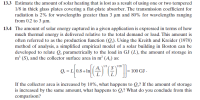
13.3 Estimate the amount of solar heating that is lost as a result of using one or two tempered 1/8 in thick glass plates covering a flat-plate absorber. The transmission coefficient for radiation is 2% for wavelengths greater than 3 m and 80% for wavelengths ranging from 0.2 to 3 um. 13.4 The amount of solar energy captured in a given application is expressed in terms of how much thermal energy is delivered relative to the total demand...
Both please
13.3 Estimate the amount of solar heating that is lost as a result of using one or two tempered 1/8 in thick glass plates covering a flat-plate absorber. The transmission coefficient for radiation is 2% for wavelengths greater than 3 m and 80% for wavelengths ranging from 0.2 to 3 um. 13.4 The amount of solar energy captured in a given application is expressed in terms of how much thermal energy is delivered relative to the total demand...
10. (10pts) The surface area of an adult human being is 1,8 m2. Suppose a person with a skin tem ...
 10. (10pts) The surface area of an adult human being is 1,8 m2. Suppose a person with a skin tem omperature of 34°C is standing with bare skin in a room where the air is 22°C but the walls are 21°C. (ơ 5.67" 104 J / (sm"к"). There is a "dead ai lay ran around you next to your skin that acts as insulation. This dead-air layer is 5.0 mm thick. a) Draw b) What is the person's rate of...
 P2 (50 pts.) Assume the roof of a room in a typical house is 12 cm thick concrete slab with a thermal conductivity k = 1.50 W/m•°C. The roof of the room is 4 m wide and 4 m long. Assume convection heat transfer coefficients on the inner and outer surfaces of the roof are hi=6 and ho=10 W/m2°C, respectively. At noon, when the sun is "hotter" the solar irradiation is estimated to be color = 750 W/m- and the...
 Heat Loss and Heating Costs of a House Part A A house has well-insulated walls 17.1 cm thick (assume conductivity of air) and area 411 m2, a roof of wood б.бб cm thick and area 279 m2, and uncovered windows 0.626 cm thick and total area 33.4 m2. Assuming that the heat loss is only by conduction, calculate the rate at which heat must be supplied to this house to maintain its temperature at 21.4°C if the outside temperature is...
 Ch 17 HW Problem 17.104 Constants Animals in cold climates often depend on two layers of insulation a layer of body fat jof thermal conductivity 0 200 W/(m K)I surrounded by a layer of air trapped inside fur or down We can model a black bear (Ursus americanus) as a sphere 1.40 m in diameter having a layer of fat 4 10 cm thick (Actually the thickness varies with the season, but we are interested in hibernation, when the fat...
 A concrete wall of a house is 45 cm thick and has a surface area 20m x 5 m. The inside temperature of the wall is 47 °C and the outside air temperature is 14 °C. Thermal conductivity of the concrete wall is 0.8 W/mK. Calculate the heat transfer rate through the wall by conduction and its thermal resistance.
 Calculate the rate of energy loss due to thermal radiation from an unclothed person if the average skin temperature is 37 °C and the room temperature is 20 °C. You may sume a total surface area of 1.5 m and a skin emissivity value of 0.9. How much energy (from food) must be consumed per day to compensate for this loss? If the person is surrounded by a layer of insulation of thickness 1.0 cm with a thermal conductivity of...
 To reduce building heating costs, modern building codes in many parts of the country require the use of double-pane windows (sometimes, called "double-glazed" or "thermopane" windows). Ivpically, a double-pane window consists of two panes of glass separated by a space that contains trapped stagnant air. In one design of a double-pane window, each glass layer is 0.7 cm thick, the stagnant air layer is 2 cm thick, and the area is 4 m2 In the living room of a large...
 Both please
13.3 Estimate the amount of solar heating that is lost as a result of using one or two tempered 1/8 in thick glass plates covering a flat-plate absorber. The transmission coefficient for radiation is 2% for wavelengths greater than 3 m and 80% for wavelengths ranging from 0.2 to 3 um. 13.4 The amount of solar energy captured in a given application is expressed in terms of how much thermal energy is delivered relative to the total demand...
Both please
13.3 Estimate the amount of solar heating that is lost as a result of using one or two tempered 1/8 in thick glass plates covering a flat-plate absorber. The transmission coefficient for radiation is 2% for wavelengths greater than 3 m and 80% for wavelengths ranging from 0.2 to 3 um. 13.4 The amount of solar energy captured in a given application is expressed in terms of how much thermal energy is delivered relative to the total demand...
 10. (10pts) The surface area of an adult human being is 1,8 m2. Suppose a person with a skin tem omperature of 34°C is standing with bare skin in a room where the air is 22°C but the walls are 21°C. (ơ 5.67" 104 J / (sm"к"). There is a "dead ai lay ran around you next to your skin that acts as insulation. This dead-air layer is 5.0 mm thick. a) Draw b) What is the person's rate of...
Most questions answered within 3 hours.
-
Where is the error in this code sequence?
String s1 = "Hello";
String s2 = "ello";...
asked 11 months ago -
Financial data for Joel de Paris, Inc., for last year
follow:
Joel de Paris, Inc.
Balance...
asked 11 months ago -
Consider this reaction:
Al2(SO4)3 (aq)+ BaCl3
(aq) Al2Cl6 (aq)- +
3BaSO4(s) . What is the...
asked 11 months ago -
Suppose that Savneet is considering increasing her
recent random sample from 20 car rentals to 40...
asked 11 months ago -
Trucks arrive at an unloading terminal at an average rate of 120
per hour.
Trucks arrive...
asked 11 months ago -
Why are methanol and ethanol completely soluble in water while
octanol is not very little soluble....
asked 11 months ago -
A facilities manager at a university reads in a research report
that the mean amount of...
asked 11 months ago -
When the CuSO4 is rehydrated by adding water to the anhydrous
compound, is this an endothermic...
asked 11 months ago -
A ray of sunlight is passing from diamond into crown glass; the
angle of incidence is...
asked 11 months ago -
A block of mass 0.249 kg is placed on top of a light, vertical
spring of...
asked 11 months ago -
how do the kidneys compensate in the presences of acidosis
a) trigger hyperventilate
b) reserve acid...
asked 11 months ago -
Question 501 pts
The rental rate of capital to the firm increases. Which of the
following...
asked 11 months ago