
Homework Answers
Add Answer to:
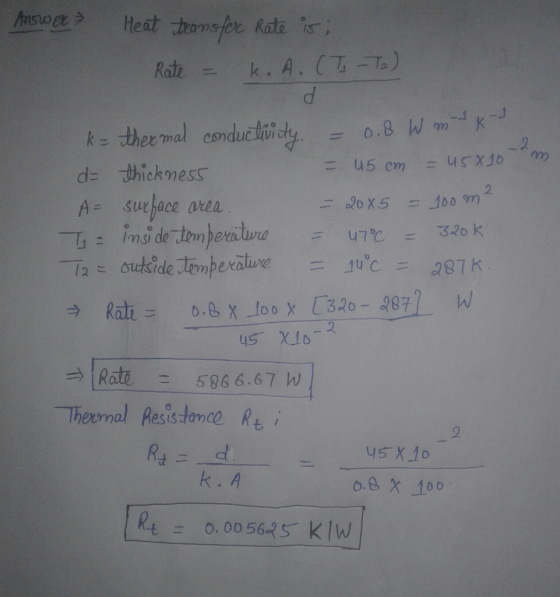
A concrete wall of a house is 45 cm thick and has a surface area 20m...
QUESTION 1 Quarter of the area of a 5m x 3m outside wall of a house...
 QUESTION 1 Quarter of the area of a 5m x 3m outside wall of a house is made of glass windows. The wall is 15 cm thick and has an average thermal conductivity of 0.8 W/m K. The window glass is 8 mm thick and has an average thermal conductivity of 0.15 W/m K. On a winter day the inside temperature of the wall and the glass is 20°C, and the outside air temperature is -10°C. The outside convection heat...
The wall of a house is 3 m high, 10 m long and 30 cm thick;...
The wall of a house is 3 m high, 10 m long and 30 cm thick; it has an effective thermal conductivity of 10 W/m K. The outer surface of the wall has an emissivity of 0.75. On a winter night, the outer surface of this wall is at a temperature of 0 °C and the air is at a temperature of –10 °C. The heat transfer coefficient for the outside wall is 8 W/m2 K. The outside wall also...
Consider a 34 cm thick concrete wall with a thermal conductivity of 0.82 W/m·K. The temperature...
Consider a 34 cm thick concrete wall with a thermal conductivity of 0.82 W/m·K. The temperature of the left surface is held constant at 42°C, whereas the right face is exposed to a flow of 12°C air with a convection heat transfer coefficient of 23 W/m2·K. Neglecting heat transfer by radiation, find the right wall surface temperature and the heat flux through the wall.
Compare the rate of heat conduction through a 12 cm thick wall that has an area...
Compare the rate of heat conduction through a 12 cm thick wall that has an area of 15 m2 and a thermal conductivity twice that of glass wool, k=0.042, with the rate of heat conduction through a window, k=0.84, that is 0.8 cm thick and that has an area of 2.75 m2, assuming a temperature difference of 12 °C across each. (a) What is the heat transfer rate through the wall? QtQt = unit (b) What is the heat transfer rate...
Figure Q2(b) shows the composite wall of a freezing plant which consists of a 10 cm...
 Figure Q2(b) shows the composite wall of a freezing
plant which consists of a 10 cm layer of corkboard on the inside
and 14 cm layer of concrete on the outside, with an area of 1 m2.
The temperature on the inside corkboard surface is -20 °C, and the
temperature on the outside concrete surface is 24 °C. The thermal
conductivity for corkboard is 0.04 W/m.K and for concrete is 0.8
W/m.K.
Calculate the temperature of the interface between the...
Figure Q2(b) shows the composite wall of a freezing
plant which consists of a 10 cm layer of corkboard on the inside
and 14 cm layer of concrete on the outside, with an area of 1 m2.
The temperature on the inside corkboard surface is -20 °C, and the
temperature on the outside concrete surface is 24 °C. The thermal
conductivity for corkboard is 0.04 W/m.K and for concrete is 0.8
W/m.K.
Calculate the temperature of the interface between the...
A 15 cm diameter, 2 cm thick sight glass installed in the wall of a glass...
A 15 cm diameter, 2 cm thick sight glass installed in the wall of a glass fired boiler allows the operator to observe conditions inside the boiler during operation. During normal boiler operation, the inside surface of the sight glass is 130C. Due to natural convection current in the warm boiler room, air at 35C flows vertically across the outside surface of the sight glass, giving the heat transfer coefficient of 25 ?/?2 ?. The sight glass is made of...
[6] A 20-cm thick wall of a house made of brick (k = 0.72W/m. C) is...
 [6] A 20-cm thick wall of a house made of brick (k = 0.72W/m. C) is subjected to inside air at 22.C with a convection heat-transfer coefficient of 15 W/m2. C. The inner surface temperature of the wall is 18 C and the outside air temperature is -1 °C. Determine the outer surface temperature of the wall and the heat-transfer coefficient at the outer surface.
(a) Calculate the rate of heat conduction through house walls that are 15.5 cm thick and...
(a) Calculate the rate of heat conduction through house walls that are 15.5 cm thick and that have an average thermal conductivity twice that of glass wool. Assume there are no windows or doors. The surface area of the walls is 125 m2 and their inside surface is at 21.0°C, while their outside surface is at 5.00°C. W (b) How many 1-kW room heaters would be needed to balance the heat transfer due to conduction? (Round your answer to the...
(a) Calculate the rate of heat conduction through house walls that are 13.0 cm thick and...
(a) Calculate the rate of heat conduction through house walls that are 13.0 cm thick and that have an average thermal conductivity twice that of glass wool. Assume there are no windows or doors. The surface area of the walls is 120m2 and their inside surface is at 18.0ºC, while their outside surface is at 5.00ºC (b) How many 1-kW room heaters would be needed to balance the heat transfer due to conduction?
2.) A plane wall is made of brick with a thermal conductivity of 1.5 W/(m-K). The...
 2.) A plane wall is made of brick with a thermal conductivity of 1.5 W/(m-K). The wall is 20 cm thick and has a surface area of 10 m2. One side of the wall is exposed to outside air blowing against the wall resulting in a heat transfer coefficient of 20 W/(m2-K). The other side is exposed to an air-conditioned room with a convective heat transfer coefficient of 5 W/(m2-K). a. What are the thermal resistances corresponding to conduction through...
 QUESTION 1 Quarter of the area of a 5m x 3m outside wall of a house is made of glass windows. The wall is 15 cm thick and has an average thermal conductivity of 0.8 W/m K. The window glass is 8 mm thick and has an average thermal conductivity of 0.15 W/m K. On a winter day the inside temperature of the wall and the glass is 20°C, and the outside air temperature is -10°C. The outside convection heat...
 Figure Q2(b) shows the composite wall of a freezing
plant which consists of a 10 cm layer of corkboard on the inside
and 14 cm layer of concrete on the outside, with an area of 1 m2.
The temperature on the inside corkboard surface is -20 °C, and the
temperature on the outside concrete surface is 24 °C. The thermal
conductivity for corkboard is 0.04 W/m.K and for concrete is 0.8
W/m.K.
Calculate the temperature of the interface between the...
Figure Q2(b) shows the composite wall of a freezing
plant which consists of a 10 cm layer of corkboard on the inside
and 14 cm layer of concrete on the outside, with an area of 1 m2.
The temperature on the inside corkboard surface is -20 °C, and the
temperature on the outside concrete surface is 24 °C. The thermal
conductivity for corkboard is 0.04 W/m.K and for concrete is 0.8
W/m.K.
Calculate the temperature of the interface between the...
 [6] A 20-cm thick wall of a house made of brick (k = 0.72W/m. C) is subjected to inside air at 22.C with a convection heat-transfer coefficient of 15 W/m2. C. The inner surface temperature of the wall is 18 C and the outside air temperature is -1 °C. Determine the outer surface temperature of the wall and the heat-transfer coefficient at the outer surface.
 2.) A plane wall is made of brick with a thermal conductivity of 1.5 W/(m-K). The wall is 20 cm thick and has a surface area of 10 m2. One side of the wall is exposed to outside air blowing against the wall resulting in a heat transfer coefficient of 20 W/(m2-K). The other side is exposed to an air-conditioned room with a convective heat transfer coefficient of 5 W/(m2-K). a. What are the thermal resistances corresponding to conduction through...
Most questions answered within 3 hours.
-
Where is the error in this code sequence?
String s1 = "Hello";
String s2 = "ello";...
asked 11 months ago -
Financial data for Joel de Paris, Inc., for last year
follow:
Joel de Paris, Inc.
Balance...
asked 11 months ago -
Consider this reaction:
Al2(SO4)3 (aq)+ BaCl3
(aq) Al2Cl6 (aq)- +
3BaSO4(s) . What is the...
asked 11 months ago -
Suppose that Savneet is considering increasing her
recent random sample from 20 car rentals to 40...
asked 11 months ago -
Trucks arrive at an unloading terminal at an average rate of 120
per hour.
Trucks arrive...
asked 11 months ago -
Why are methanol and ethanol completely soluble in water while
octanol is not very little soluble....
asked 11 months ago -
A facilities manager at a university reads in a research report
that the mean amount of...
asked 11 months ago -
When the CuSO4 is rehydrated by adding water to the anhydrous
compound, is this an endothermic...
asked 11 months ago -
A ray of sunlight is passing from diamond into crown glass; the
angle of incidence is...
asked 11 months ago -
A block of mass 0.249 kg is placed on top of a light, vertical
spring of...
asked 11 months ago -
how do the kidneys compensate in the presences of acidosis
a) trigger hyperventilate
b) reserve acid...
asked 11 months ago -
Question 501 pts
The rental rate of capital to the firm increases. Which of the
following...
asked 11 months ago