Review Conceptual Example 9 for background pertinent to this problem. Suppose that the speed of light...
Review Conceptual Example 9 for background pertinent to this problem. Suppose that the speed of light in a vacuum were one million times smaller than its actual value: c = 3.00 × 10² m/s. The spring constant of a spring is 970 N/m. Determine how far you would have to compress the spring from its equilibrium length in order to increase its mass by 0.016 g.
Homework Answers


Add Answer to:
Review Conceptual Example 9 for background pertinent to this
problem. Suppose that the speed of light...
Review Conceptual Example 6 as background for this problem. A car is traveling to the left,...
 Review Conceptual Example 6 as background for this problem. A car is traveling to the left, which is the negative direction. The direction of travel remains the same throughout this problem. The car's initial speed is 27.0 m/s, and during a 5.0 s interval, it changes to a final speed. In each case, find the acceleration (magnitude and algebraic sign) and whether or not the car is decelerating. (a) The final speed is 28.7 m/s. m/s2 and the car is...
Chapter 04, Problem 075 Review Conceptual Example 16 as background for this problem. The water skier...
 Chapter 04, Problem 075 Review Conceptual Example 16 as background for this problem. The water skier there has a mass of 65.0 kg. Find the magnitude of the net force acting on the skier when (a) she is accelerated from rest to a speed of 15.0 m/s in 7.00 s and (b) she lets go of the tow rope and glides to a halt in 22.0 s. (a) Number Units | (b) Number Units
Review Conceptual Example 3 and the drawing as an aid in solving this problem. A conducting...
Review Conceptual Example 3 and the drawing as an aid in solving this problem. A conducting rod slides down between two frictionless vertical copper tracks at a constant speed of 4.1 m/s perpendicular to a 0.47-T magnetic field. The resistance of the rod and tracks is negligible. The rod maintains electrical contact with the tracks at all times and has a length of 1.6 m. A 0.98- resistor is attached between the tops of the tracks. Find the change in...
Review Concept Simulation 9.2 and Conceptual Example 7 as background material for this problem. A jet...
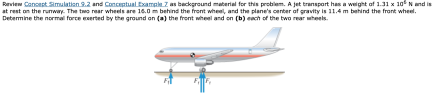 Review Concept Simulation 9.2 and Conceptual Example 7 as background material for this problem. A jet transport has a weight of 1.31 x N and is at rest on the runway. The two rear wheels are 16.0 m behind the front wheel, and the plane's center of gravity is 11.4 m behind the front wheel. Determine the normal force exerted by the ground on (a) the front wheel and on (b) each of the two rear wheels.
Review Concept Simulation 9.2 and Conceptual Example 7 as background material for this problem. A jet...
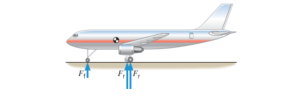 Review Concept Simulation 9.2
and Conceptual Example 7 as background material for this problem. A
jet transport has a weight of 1.36 x 10⁶ N and is at rest on the
runway. The two rear wheels are 17.0 m behind the front wheel, and
the plane's center of gravity is 12.6 m behind the front wheel.
Determine the normal force exerted by the ground on (a) the front
wheel and on (b) each of the two rear wheels.
Review Concept Simulation 9.2
and Conceptual Example 7 as background material for this problem. A
jet transport has a weight of 1.36 x 10⁶ N and is at rest on the
runway. The two rear wheels are 17.0 m behind the front wheel, and
the plane's center of gravity is 12.6 m behind the front wheel.
Determine the normal force exerted by the ground on (a) the front
wheel and on (b) each of the two rear wheels.
Chapter 07, Problem 29 Consult Multiple-Concept Example 8 for background pertinent to this problem. A 2.11-9 bullet, tr...
 Chapter 07, Problem 29 Consult Multiple-Concept Example 8 for background pertinent to this problem. A 2.11-9 bullet, traveling at a speed of 442 m/s, strikes the wooden block of a ballistic pendulum, such as that in Figure 7.14. The block has a mass of 283 g. (a) Find the speed of the bullet/block combination immediately after the collision. (b) How high does the combination rise above its initial position? (a) Number Units Units (b) Number
Consult Multiple-Concept Example 8 for background pertinent to this problem. A 2.00-g bullet, traveling at a...
Consult Multiple-Concept Example 8 for background pertinent to this problem. A 2.00-g bullet, traveling at a speed of 416 m/s, strikes the wooden block of a ballistic pendulum, such as that in Figure 7.14. The block has a mass of 117 g. (a) Find the speed of the bullet/block combination immediately after the collision. (b) How high does the combination rise above its initial position?
Consult Multiple-Concept Example 8 for background pertinent to this problem. A 3.91-g bullet, traveling at a...
Consult Multiple-Concept Example 8 for background pertinent to this problem. A 3.91-g bullet, traveling at a speed of 447 m/s, strikes the wooden block of a ballistic pendulum, such as that in Figure 7.14. The block has a mass of 142 g. (a) Find the speed of the bullet/block combination immediately after the collision. (b) How high does the combination rise above its initial position?
Chapter 24, Problem 43 Review Conceptual Example Z before solving this problem. Suppose unpolarized light of...
 Chapter 24, Problem 43 Review Conceptual Example Z before solving this problem. Suppose unpolarized light of intensity 275 W/m2 falls on the polarizer in the figure, and the angle θ in the drawing is 25.00, what is the light intensity reaching the photocell? Light Insert Number Units the tolerance is +/-2%
Review Concept Simulation 9.2 and Conceptual Example 7 as background material for this problem. A jet transport has a w...
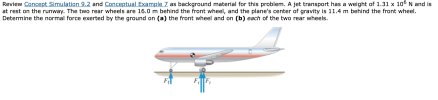 Review Concept Simulation 9.2 and Conceptual Example 7 as background material for this problem. A jet transport has a weight of 1.31 x N and is at rest on the runway. The two rear wheels are 16.0 m behind the front wheel, and the plane's center of gravity is 11.4 m behind the front wheel. Determine the normal force exerted by the ground on (a) the front wheel and on (b) each of the two rear wheels.
 Review Conceptual Example 6 as background for this problem. A car is traveling to the left, which is the negative direction. The direction of travel remains the same throughout this problem. The car's initial speed is 27.0 m/s, and during a 5.0 s interval, it changes to a final speed. In each case, find the acceleration (magnitude and algebraic sign) and whether or not the car is decelerating. (a) The final speed is 28.7 m/s. m/s2 and the car is...
 Chapter 04, Problem 075 Review Conceptual Example 16 as background for this problem. The water skier there has a mass of 65.0 kg. Find the magnitude of the net force acting on the skier when (a) she is accelerated from rest to a speed of 15.0 m/s in 7.00 s and (b) she lets go of the tow rope and glides to a halt in 22.0 s. (a) Number Units | (b) Number Units
 Review Concept Simulation 9.2 and Conceptual Example 7 as background material for this problem. A jet transport has a weight of 1.31 x N and is at rest on the runway. The two rear wheels are 16.0 m behind the front wheel, and the plane's center of gravity is 11.4 m behind the front wheel. Determine the normal force exerted by the ground on (a) the front wheel and on (b) each of the two rear wheels.
 Review Concept Simulation 9.2
and Conceptual Example 7 as background material for this problem. A
jet transport has a weight of 1.36 x 10⁶ N and is at rest on the
runway. The two rear wheels are 17.0 m behind the front wheel, and
the plane's center of gravity is 12.6 m behind the front wheel.
Determine the normal force exerted by the ground on (a) the front
wheel and on (b) each of the two rear wheels.
Review Concept Simulation 9.2
and Conceptual Example 7 as background material for this problem. A
jet transport has a weight of 1.36 x 10⁶ N and is at rest on the
runway. The two rear wheels are 17.0 m behind the front wheel, and
the plane's center of gravity is 12.6 m behind the front wheel.
Determine the normal force exerted by the ground on (a) the front
wheel and on (b) each of the two rear wheels.
 Chapter 07, Problem 29 Consult Multiple-Concept Example 8 for background pertinent to this problem. A 2.11-9 bullet, traveling at a speed of 442 m/s, strikes the wooden block of a ballistic pendulum, such as that in Figure 7.14. The block has a mass of 283 g. (a) Find the speed of the bullet/block combination immediately after the collision. (b) How high does the combination rise above its initial position? (a) Number Units Units (b) Number
 Chapter 24, Problem 43 Review Conceptual Example Z before solving this problem. Suppose unpolarized light of intensity 275 W/m2 falls on the polarizer in the figure, and the angle θ in the drawing is 25.00, what is the light intensity reaching the photocell? Light Insert Number Units the tolerance is +/-2%
 Review Concept Simulation 9.2 and Conceptual Example 7 as background material for this problem. A jet transport has a weight of 1.31 x N and is at rest on the runway. The two rear wheels are 16.0 m behind the front wheel, and the plane's center of gravity is 11.4 m behind the front wheel. Determine the normal force exerted by the ground on (a) the front wheel and on (b) each of the two rear wheels.
Most questions answered within 3 hours.
-
Where is the error in this code sequence?
String s1 = "Hello";
String s2 = "ello";...
asked 11 months ago -
Financial data for Joel de Paris, Inc., for last year
follow:
Joel de Paris, Inc.
Balance...
asked 11 months ago -
Consider this reaction:
Al2(SO4)3 (aq)+ BaCl3
(aq) Al2Cl6 (aq)- +
3BaSO4(s) . What is the...
asked 11 months ago -
Suppose that Savneet is considering increasing her
recent random sample from 20 car rentals to 40...
asked 11 months ago -
Trucks arrive at an unloading terminal at an average rate of 120
per hour.
Trucks arrive...
asked 11 months ago -
Why are methanol and ethanol completely soluble in water while
octanol is not very little soluble....
asked 11 months ago -
A facilities manager at a university reads in a research report
that the mean amount of...
asked 11 months ago -
When the CuSO4 is rehydrated by adding water to the anhydrous
compound, is this an endothermic...
asked 11 months ago -
A ray of sunlight is passing from diamond into crown glass; the
angle of incidence is...
asked 11 months ago -
A block of mass 0.249 kg is placed on top of a light, vertical
spring of...
asked 11 months ago -
how do the kidneys compensate in the presences of acidosis
a) trigger hyperventilate
b) reserve acid...
asked 11 months ago -
Question 501 pts
The rental rate of capital to the firm increases. Which of the
following...
asked 11 months ago