short introduction about steam to water heat exchanger
short introduction about steam to water heat exchanger
Homework Answers
The Heat transfer units that use steam for the production hot
water are called as indirect heaters. These are generally shell and
tube type heat exchangers and referred as converters.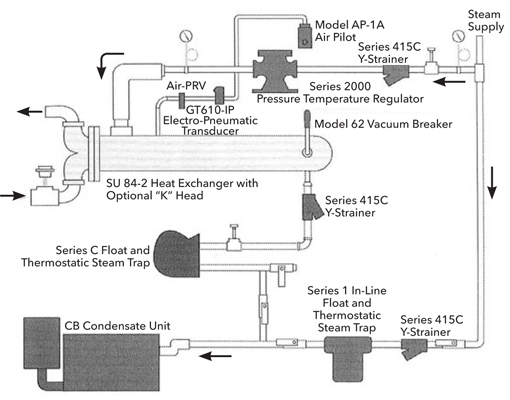
The above figure depicts a general steam to water heat exchanger system.
As these type heaters use steam as their heat source so they are called steam to water converters.
Working of the shell and tube heat exchanger :
1.Steam enters to the heat exchanger shell through the top vapor opening and surrounds the outside of the tubes.
2.The heat transfer then condenses the steam inside the shell forming condensate which drops to the bottom of the HES (heat exchanger shell). The condensate then flows though the bottom condensate outlet.
3.When we remove the latent heat of vaporization, the condensate will be very near to the saturation temperature.
4.Depending on the load of the system, a small subcooling may take place from the bottom of the HE and the inlet piping to steam trap.
Can a fluidized bed heat exchanger produce superheated steam using water and heat transfer fluid ...
Can a fluidized bed heat exchanger produce superheated steam using water and heat transfer fluid as inlets?
4. The heat exchanger, shown below, is being used to generate vapor from saturated water at 385-K. The other side of the exchanger is condensing saturated steam at 400-K、The heat exchanger has 1...
 4. The heat exchanger, shown below, is being used to generate vapor from saturated water at 385-K. The other side of the exchanger is condensing saturated steam at 400-K、The heat exchanger has 15, S-cm ID thin-wall copper tubes, each 10-em long between the tube sheets. Calculate the steam condensation heat transfer coefficient for the tubes of this exchanger Calculate the rate of exchanger (10) a. vapor generation (kg/sec), m, in the tubes of this (10) a. 400 k 帛? 40...
The condenser of a large steam power plant is a heat exchanger in which steam is...
 The condenser of a large steam power plant is a heat exchanger in which steam is condensed to liquid water. Assume the condenser to be a shell-and-tube heat exchanger consisting of a single shell and 30,000 tubes, each executing two passes (see figure below). The tubes are of thin wall construction with D=25mm, and steam condenses on their outer surface with an associated convection coefficient ho=11,000W/ m K The heat transfer rate that must be effected by the heat exchanger...
Problem 3 Steam enters a heat exchanger at 0.1 bar with a quality of 0.95 and...
 Problem 3 Steam enters a heat exchanger at 0.1 bar with a quality of 0.95 and condensate exits at 0.1 bar and 45'C. Cooling water enters the heat exchanger in a separate stream as a liquid at 20'C and exits as a liquid at 35 C with no changes in pressure. Heat transfer from the outside of the heat exchanger and changes in the kinetic and potential energies of the flowing streams can be ignored. For steady state operation, (a)...
Steam is to be condensed on the shell side of a heat exchanger at 120°F. Cooling...
Steam is to be condensed on the shell side of a heat exchanger at 120°F. Cooling water enters the tubes at 65°F at a rate of 108.6 lbm/s and leaves at 80°F. Assuming the heat exchanger to be well insulated, determine (a) the rate of heat transfer in the heat exchanger and (b) the rate of exergy destruction in the heat exchanger. Take T0 = 98°F PLEASE EXPLAIN CLEARLY, WRITE CLEARLY, DOUBLE CHECK ANSWERS!!!!!!!!!!!!!!!!!!!!!!!!!!!!!!!!!!!!!
PROBLEM 3 (45 points) The condenser of a large steam power plant is a heat exchanger...
 PROBLEM 3 (45 points) The condenser of a large steam power plant is a heat exchanger in which steam is condensed to liquid water. Assume the condenser to be a parallel flow shell-and-tube heat exchanger consisting of a single shell and 1x10 tubes, each executing two passes. The inner diameter of tubes is D = 50 mm and its thickness is 5 mm (Do not ignore the thickness). The steam condenses on their outer surface. Thermal conductivity of the tube...
6) Heat Exchanger Specification The mixed reactor feed must be evaporated in a heat exchanger, which...
 6) Heat Exchanger Specification The mixed reactor feed must be evaporated in a heat exchanger, which requires 1.45x10⁴ kJ/h of heat. To accomplish this, steam at 450°C and 40.0 bar is condensed to saturated liquid water at 40.0 bar and 250.3°C. Determine the required flow rate (in kg/h) of steam. Heat Exchanger Liquid Reactor Feed @ 41°C Gas Reactor Feed @ 215°C Steam Saturated Liquid Water
It is found that superheated steam (100kg/hr, 1bar 250°C) gives Q=29960kJ/hr in a heat exchanger and...
 It is found that superheated steam (100kg/hr, 1bar 250°C) gives Q=29960kJ/hr in a heat exchanger and leaves as saturated steam at 1bar. a) If the superheated steam (1bar, 250 °C) leaves the heat exchanger as saturated water at 1bar. Calculate the mass flow rate of the steam giving the same Q. (11.71kg/hr) b) Calculate the inlet volume flow rate. (28.29 m3/hr)
Steam Generator air (inlet) - 320°C P. = 100 kPa th =0.5 kg/s heat exchanger -...
 Steam Generator air (inlet) - 320°C P. = 100 kPa th =0.5 kg/s heat exchanger - water (inlet) T = 20°C Pw = 100 kPa m = 0.025 kg/s Problem sketch Solve with EES. Document all necessary balances The problem sketch illustrates a heat exchanger in which hot air is used to generate steam. Air enters the heat exchanger at 1a, in = 320C, Pa = 100 kPa, and ma -0.5 kg/s. Model air as an ideal gas with constant...
Section C – shell and tube heat exchanger sizing The vapour condenser for the combined gas-steam ...
Section C – shell and tube heat exchanger sizing The vapour condenser for the combined gas-steam power cycle described in Section B heats river water from 15 °C to 18 °C. The condenser is a shell and tube heat exchanger with one shell pass and two tube passes. The cooling water is inside the tubes while the shell side has the condensing vapour. More details: a. The tube OD is 1 ¼” (inches), the tube wall thickness is 0.05 inches....
 4. The heat exchanger, shown below, is being used to generate vapor from saturated water at 385-K. The other side of the exchanger is condensing saturated steam at 400-K、The heat exchanger has 15, S-cm ID thin-wall copper tubes, each 10-em long between the tube sheets. Calculate the steam condensation heat transfer coefficient for the tubes of this exchanger Calculate the rate of exchanger (10) a. vapor generation (kg/sec), m, in the tubes of this (10) a. 400 k 帛? 40...
 The condenser of a large steam power plant is a heat exchanger in which steam is condensed to liquid water. Assume the condenser to be a shell-and-tube heat exchanger consisting of a single shell and 30,000 tubes, each executing two passes (see figure below). The tubes are of thin wall construction with D=25mm, and steam condenses on their outer surface with an associated convection coefficient ho=11,000W/ m K The heat transfer rate that must be effected by the heat exchanger...
 Problem 3 Steam enters a heat exchanger at 0.1 bar with a quality of 0.95 and condensate exits at 0.1 bar and 45'C. Cooling water enters the heat exchanger in a separate stream as a liquid at 20'C and exits as a liquid at 35 C with no changes in pressure. Heat transfer from the outside of the heat exchanger and changes in the kinetic and potential energies of the flowing streams can be ignored. For steady state operation, (a)...
 PROBLEM 3 (45 points) The condenser of a large steam power plant is a heat exchanger in which steam is condensed to liquid water. Assume the condenser to be a parallel flow shell-and-tube heat exchanger consisting of a single shell and 1x10 tubes, each executing two passes. The inner diameter of tubes is D = 50 mm and its thickness is 5 mm (Do not ignore the thickness). The steam condenses on their outer surface. Thermal conductivity of the tube...
 6) Heat Exchanger Specification The mixed reactor feed must be evaporated in a heat exchanger, which requires 1.45x10⁴ kJ/h of heat. To accomplish this, steam at 450°C and 40.0 bar is condensed to saturated liquid water at 40.0 bar and 250.3°C. Determine the required flow rate (in kg/h) of steam. Heat Exchanger Liquid Reactor Feed @ 41°C Gas Reactor Feed @ 215°C Steam Saturated Liquid Water
 It is found that superheated steam (100kg/hr, 1bar 250°C) gives Q=29960kJ/hr in a heat exchanger and leaves as saturated steam at 1bar. a) If the superheated steam (1bar, 250 °C) leaves the heat exchanger as saturated water at 1bar. Calculate the mass flow rate of the steam giving the same Q. (11.71kg/hr) b) Calculate the inlet volume flow rate. (28.29 m3/hr)
 Steam Generator air (inlet) - 320°C P. = 100 kPa th =0.5 kg/s heat exchanger - water (inlet) T = 20°C Pw = 100 kPa m = 0.025 kg/s Problem sketch Solve with EES. Document all necessary balances The problem sketch illustrates a heat exchanger in which hot air is used to generate steam. Air enters the heat exchanger at 1a, in = 320C, Pa = 100 kPa, and ma -0.5 kg/s. Model air as an ideal gas with constant...
Most questions answered within 3 hours.
-
Where is the error in this code sequence?
String s1 = "Hello";
String s2 = "ello";...
asked 11 months ago -
Financial data for Joel de Paris, Inc., for last year
follow:
Joel de Paris, Inc.
Balance...
asked 11 months ago -
Consider this reaction:
Al2(SO4)3 (aq)+ BaCl3
(aq) Al2Cl6 (aq)- +
3BaSO4(s) . What is the...
asked 11 months ago -
Suppose that Savneet is considering increasing her
recent random sample from 20 car rentals to 40...
asked 11 months ago -
Trucks arrive at an unloading terminal at an average rate of 120
per hour.
Trucks arrive...
asked 11 months ago -
Why are methanol and ethanol completely soluble in water while
octanol is not very little soluble....
asked 11 months ago -
A facilities manager at a university reads in a research report
that the mean amount of...
asked 11 months ago -
When the CuSO4 is rehydrated by adding water to the anhydrous
compound, is this an endothermic...
asked 11 months ago -
A ray of sunlight is passing from diamond into crown glass; the
angle of incidence is...
asked 11 months ago -
A block of mass 0.249 kg is placed on top of a light, vertical
spring of...
asked 11 months ago -
how do the kidneys compensate in the presences of acidosis
a) trigger hyperventilate
b) reserve acid...
asked 11 months ago -
Question 501 pts
The rental rate of capital to the firm increases. Which of the
following...
asked 11 months ago