What is the output of this program? void wth(int i, int &k) { i = 1;...
What is the output of this program?
void wth(int i, int &k) {
i = 1;
k = 2;
}
int main (){
int x = 0;
wth(x, x);
cout << x << endl;
return 0;
}
(a) 2
(b) wth
(c) 1
(d) Run-time error
(e) 0
(f) Compile-time error
(g) None of the above
Homework Answers
Answer : 2 (option a)
Code: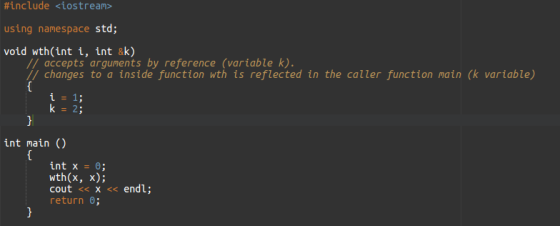
Output:
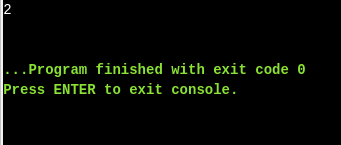
Hint: If a variable is accepted by a function (wth) as reference (&k) then the changes done in that function to that variable will be reflected in the caller function (main) too. That is what happened with the variable x in the main function.
&k in the function wth accepts the address of the variable sent (not the value of it i.e., 0) so the value assigned to that address in wth will affect to the value in the caller function too. So, x = 2.
Please comment if any clarification needed. Thank you.
Add Answer to:
What is the output of this program?
void wth(int i, int &k) {
i = 1;...
Explain the output of the following C++ program. #include <iostream> using namespace std; void Magic(int i=1,...
Explain the output of the following C++ program. #include <iostream> using namespace std; void Magic(int i=1, int j=2,int k=3, double product =1.0) { i+=2; j*=2; k/=2; product=i*j*k; } void Magic(int& i, int& j, double& product) { i+=2; j=j*2+2; product=i*j; } void Magic(int* i,int* j) { double product; *i+=2; *j=*j*2+2; product=*i * *j; } int main() { double product; int i=0,j=0,k=0; product=i*j*k; Magic(); cout<<"i, j, k and product in main () after 1st round:"<<endl<<i<<endl<<j<<endl<<k<<endl<<product<<endl; Magic(2,4); cout<<"i, j, k and...
Consider the following program: # include <iostream> int x = 3, y = 5; void foo(void)...
Consider the following program: # include <iostream> int x = 3, y = 5; void foo(void) { x = x + 2; y = y + 4; } void bar(void) { int x = 10; y = y + 3; foo( ); cout << x << endl; cout << y << endl; } void baz(void) { int y = 7; bar( ); cout << y << endl; } void main( ) { baz( ); } What output does this program...
What is the output of the following program? int main(void) { int x, y, z; x...
What is the output of the following program? int main(void) { int x, y, z; x = 5; y= test(x); z= x + y; cout<< setw(4)<<x <<” + “<<setw(4)<<y<<”=” << setw(4)<<z<<endl; return 0; } int test (int x) { int w; w = x + 10; return (w); }
7. What is the output of the following program? #include <iostream> int f(int n, int &...
 7. What is the output of the following program? #include <iostream> int f(int n, int & v, int * p) { V = *p; v = y + 1; return n+ (*p); int main() { int n = 10; int m = 20; std::cout << fin, n, & m); a. 30. b. 31. c. 41. d. 42. e. An error occurs. 8. What is the output of the following program? Note that both the signature and the body of the...
Give the output for the following code assume int globalvar 10: above the function prototypes void...
 Give the output for the following code assume int globalvar 10: above the function prototypes void foo(int&); void bar(int); int main() { int globalVar = 5; foo(globalVar); cout << globalVar << endl; bar(globalVar); cout << globalVar << endl; return 0; } void foo(int& x) { x = globalVar + x; cout << globalVar << endl; return; void bar(int x) { globalVar + x; cout << globalVar << endl; X = return;
What is the output of the following code:for(int i = 1; i < 5; i++) {...
What is the output of the following code:for(int i = 1; i < 5; i++) { cout << i << " "; for(int j = 1; j <= i; j++) { cout << j << " "; } cout << endl; } Write C++ code that will store the input “John” in a character array. Make sure to use an array initializer. //CODE int g(int a, int b); void g(int a, int b); True or False? Function g above...
QUESTION 6 What is the output of following C code? struct numbers { int x...
QUESTION 6 What is the output of following C code? struct numbers { int x = 2; int y = 3; } int main() { struct numbers nums; nums.x = 110; nums.y = 100; printf("%d\n%d", nums.x, nums.y); return 0; } A. Compile-time Error B. 110 100 C. 2 3 D. Run-time Error 2 points QUESTION 7 What is the output of following C code? typedef struct student { char *stud; }s1; int main() { s1 s; s.stud...
What is the output of the program? int function1( int x, int& y) { if( x...
What is the output of the program? int function1( int x, int& y) { if( x % 2 == 0) { x = x + y; } y = y - x; return x; } int main() { int a, b, result; cin >> a >> b; result = function1(a, b); cout << "a = "<< a << ", b = " << b << endl; cout << "result = " << result << endl; } Please make comments...
Consider the following C++code snippet and what is the output of this program? # include<iostream> using...
 Consider the following C++code snippet and what is the output of this program? # include<iostream> using namespace std; void arraySome (int[), int, int); int main () const int arraysize = 10; int a[arraysize]-1,2,3,4,5, 6,7,8,9,10 cout << "The values in the array are:" << endl; arraySome (a, 0, arraySize) cout<< endl; system ("pause") return 0; void arraySome (int b[], int current, int size) if (current< size) arraySome (b, current+1, size); cout << b[current] <<""; a) Print the array values b) Double...
16 Points) Question 3 Write down the outputs of the following program into the provided table include <iostream> using namespace std; void fun I(int a); int fun2(int a, int b); int x-3: int...
 16 Points) Question 3 Write down the outputs of the following program into the provided table include <iostream> using namespace std; void fun I(int a); int fun2(int a, int b); int x-3: int main) int x-1,y 0,z-2; x-fun2(y,z); cout sx fun 1 (z); cout (#xtytz(endl; y-fun2(x,x); cout <exty+zscendl; system("pause"); void fun 1 (int a) int fun2(int a, int b) int static c2; return atx;
16 Points) Question 3 Write down the outputs of the following program into the provided table...
16 Points) Question 3 Write down the outputs of the following program into the provided table include <iostream> using namespace std; void fun I(int a); int fun2(int a, int b); int x-3: int main) int x-1,y 0,z-2; x-fun2(y,z); cout sx fun 1 (z); cout (#xtytz(endl; y-fun2(x,x); cout <exty+zscendl; system("pause"); void fun 1 (int a) int fun2(int a, int b) int static c2; return atx;
16 Points) Question 3 Write down the outputs of the following program into the provided table...
 7. What is the output of the following program? #include <iostream> int f(int n, int & v, int * p) { V = *p; v = y + 1; return n+ (*p); int main() { int n = 10; int m = 20; std::cout << fin, n, & m); a. 30. b. 31. c. 41. d. 42. e. An error occurs. 8. What is the output of the following program? Note that both the signature and the body of the...
 Give the output for the following code assume int globalvar 10: above the function prototypes void foo(int&); void bar(int); int main() { int globalVar = 5; foo(globalVar); cout << globalVar << endl; bar(globalVar); cout << globalVar << endl; return 0; } void foo(int& x) { x = globalVar + x; cout << globalVar << endl; return; void bar(int x) { globalVar + x; cout << globalVar << endl; X = return;
 Consider the following C++code snippet and what is the output of this program? # include<iostream> using namespace std; void arraySome (int[), int, int); int main () const int arraysize = 10; int a[arraysize]-1,2,3,4,5, 6,7,8,9,10 cout << "The values in the array are:" << endl; arraySome (a, 0, arraySize) cout<< endl; system ("pause") return 0; void arraySome (int b[], int current, int size) if (current< size) arraySome (b, current+1, size); cout << b[current] <<""; a) Print the array values b) Double...
 16 Points) Question 3 Write down the outputs of the following program into the provided table include <iostream> using namespace std; void fun I(int a); int fun2(int a, int b); int x-3: int main) int x-1,y 0,z-2; x-fun2(y,z); cout sx fun 1 (z); cout (#xtytz(endl; y-fun2(x,x); cout <exty+zscendl; system("pause"); void fun 1 (int a) int fun2(int a, int b) int static c2; return atx;
16 Points) Question 3 Write down the outputs of the following program into the provided table...
16 Points) Question 3 Write down the outputs of the following program into the provided table include <iostream> using namespace std; void fun I(int a); int fun2(int a, int b); int x-3: int main) int x-1,y 0,z-2; x-fun2(y,z); cout sx fun 1 (z); cout (#xtytz(endl; y-fun2(x,x); cout <exty+zscendl; system("pause"); void fun 1 (int a) int fun2(int a, int b) int static c2; return atx;
16 Points) Question 3 Write down the outputs of the following program into the provided table...
Most questions answered within 3 hours.
-
Where is the error in this code sequence?
String s1 = "Hello";
String s2 = "ello";...
asked 10 months ago -
Financial data for Joel de Paris, Inc., for last year
follow:
Joel de Paris, Inc.
Balance...
asked 10 months ago -
Consider this reaction:
Al2(SO4)3 (aq)+ BaCl3
(aq) Al2Cl6 (aq)- +
3BaSO4(s) . What is the...
asked 10 months ago -
Suppose that Savneet is considering increasing her
recent random sample from 20 car rentals to 40...
asked 10 months ago -
Trucks arrive at an unloading terminal at an average rate of 120
per hour.
Trucks arrive...
asked 10 months ago -
Why are methanol and ethanol completely soluble in water while
octanol is not very little soluble....
asked 10 months ago -
A facilities manager at a university reads in a research report
that the mean amount of...
asked 10 months ago -
When the CuSO4 is rehydrated by adding water to the anhydrous
compound, is this an endothermic...
asked 10 months ago -
A ray of sunlight is passing from diamond into crown glass; the
angle of incidence is...
asked 10 months ago -
A block of mass 0.249 kg is placed on top of a light, vertical
spring of...
asked 10 months ago -
how do the kidneys compensate in the presences of acidosis
a) trigger hyperventilate
b) reserve acid...
asked 10 months ago -
Question 501 pts
The rental rate of capital to the firm increases. Which of the
following...
asked 10 months ago