Hello, i cant see the logic of why in OPAMP in common mode we have virtual...
Hello, i cant see the logic of why in OPAMP in common mode we
have virtual OPEN CIRCUIT,and in differential mode we have SHORT
circuit?
Thanks.
Homework Answers
In common mode of operation, we apply same signal both in phase and amplitude at the both ends of input ( at negative and positive ) terminals. The effective input voltage is the difference of voltage applied at positive terminal (Vp) and voltage applied at negative terminal (Vn). As both are equal, the effective input voltage will be zero. This leads to no current flow as both voltages are at same potential and leads to virtual OPEN CIRCUIT.
In differential mode, an exact opposite signal of the signal which is applied at positive terminal is given as input to negative terminal. Thus, here Vn = - Vp. Therefore, the effective voltage will be twice of Vp. This is the mode where we can get maximum potential difference between positive and negative terminals thereby increasing the current flow. This leads to short circuit in differential mode.
Thank you.
Add Answer to:
Hello, i cant see the logic of why in OPAMP in common mode we
have virtual...
Hello, in the transimpdance circuit shown bellow,why both input and output feedback are parrarel? i cant...
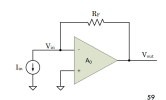 Hello, in the transimpdance circuit shown bellow,why both input
and output feedback are parrarel?
i cant see where is the parralel in here.
Thanks
Vin V out hin + 59
Hello, in the transimpdance circuit shown bellow,why both input
and output feedback are parrarel?
i cant see where is the parralel in here.
Thanks
Vin V out hin + 59
32.Determire ( The common-mode gain (i) The differential mode gain ard (ili) The common-mode rejection retio...
 32.Determire ( The common-mode gain (i) The differential mode gain ard (ili) The common-mode rejection retio in decibels when an EKS differential amplification circuit inpur values are l0m and and yields o common-mode output voltage of 27mV and differential-mode output voltoge of 13 V
a) Why can we have the packet header in virtual circuit switching to be much smaller...
a) Why can we have the packet header in virtual circuit switching to be much smaller than the typical header in datagram switching? b) Assume that we are using datagram switching (i.e. we are not using virtual circuits). Is it possible to guarantee bandwidth to each source-destination pair? Are there disadvantages of doing this using datagram switching? c) What is the big-O complexity of processing the header of a packet if we are using virtual circuits? Briefly explain why. d)...
Hello, in the image attached below, why cant we form a gringard in the presence of...
 Hello, in the image attached below, why cant we form a gringard
in the presence of the OH?
HO NaCN HO H30+ НО, CI H2O heat OH 2-Chloroethanol 2-Cyanoethanol 3-Hydroxypropanoic acid The presence of the hydroxyl group in 2-chloroethanol precludes the preparation of a Grignard reagent from this material, and so any attempt at the preparation of 3-hydroxypropanoic acid via the Grignard reagent of 2-chloroethanol is certain to fail.
Hello, in the image attached below, why cant we form a gringard
in the presence of the OH?
HO NaCN HO H30+ НО, CI H2O heat OH 2-Chloroethanol 2-Cyanoethanol 3-Hydroxypropanoic acid The presence of the hydroxyl group in 2-chloroethanol precludes the preparation of a Grignard reagent from this material, and so any attempt at the preparation of 3-hydroxypropanoic acid via the Grignard reagent of 2-chloroethanol is certain to fail.
I have used the B=(uo*I)/2pi*r) , but i cant see to get correct answer. Thank you...
 I have used the B=(uo*I)/2pi*r) , but i cant see to get
correct answer. Thank you so much in advance!
I have used the B=(uo*I)/2pi*r) , but i cant see to get
correct answer. Thank you so much in advance!
hello.. i have timer 555 ic working in astable mode .. i need the output to...
 hello.. i have timer 555 ic working in astable mode ..
i need the output to be:
f=1.2Hz
time low(t0) = 416.6666ms
time high(t1)=416.6666ms
what are the values of R1 , R2 and C ?
Vcc 4 Output 7 3 NE555 2 2 10 nF
hello.. i have timer 555 ic working in astable mode ..
i need the output to be:
f=1.2Hz
time low(t0) = 416.6666ms
time high(t1)=416.6666ms
what are the values of R1 , R2 and C ?
Vcc 4 Output 7 3 NE555 2 2 10 nF
Hello, I have a prac coming up related to Spectroscopy and using the Beer-Lambert Law. We...
Hello, I have a prac coming up related to Spectroscopy and using the Beer-Lambert Law. We need to graph absorbance vs. concentration for a chose solution at two different wavelengths (max & 510nm) and compare and comment on the magnitude of molar absorption coefficients determined at these wavelengths. I know the graph at maximum wavelength produces a steeper gradient (Has a higher absorbance than at wavelength 510nm). Why is this the case? A detailed explanation would be ideal. Thanks!
Why can't we design a combinational digital logic circuit to control a light so that the...
Why can't we design a combinational digital logic circuit to control a light so that the light changes state any time its "push-button" switch is pressed? (Press and release the button, and the light changes state. Press and release again, and the light changes state again.) Try to list as many properties this circuit needs to have that we cannot model as you can! Reminder: a "combinational digital logic circuit" takes one or more boolean inputs and feeds them through...
Texas Instruments asks you to build an amplifier circuit. The requested amplifier must have a high...
 Texas Instruments asks you to build an amplifier circuit. The
requested amplifier must have a
high value of CMRR, which is why it is requested that the
differential stage be a differential amplifier
with power source, see figure 1. Use transistor LM3046.
Calculate the value of the gain in common mode. Calculate the
gain value in differential mode.
+VCC - Rc LV. + Vet V2 RM RW -VEE
Texas Instruments asks you to build an amplifier circuit. The
requested amplifier must have a
high value of CMRR, which is why it is requested that the
differential stage be a differential amplifier
with power source, see figure 1. Use transistor LM3046.
Calculate the value of the gain in common mode. Calculate the
gain value in differential mode.
+VCC - Rc LV. + Vet V2 RM RW -VEE
Hello, I am stuck on this problem as you can see I have tried a lot...
 Hello,
I am stuck on this problem as you can see I have tried a lot I
need some help and direction!
Thank you!
A(S)= t it - itat shown in the block diagram and accompanying ind has a forward gain of 105 17. (30pts total) For the next five questions, refer to the feedback system shown in the block di OPAMP schematic. Assume the OPAMP exhibits ideal characteristics and has a forward an 101F + 1012 jio - Vout...
Hello,
I am stuck on this problem as you can see I have tried a lot I
need some help and direction!
Thank you!
A(S)= t it - itat shown in the block diagram and accompanying ind has a forward gain of 105 17. (30pts total) For the next five questions, refer to the feedback system shown in the block di OPAMP schematic. Assume the OPAMP exhibits ideal characteristics and has a forward an 101F + 1012 jio - Vout...
 Hello, in the transimpdance circuit shown bellow,why both input
and output feedback are parrarel?
i cant see where is the parralel in here.
Thanks
Vin V out hin + 59
Hello, in the transimpdance circuit shown bellow,why both input
and output feedback are parrarel?
i cant see where is the parralel in here.
Thanks
Vin V out hin + 59
 32.Determire ( The common-mode gain (i) The differential mode gain ard (ili) The common-mode rejection retio in decibels when an EKS differential amplification circuit inpur values are l0m and and yields o common-mode output voltage of 27mV and differential-mode output voltoge of 13 V
 Hello, in the image attached below, why cant we form a gringard
in the presence of the OH?
HO NaCN HO H30+ НО, CI H2O heat OH 2-Chloroethanol 2-Cyanoethanol 3-Hydroxypropanoic acid The presence of the hydroxyl group in 2-chloroethanol precludes the preparation of a Grignard reagent from this material, and so any attempt at the preparation of 3-hydroxypropanoic acid via the Grignard reagent of 2-chloroethanol is certain to fail.
Hello, in the image attached below, why cant we form a gringard
in the presence of the OH?
HO NaCN HO H30+ НО, CI H2O heat OH 2-Chloroethanol 2-Cyanoethanol 3-Hydroxypropanoic acid The presence of the hydroxyl group in 2-chloroethanol precludes the preparation of a Grignard reagent from this material, and so any attempt at the preparation of 3-hydroxypropanoic acid via the Grignard reagent of 2-chloroethanol is certain to fail.
 I have used the B=(uo*I)/2pi*r) , but i cant see to get
correct answer. Thank you so much in advance!
I have used the B=(uo*I)/2pi*r) , but i cant see to get
correct answer. Thank you so much in advance!
 hello.. i have timer 555 ic working in astable mode ..
i need the output to be:
f=1.2Hz
time low(t0) = 416.6666ms
time high(t1)=416.6666ms
what are the values of R1 , R2 and C ?
Vcc 4 Output 7 3 NE555 2 2 10 nF
hello.. i have timer 555 ic working in astable mode ..
i need the output to be:
f=1.2Hz
time low(t0) = 416.6666ms
time high(t1)=416.6666ms
what are the values of R1 , R2 and C ?
Vcc 4 Output 7 3 NE555 2 2 10 nF
 Texas Instruments asks you to build an amplifier circuit. The
requested amplifier must have a
high value of CMRR, which is why it is requested that the
differential stage be a differential amplifier
with power source, see figure 1. Use transistor LM3046.
Calculate the value of the gain in common mode. Calculate the
gain value in differential mode.
+VCC - Rc LV. + Vet V2 RM RW -VEE
Texas Instruments asks you to build an amplifier circuit. The
requested amplifier must have a
high value of CMRR, which is why it is requested that the
differential stage be a differential amplifier
with power source, see figure 1. Use transistor LM3046.
Calculate the value of the gain in common mode. Calculate the
gain value in differential mode.
+VCC - Rc LV. + Vet V2 RM RW -VEE
 Hello,
I am stuck on this problem as you can see I have tried a lot I
need some help and direction!
Thank you!
A(S)= t it - itat shown in the block diagram and accompanying ind has a forward gain of 105 17. (30pts total) For the next five questions, refer to the feedback system shown in the block di OPAMP schematic. Assume the OPAMP exhibits ideal characteristics and has a forward an 101F + 1012 jio - Vout...
Hello,
I am stuck on this problem as you can see I have tried a lot I
need some help and direction!
Thank you!
A(S)= t it - itat shown in the block diagram and accompanying ind has a forward gain of 105 17. (30pts total) For the next five questions, refer to the feedback system shown in the block di OPAMP schematic. Assume the OPAMP exhibits ideal characteristics and has a forward an 101F + 1012 jio - Vout...
Most questions answered within 3 hours.
-
Where is the error in this code sequence?
String s1 = "Hello";
String s2 = "ello";...
asked 11 months ago -
Financial data for Joel de Paris, Inc., for last year
follow:
Joel de Paris, Inc.
Balance...
asked 11 months ago -
Consider this reaction:
Al2(SO4)3 (aq)+ BaCl3
(aq) Al2Cl6 (aq)- +
3BaSO4(s) . What is the...
asked 11 months ago -
Suppose that Savneet is considering increasing her
recent random sample from 20 car rentals to 40...
asked 11 months ago -
Trucks arrive at an unloading terminal at an average rate of 120
per hour.
Trucks arrive...
asked 11 months ago -
Why are methanol and ethanol completely soluble in water while
octanol is not very little soluble....
asked 11 months ago -
A facilities manager at a university reads in a research report
that the mean amount of...
asked 11 months ago -
When the CuSO4 is rehydrated by adding water to the anhydrous
compound, is this an endothermic...
asked 11 months ago -
A ray of sunlight is passing from diamond into crown glass; the
angle of incidence is...
asked 11 months ago -
A block of mass 0.249 kg is placed on top of a light, vertical
spring of...
asked 11 months ago -
how do the kidneys compensate in the presences of acidosis
a) trigger hyperventilate
b) reserve acid...
asked 11 months ago -
Question 501 pts
The rental rate of capital to the firm increases. Which of the
following...
asked 11 months ago