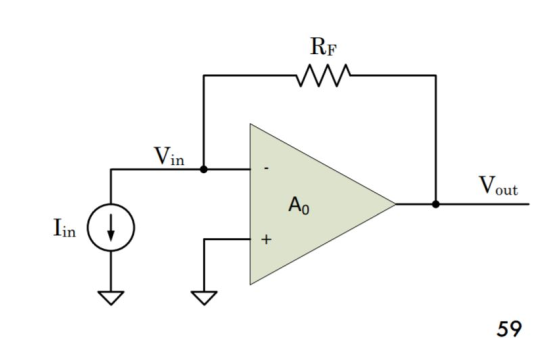
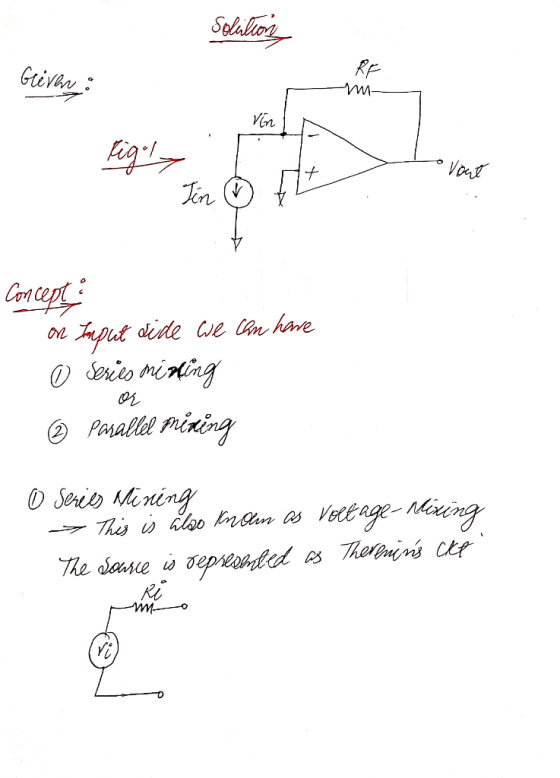
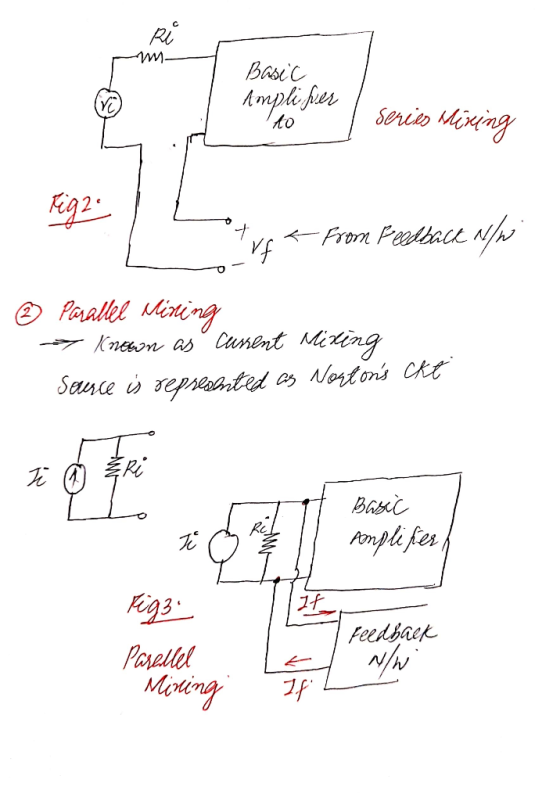
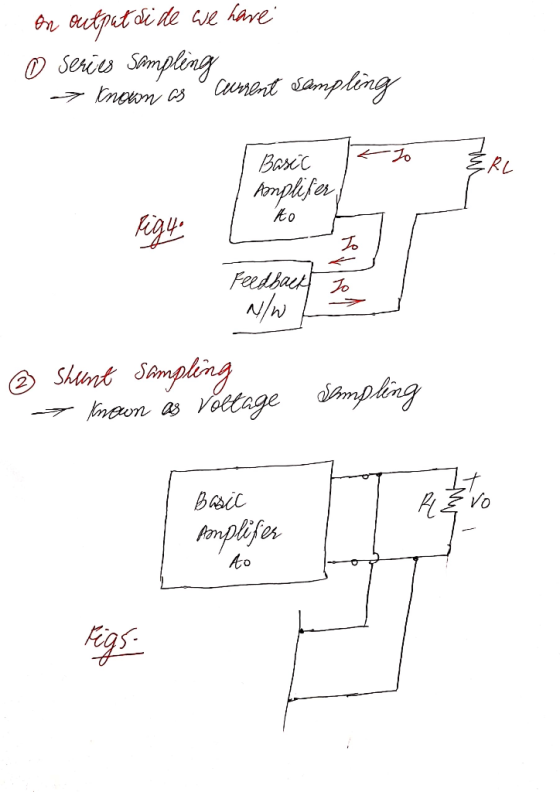
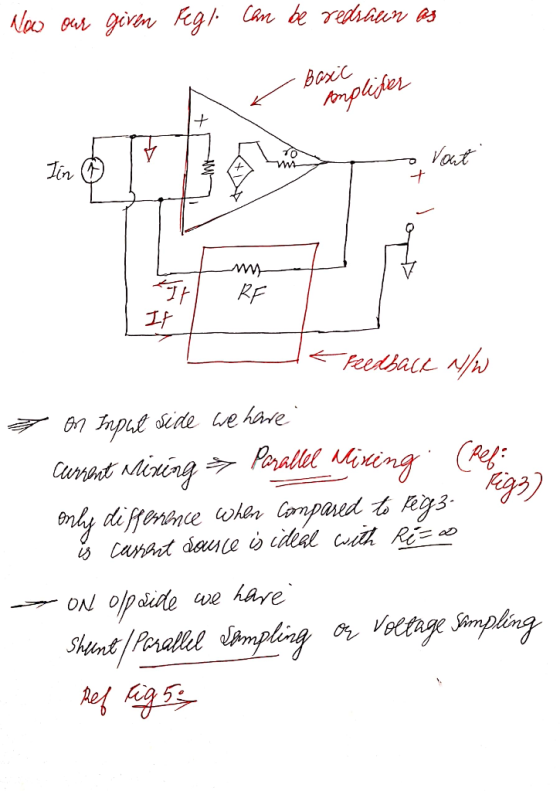
Hello, in the transimpdance circuit shown bellow,why both input and output feedback are parrarel?
i cant see where is the parralel in here.
Thanks
Homework Answers
Add Answer to:
Hello, in the transimpdance circuit shown bellow,why both input
and output feedback are parrarel?
i cant...
Hello, i cant see the logic of why in OPAMP in common mode we have virtual...
Hello, i cant see the logic of why in OPAMP in common mode we have virtual OPEN CIRCUIT,and in differential mode we have SHORT circuit? Thanks.
4. In the circuit shown below, a parallel RC network creates a frequency-dependent feedback path ...
 4. In the circuit shown below, a parallel RC network creates a frequency-dependent feedback path for the inverting amplifier block with gain Av (a large negative value). Use the Miller theorem to find the equivalent input impedance Zin as indicated in the diagram and then show that Vin/Vsig is given by the symbolic expression shown below right. Choose a value for capacitor C to make the upper cut-off frequency fH equal to 22 kHz. Repeat the calculation for the case...
1. Find the ratio of the output voltage to the input voltage, Vo/Vin, in the circuit...
 1. Find the ratio of the output voltage to the input voltage, Vo/Vin, in the circuit shown. State your assumptions in using the ideal op-amp model. 15 k2 Vin 2. Find the output voltage Vo in the circuit shown assuming an ideal op-amp. State your assumptions in using the ideal op-amp model 15 k12 Vo . Find the voltage Vx and the output voltage Vo in the circuit shown assuming ideal op-amp 3 k2 1 V 6 kn 12 k2
For the circuit below, the output is at 15 V and the input voltage is at +2 V if the input voltage is gradually lowered to -2 V, at what input voltage does the output switch from +15 V to-15 V (to 1...
 For the circuit below, the output is at 15 V and the input voltage is at +2 V if the input voltage is gradually lowered to -2 V, at what input voltage does the output switch from +15 V to-15 V (to 1 % accuracy)? The op-amp has rail-to-rail swing, and a gain-bandwidth product of 3 MHz. The resistors used are r1 -1.5 k ohm and r2 22.8 k ohm r2 Vin 2 +2 V +15 V r1 f 1...
For the circuit below, the output is at-15 V, and the input voltage is at +2 V if the input voltage is gradually lowered to -2 V, at what input voltage does the output switch from-15 V to +15 V (to 1...
 For the circuit below, the output is at-15 V, and the input voltage is at +2 V if the input voltage is gradually lowered to -2 V, at what input voltage does the output switch from-15 V to +15 V (to 1 % accuracy)? The op-amp has rail-to-rail swing, and a gain-bandwidth product of 3 MHz. The resistors used are r1 0.6 k ohm and r2 49.8 k ohm. r2 Vin 2/+2 V +15 V r1 out f-1 kHz 15...
For the circuit below, the output is at -15 V, and the input voltage is at -2 V. if the input voltage is gradually raised to 2 V, at what input voltage does the output switch from-15 V to +15 V (to 1...
 For the circuit below, the output is at -15 V, and the input voltage is at -2 V. if the input voltage is gradually raised to 2 V, at what input voltage does the output switch from-15 V to +15 V (to 1% accuracy)? - The op-amp has rail-to-rail swing, and a gain-bandwidth product of 3 MHz. The resistors used are r1 1.3 k ohm and r2 37.7 k ohm r2 Vin 2/+2 V +15 V r1 o out f...
Q6: In the circuit shown in Figure-6, assume the initial conditions, i0-0 and v(0)-0.The input, Vin...
 Q6: In the circuit shown in Figure-6, assume the initial conditions, i0-0 and v(0)-0.The input, Vin is a step voltage of 5V at t20. (i Draw the Laplace Transformed circuit of the network at t20. (i Find Laplace function, Vou s). (iii) Solve for Vourt) [61 2? 4? Vin-5u(t) 0.2F 0.5H v out Figure-6 4
2. The voltage gain of a circuit (jw) V- ., where vi and v, are input...
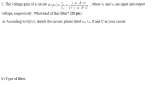 2. The voltage gain of a circuit (jw) V- ., where vi and v, are input and output Samo i RC voltage, respectively. What kind of this filter? (25 pts) a) According to G(jw), sketch the circuit, please label vin, V. R and C in your circuit. b) Type of filter:
The input to the circuit shown in Fig. 2 is the voltage source v(t). The output...
 The input to the circuit shown in Fig. 2 is the voltage source v(t). The output is the voltage across the capacitor, v(t). Determine the output of this circuit as a function of time t when the input is v.(t)-8+12u(t) V 40 18 s(t) 160 Fig. 2
(c) Consider the circuit shown in Figure Q4c. If the input voltage is Vin = 5...
 (c) Consider the circuit shown in Figure Q4c. If the input voltage is Vin = 5 [V] and open loop gain A0 = 10,000, determine the output voltage and derive the closed-loop gain [4 marks] Page 5 of 6 Figure Q4c
 4. In the circuit shown below, a parallel RC network creates a frequency-dependent feedback path for the inverting amplifier block with gain Av (a large negative value). Use the Miller theorem to find the equivalent input impedance Zin as indicated in the diagram and then show that Vin/Vsig is given by the symbolic expression shown below right. Choose a value for capacitor C to make the upper cut-off frequency fH equal to 22 kHz. Repeat the calculation for the case...
 1. Find the ratio of the output voltage to the input voltage, Vo/Vin, in the circuit shown. State your assumptions in using the ideal op-amp model. 15 k2 Vin 2. Find the output voltage Vo in the circuit shown assuming an ideal op-amp. State your assumptions in using the ideal op-amp model 15 k12 Vo . Find the voltage Vx and the output voltage Vo in the circuit shown assuming ideal op-amp 3 k2 1 V 6 kn 12 k2
 For the circuit below, the output is at 15 V and the input voltage is at +2 V if the input voltage is gradually lowered to -2 V, at what input voltage does the output switch from +15 V to-15 V (to 1 % accuracy)? The op-amp has rail-to-rail swing, and a gain-bandwidth product of 3 MHz. The resistors used are r1 -1.5 k ohm and r2 22.8 k ohm r2 Vin 2 +2 V +15 V r1 f 1...
 For the circuit below, the output is at-15 V, and the input voltage is at +2 V if the input voltage is gradually lowered to -2 V, at what input voltage does the output switch from-15 V to +15 V (to 1 % accuracy)? The op-amp has rail-to-rail swing, and a gain-bandwidth product of 3 MHz. The resistors used are r1 0.6 k ohm and r2 49.8 k ohm. r2 Vin 2/+2 V +15 V r1 out f-1 kHz 15...
 For the circuit below, the output is at -15 V, and the input voltage is at -2 V. if the input voltage is gradually raised to 2 V, at what input voltage does the output switch from-15 V to +15 V (to 1% accuracy)? - The op-amp has rail-to-rail swing, and a gain-bandwidth product of 3 MHz. The resistors used are r1 1.3 k ohm and r2 37.7 k ohm r2 Vin 2/+2 V +15 V r1 o out f...
 Q6: In the circuit shown in Figure-6, assume the initial conditions, i0-0 and v(0)-0.The input, Vin is a step voltage of 5V at t20. (i Draw the Laplace Transformed circuit of the network at t20. (i Find Laplace function, Vou s). (iii) Solve for Vourt) [61 2? 4? Vin-5u(t) 0.2F 0.5H v out Figure-6 4
 2. The voltage gain of a circuit (jw) V- ., where vi and v, are input and output Samo i RC voltage, respectively. What kind of this filter? (25 pts) a) According to G(jw), sketch the circuit, please label vin, V. R and C in your circuit. b) Type of filter:
 The input to the circuit shown in Fig. 2 is the voltage source v(t). The output is the voltage across the capacitor, v(t). Determine the output of this circuit as a function of time t when the input is v.(t)-8+12u(t) V 40 18 s(t) 160 Fig. 2
 (c) Consider the circuit shown in Figure Q4c. If the input voltage is Vin = 5 [V] and open loop gain A0 = 10,000, determine the output voltage and derive the closed-loop gain [4 marks] Page 5 of 6 Figure Q4c
Most questions answered within 3 hours.
-
Where is the error in this code sequence?
String s1 = "Hello";
String s2 = "ello";...
asked 10 months ago -
Financial data for Joel de Paris, Inc., for last year
follow:
Joel de Paris, Inc.
Balance...
asked 10 months ago -
Consider this reaction:
Al2(SO4)3 (aq)+ BaCl3
(aq) Al2Cl6 (aq)- +
3BaSO4(s) . What is the...
asked 10 months ago -
Suppose that Savneet is considering increasing her
recent random sample from 20 car rentals to 40...
asked 10 months ago -
Trucks arrive at an unloading terminal at an average rate of 120
per hour.
Trucks arrive...
asked 10 months ago -
Why are methanol and ethanol completely soluble in water while
octanol is not very little soluble....
asked 10 months ago -
A facilities manager at a university reads in a research report
that the mean amount of...
asked 10 months ago -
When the CuSO4 is rehydrated by adding water to the anhydrous
compound, is this an endothermic...
asked 10 months ago -
A ray of sunlight is passing from diamond into crown glass; the
angle of incidence is...
asked 10 months ago -
A block of mass 0.249 kg is placed on top of a light, vertical
spring of...
asked 10 months ago -
how do the kidneys compensate in the presences of acidosis
a) trigger hyperventilate
b) reserve acid...
asked 10 months ago -
Question 501 pts
The rental rate of capital to the firm increases. Which of the
following...
asked 10 months ago