Consider a stock with, a price of 80, dividend growth 0.05, initial dividend 10 . If...
Consider a stock with, a price of 80, dividend growth 0.05, initial dividend 10 .
If the riskfree rate is 1% , what is the equity risk premium?
Enter as a rate with two decimal places, but do not type the % sign.
Please show your work!
Homework Answers
Answer:
First of all we need to find cost of equity from the formula of dividend growth model of Gorden
Value of stock = D1 / (k - g)
D1 = Next year's expected dividend = Do(1+g)
Do = Current / Initial dividend
k = Cost of equity
g = dividend growth rate
80 = 10 (1.05) / ( k - 0.05 )
k - 0.05 = 0.13125
k = 0.13125 + 0.05
k = 0.18125 , 18.125 is equity cost
As per CAPM model
Ke = Rf + β (Rm - Rf)
Rf = Risk free return
β (Rm - Rf) = equity risk premium
18.125 = 1 + equity risk premium
equity risk premium = 18.125 - 1 = 17.125
Equity risk premium = 17.125
Add Answer to:
Consider a stock with, a price of 80, dividend growth 0.05,
initial dividend 10 .
If...
Suppose a stock had an initial price of $50 per share, paid a dividend of $.80...
Suppose a stock had an initial price of $50 per share, paid a dividend of $.80 per share during the year, and had an ending share price of $38. Compute the percentage total return. (A negative answer should be indicated by a minus sign. Do not round intermediate calculations and enter your answer as a percent rounded to 2 decimal places, e.g., 32.16.) Total return % What was the dividend yield and the capital gains yield? (A negative answer should...
Dividend Growth Model & CAPM A company’s stock has the following attributes: Current Market price of...
Dividend Growth Model & CAPM A company’s stock has the following attributes: Current Market price of $25.00 Current annual dividend of $1.50 Constant dividend growth rate of 4% A beta of 1.14 The risk-free rate is currently 3.4% and the market risk premium is 6.0%. If the risk-free rate suddenly jumps to 4.25% what happens to this company’s stock price (Give the price to 2 decimal places)?
Consider a stock that is expected to pay a dividend of $0.93 a year from now....
Consider a stock that is expected to pay a dividend of $0.93 a year from now. The current price of the stock is $45.18. The expected rate of return on the stock is 13%. What must be the expected growth rate of the dividends? Enter your answer as a percentage. Do not enter the percentage sign into your answer. Enter your response below rounded to 2 DECIMAL PLACES
Suppose a stock had an initial price of $85 per share, paid a dividend of $1.60...
Suppose a stock had an initial price of $85 per share, paid a dividend of $1.60 per share during the year, and had an ending share price of $72.00. Compute the percentage total return. (A negative answer should be indicated by a minus sign. Do not round intermediate calculations and enter your answer as a percent rounded to 2 decimal places, e.g., 32.16.) Percentage total return % What was the dividend yield? (Do not round intermediate calculations...
Problem 10-6 Cost of Common Equity The future earnings, dividends, and common stock price of Callahan...
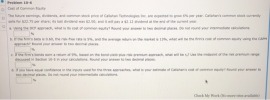 Problem 10-6 Cost of Common Equity The future earnings, dividends, and common stock price of Callahan Technologies Inc. are expected to grow 6 % per year. Callahan's common stock currently sells for $22.75 per share; its last dividend was $2.00; and it will pay a $2.12 dividend at the end of the current year. a. Using the DCF approach, what is its cost of common equity? Round your answer to two decimal places. Do not round your intermediate calculations. b....
Suppose a stock had an initial price of $88 per share, paid a dividend of $1.90...
Suppose a stock had an initial price of $88 per share, paid a dividend of $1.90 per share during the year, and had an ending share price of $73.50. a. Compute the percentage total return. (A negative answer should be indicated by a minus sign. Do not round intermediate calculations and enter your answer as a percent rounded to 2 decimal places, e.g., 32.16.) b. What was the dividend yield? (Do not round intermediate calculations and enter your answer as...
Suppose a stock had an initial price of $87 per share, paid a dividend of $2.15...
Suppose a stock had an initial price of $87 per share, paid a dividend of $2.15 per share during the year, and had an ending share price of $78. a. Compute the percentage total return. (A negative answer should be indicated by a minus sign. Do not round intermediate calculations and enter your answer as a percent rounded to 2 decimal places, e.g., 32.16.) b. What was the dividend yield? (Do not round intermediate calculations and enter your answer as...
Suppose a stock had an initial price of $65 per share, paid a dividend of $1.45...
Suppose a stock had an initial price of $65 per share, paid a dividend of $1.45 per share during the year, and had an ending share price of $58. a, Compute the percentage total return. (A negative answer should be indicated by a minus sign. Do not round intermediate calculations and enter your answer as a percent rounded to 2 decimal places, e.g., 32.16.) b. What was the dividend yield and the capital gains yield? (A negative answer should be...
Suppose you bought 500 shares of stock at an initial price of $44 per share. The...
Suppose you bought 500 shares of stock at an initial price of $44 per share. The stock paid a dividend of $.42 per share during the following year, and the share price at the end of the year was $45. a. What is the capital gains yield? (Do not round intermediate calculations. Enter your answer as a percent rounded to 2 decimal places. Omit the "%" sign in your response.) Capital gains yield % b. What is the dividend yield?...
Suppose a stock had an initial price of $65 per share, paid a dividend of $1.45...
 Suppose a stock had an initial price of $65 per share, paid a dividend of $1.45 per share during the year, and had an ending share price of $58. a, Compute the percentage total return. (A negative answer should be indicated by a minus sign. Do not round intermediate calculations and enter your answer as a percent rounded to 2 decimal places, e... 32.16.) b. What was the dividend yield and the capital gains yield? (A negative answer should be...
 Problem 10-6 Cost of Common Equity The future earnings, dividends, and common stock price of Callahan Technologies Inc. are expected to grow 6 % per year. Callahan's common stock currently sells for $22.75 per share; its last dividend was $2.00; and it will pay a $2.12 dividend at the end of the current year. a. Using the DCF approach, what is its cost of common equity? Round your answer to two decimal places. Do not round your intermediate calculations. b....
 Suppose a stock had an initial price of $65 per share, paid a dividend of $1.45 per share during the year, and had an ending share price of $58. a, Compute the percentage total return. (A negative answer should be indicated by a minus sign. Do not round intermediate calculations and enter your answer as a percent rounded to 2 decimal places, e... 32.16.) b. What was the dividend yield and the capital gains yield? (A negative answer should be...
Most questions answered within 3 hours.
-
Where is the error in this code sequence?
String s1 = "Hello";
String s2 = "ello";...
asked 11 months ago -
Financial data for Joel de Paris, Inc., for last year
follow:
Joel de Paris, Inc.
Balance...
asked 11 months ago -
Consider this reaction:
Al2(SO4)3 (aq)+ BaCl3
(aq) Al2Cl6 (aq)- +
3BaSO4(s) . What is the...
asked 11 months ago -
Suppose that Savneet is considering increasing her
recent random sample from 20 car rentals to 40...
asked 11 months ago -
Trucks arrive at an unloading terminal at an average rate of 120
per hour.
Trucks arrive...
asked 11 months ago -
Why are methanol and ethanol completely soluble in water while
octanol is not very little soluble....
asked 11 months ago -
A facilities manager at a university reads in a research report
that the mean amount of...
asked 11 months ago -
When the CuSO4 is rehydrated by adding water to the anhydrous
compound, is this an endothermic...
asked 11 months ago -
A ray of sunlight is passing from diamond into crown glass; the
angle of incidence is...
asked 11 months ago -
A block of mass 0.249 kg is placed on top of a light, vertical
spring of...
asked 11 months ago -
how do the kidneys compensate in the presences of acidosis
a) trigger hyperventilate
b) reserve acid...
asked 11 months ago -
Question 501 pts
The rental rate of capital to the firm increases. Which of the
following...
asked 11 months ago